Elastocapillary length
ID: elastocapillary-length

For a thin elastic plate interacting with a liquid interface, the elastocapillary length isHere is the plate's bending stiffness, the surface tension, Young's modulus, the thickness and Poisson's ratio. In this plate convention has units , while has units ; their ratio has units of length squared. The quantity is different from the gravity-dependent capillary length.
To see the balance, bend a portion of sheet of lateral size through an angle of order one. Its curvature is of order , so its bending energy scales as . The competing surface energy scale is . Their dimensionless quantity is the sheet elastocapillary energy ratioLarge means that the capillary energy scale is large relative to the bending energy scale. This dimensional analysis does not make a universal threshold for complete closure in capillary origami.[ref]
Capillary Origami: Spontaneous Wrapping of a Droplet with an Elastic Sheet by Charlotte Py and others. Equation1 and its dimensional argument
For chosen illustrative values and , the elastocapillary length is . A lateral size of gives , whereas gives . These are calculations with assumed parameters, not measurements of a particular material.
Two ways of changing size give opposite trends. Keep Young's modulus, Poisson's ratio and surface tension fixed, and let be a lateral scale factor. At fixed thickness, stays fixed and . If all sheet dimensions shrink in the same proportion, then , and . Halving lateral size alone decreases the sheet elastocapillary energy ratio fourfold; halving lateral size and thickness together doubles it. The phrase "smaller sheets" therefore needs a specified thickness rule.
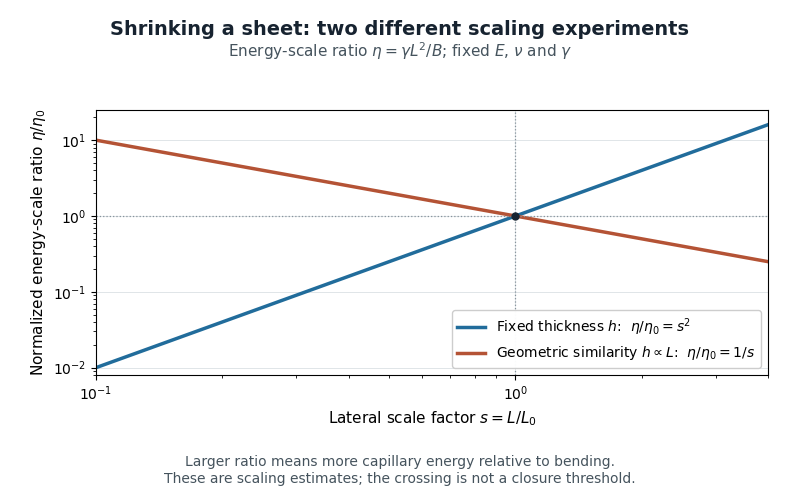
Changing lateral size at fixed thickness versus scaling all sheet dimensions: opposite trends in the capillary-to-bending energy-scale ratio
. Details. 
The length can also be calibrated directly: the 2007 study fitted an elastic-loop model to a long polydimethylsiloxane strip held by an ethanol meniscus. For their complete-wetting configuration, loop width was . The coefficient belongs to that model and geometry.[ref]
Capillary Origami: Spontaneous Wrapping of a Droplet with an Elastic Sheet by Charlotte Py and others. p.156103-2, Equation2 and loop-calibration paragraph
New to topics? Read the docs here!