
The energy eigenspace at is the vector subspacewhere is the Hamiltonian operator and is the identity operator. It is nonzero exactly when is an energy eigenvalue. Its dimension is the multiplicity of that energy eigenvalue; degenerate energy levels have multiplicity greater than one. The ground-state subspace is , and its dimension is the ground-state degeneracy. A vector in an energy eigenspace need not be one of a specially chosen orthonormal basis of energy eigenstates.
Linearity makes the useful point immediate: if and , then . Every normalized nonzero combination stays in the same energy eigenspace. For a time-independent Hamiltonian operator, its evolution is multiplication by the common global phase , so it is a stationary state. A quantum superposition within a degenerate energy eigenspace can change spatial shape when its coefficients are chosen differently, but its density does not subsequently beat under this unchanged Hamiltonian operator.
Across distinct energy eigenspaces, relative quantum phases evolve. For orthonormal eigenfunctions of the Hamiltonian operator with energy eigenvalues , an equal-weight quantum superposition hasand position probability densityThe interference term can change local probabilities even though the Born rule assigns the same time-independent probability to each energy measurement outcome. Orthogonality makes its integral zero, preserving wavefunction normalization. This pure state is not a stationary state; some particular measurement distributions may nevertheless remain constant. An incoherent mixed state with the same energy populations has no such interference term.
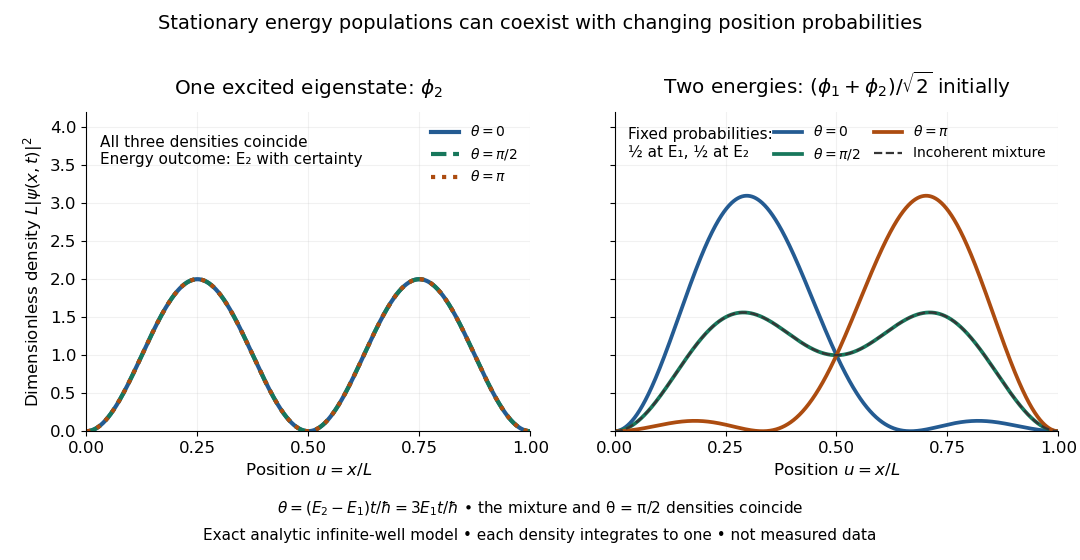

For the pictured infinite square well, and the interference repeats after . At , direct integration gives ; halfway through the period it is . This is a moving expectation value, rather than a trajectory of an individual particle. The distinction between an energy eigenspace and a combination of different energy eigenspaces is what makes the different behavior possible.
New to topics? Read the docs here!