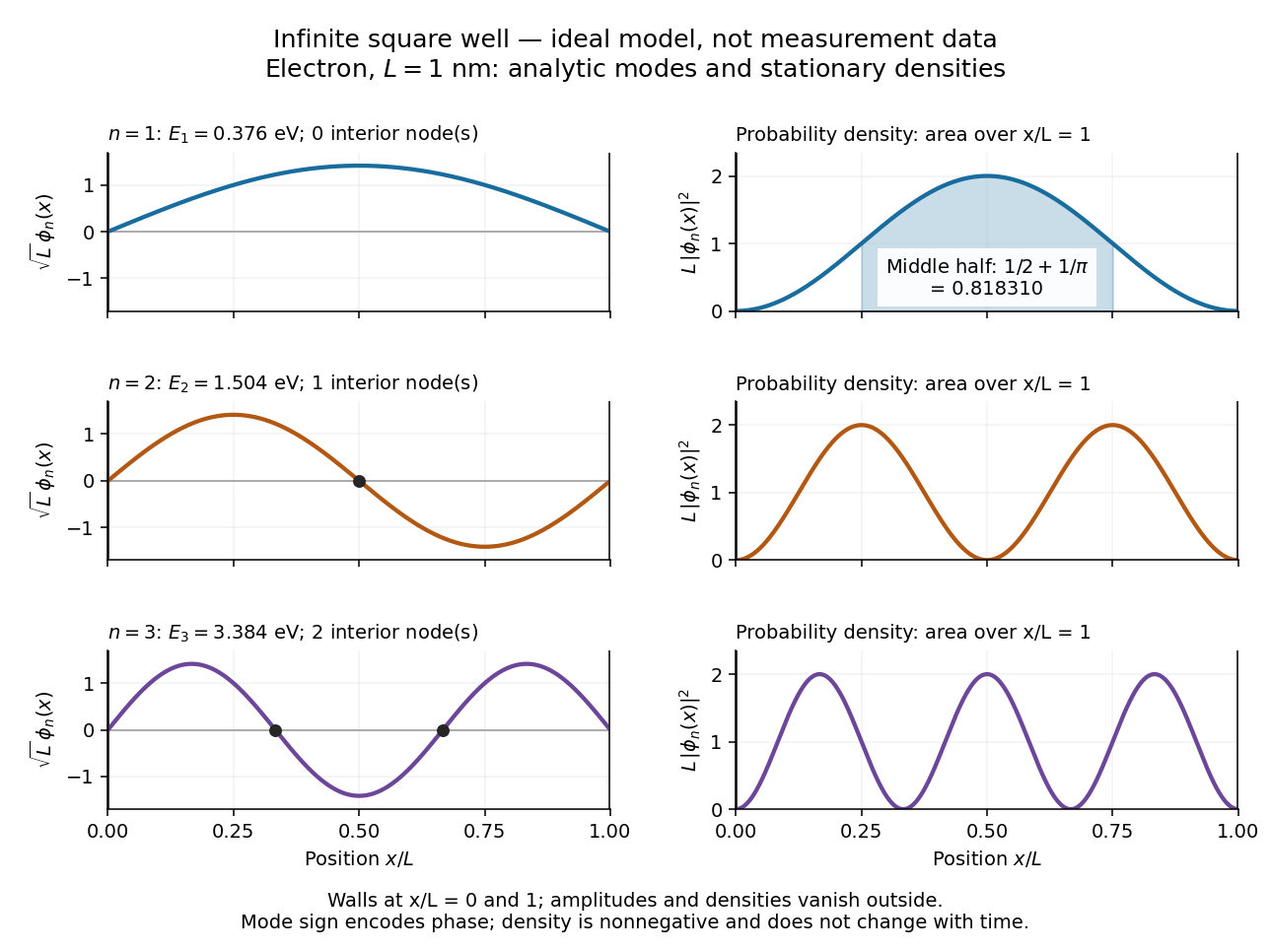
The infinite square well is an ideal confinement model with potential energy for and infinite walls outside. The walls impose Dirichlet boundary conditions and a vanishing exterior wavefunction. Inside, the time-independent Schrödinger equation isThe first wall removes the cosine term; the second requires , hence . The solution is identically zero and cannot satisfy wavefunction normalization. Each energy eigenstate has interior nodes of a standing wave, at for . More curvature costs more kinetic energy, explaining the growth. The positive ground-state energy is a confinement effect: a constant zero-energy wavefunction cannot satisfy both walls and remain normalized.
For an electron with mass in a box of length , use and . These constants are from the 2022 CODATA adjustment. [ref]. Substitution givesDoubling quarters every energy eigenvalue; doubling halves them. This scaling makes the particle in a box useful for estimating confinement energies before attempting a more realistic calculation. A finite square well permits exterior tails for bound states and has only finitely many bound energy eigenstates. For an electron, the scalar box calculation assumes fixed spin and no spin-dependent interactions.
For the ground state, the probability of finding the particle in the middle half of the box is fully computable:Thus half the available length contains about of the probability. The figure contrasts the signed wavefunctions with their nonnegative probability densities: a negative lobe is an amplitude with opposite quantum phase, not negative probability.
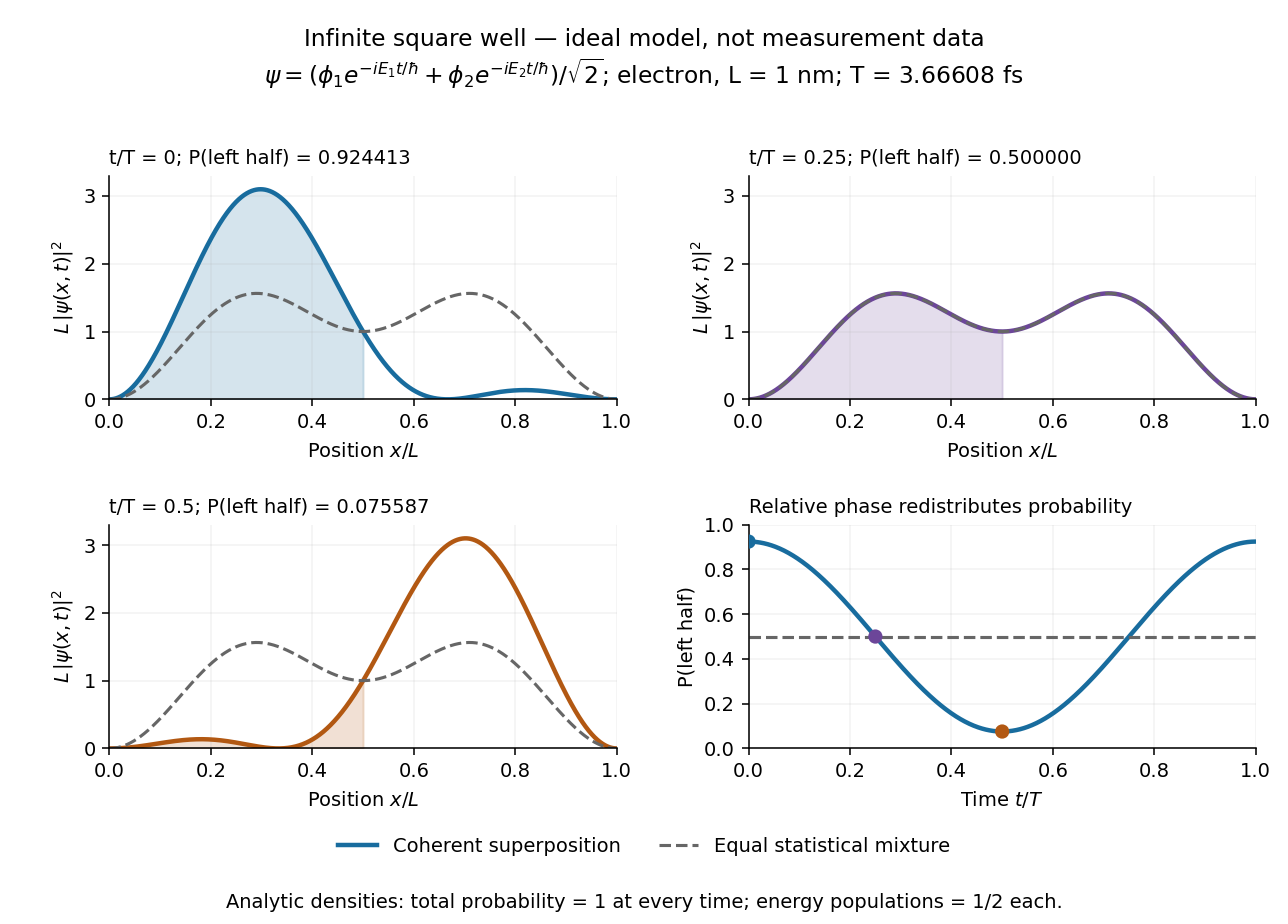
An equal quantum superposition of the first two energy eigenstates gives a simple example of moving density:Its density period is for the electron box above. At the cross term enhances the left side; at it vanishes; at it enhances the right side. More quantitatively,which takes the values , , and at those times. Orthogonality keeps the total probability one throughout. An energy measurement still returns or with equal probabilities: changing position density arises from relative quantum phase, not changing populations. A mixed state describing a statistical mixture with those populations has the constant probability density ; it lacks this matter-wave interference term.


For the infinite square well of length , the energy eigenvalues are , with . At , the dynamical phase is . Since the midpoint parity operator has eigenvalues in the same complete orthonormal basis, the time-evolution operator is exactly on every state. At every phase is one, giving a full revival.
Thus a state becomes its reflected copy, up to a global phase, at the half revival. Its position probability density is reflected, while its mean momentum changes sign because . For an initially reflection-symmetric probability density, the initial and half-revival position distributions agree even when their probability currents point in opposite directions.
The normalized wavefunction on has sine coefficients . Its ground-state probability is , while its position probability in is . The constant values of make its energy expectation divergent. It is a valid Hilbert space vector but fails the finite-energy Dirichlet boundary-trace condition.
For the normalized ground state on , direct position integrals give . The kinetic momentum second moment gives . Their product is about , strictly above the Heisenberg uncertainty principle bound. Infinite walls do not make this non-Gaussian state a minimum-uncertainty wave packet.
Every stationary state in has mean position . Splitting a uniform field coupling into separates its transition-driving odd operator from an identity term. The latter gives the common phase and cannot change populations. Removing it by an origin shift is equivalent to a time-dependent scalar phase; relative transition amplitudes are unchanged.
A centred width- infinite square well has ground state wavefunction inside and zero outside. Its momentum representation in quantum mechanics follows from the Fourier transform of a truncated cosine. The probability density in the title has removable singularities at , with limit , and an oscillatory tail envelope. The distribution is even, with and .
For a well on with real normalized sine modes, the displayed coupling holds for and the diagonal coupling vanishes. Differentiate both the normalization and the sine at fixed position, then integrate on the instantaneous interval. The moving boundary contributes no endpoint term because the modes vanish there. The resulting real antisymmetric matrix preserves total probability in the instantaneous eigenstate expansion.
For and , first-order excitation out of the instantaneous ground state has the displayed oscillatory integral. Its lower endpoint means the limit of a ground-state preparation at positive time and positive width; no normalized state exists in a zero-width well. Substitution makes convergence explicit, and as . Large excitation invalidates the first-order approximation.
For an infinite square well of width , the normalized trial obeys both Dirichlet boundary conditions and has no interior nodes of a wavefunction. Its kinetic energy isThe ratio to the exact ground-state energy is . Its expansion in the normalized sine eigenfunctions has coefficients for odd and zero for even . This supplies a concrete check of the quantum variational principle and shows that a small energy error can coexist with excited-state admixtures.
Consider hard walls at , zero potential energy on and , and a central rectangular barrier whose height equals the ground state energy . The time-independent Schrödinger equation gives on the central interval. Reflection symmetry and the nodeless theorem for a one-dimensional ground state require an even, positive state about , hence a constant central segment. Wavefunction matching at a finite potential step makes the derivatives vanish at . The side segments are proportional to and . Their common plateau value is after wavefunction normalization, and . Equality of barrier height and energy is essential: a higher barrier gives positive curvature of a positive wavefunction in the middle, while a lower barrier gives negative curvature.
For a normalized sufficiently regular solution of the Schrödinger equation on with Dirichlet walls, the instantaneous outward forces on the walls have magnitudesA wall displacement changes the kinetic-energy quadratic form by the boundary term , giving the local force. Equivalently, direct integration by parts in the time derivative of the mean particle momentum givesThe force on the particle is the opposite of the net force on the walls. For a stationary energy eigenstate each magnitude equals . For the equal superposition of the first two box states, writing and gives and . Both time averages equal , the classical mean force on one wall at that energy, even though the quantum forces vary continuously in time.
For an infinite square well on , choose and , . The state has constant expectation value , butIndeed, the diagonal position matrix elements are , whereas the off-diagonal element isA different initial relative phase shifts the oscillation in time. The oscillation comes from quantum interference, while the constant mean energy follows from the fixed populations of the two energy eigenstates.
For the equal superposition of the first two box states with zero initial relative quantum phase, put . The probability in the left half is . The continuity equation and zero wall probability current implyDirect substitution of and into the probability current verifies the sign. Positive current means probability leaves the left half. The quantum interference controls transport even though each component has stationary probability density.
For a well , choose normalized energy eigenstates , . The diagonal position matrix elements vanish by the parity operator. For ,To derive it, set and use . For unequal positive integer indices , the constant part of integrates to zero by orthogonality, whileTaking the difference for and yields the formula after setting . It vanishes for equal parity and gives for this phase convention.
In the infinite square well on , extend from by zero. It is normalized and continuous, but its derivative jumps at zero. Its energy expectation value is the quadratic form of a positive quantum Hamiltonian , giving the displayed value. It is not in the operator domain of the Dirichlet Hamiltonian operator: its distributional second derivative contains a Dirac delta. Its sine-basis coefficients are , all other even coefficients zero, and . These make finite but divergent, independently distinguishing the form domain from the operator domain.
In a well , the normalized state proportional to on and zero elsewhere has stationary-state coefficientsThey follow from the orthonormal basis inner products. Their squared magnitudes give energy-measurement probabilities by the Born rule; splitting even and odd indices in the Parseval identity gives convergent integer-coefficient series identities. The expansion is interpreted in the square-integrable state norm.
The infinite square well supplies the one-dimensional factors of this rectangular-box construction.
On , , with infinite exterior potential, separation of variables gives the normalized eigenbasisThe boundary values vanish and the functions are orthonormal. A general state is a superposition of these products. A degenerate energy eigenspace can contain nonseparable linear combinations of products at the same energy, so a single separated product is not the most general stationary wavefunction in that eigenspace.
For in a two-dimensional infinite square well, the lowest two states are and , both nondegenerate. The next energy is the smaller of and : every other candidate lies above at least one of these. Requiring equality gives , or . In units the lowest distinct energies are then , and , with degeneracies one, one and two. The third-level pair is exactly and .
Articles by others on the same topic
There are currently no matching articles.