When a ground state exists, its ground-state degeneracy is the dimension of the ground-state subspace:Here is the identity operator, and the kernel of a linear map is taken within the operator domain of the Hamiltonian operator . The count concerns linearly independent energy eigenstates, rather than every normalized quantum superposition or every choice of global phase. Even a single energy eigenspace contains infinitely many representing vectors; its dimension measures independent freedom. Ground-state degeneracy is the lowest-energy instance of degenerate energy levels.
For an exact finite model with energy unit , let the Hamiltonian operator be the diagonal matrixIts ground-state energy is zero and : the first two coordinate unit vectors span the ground-state subspace. Every normalized , with , is a ground state, including . Its energy measurement is certain to return zero, even though a measurement distinguishing from need not have a definite outcome. Under the unchanged Hamiltonian operator, this quantum superposition is a stationary state because both components acquire the same global phase.
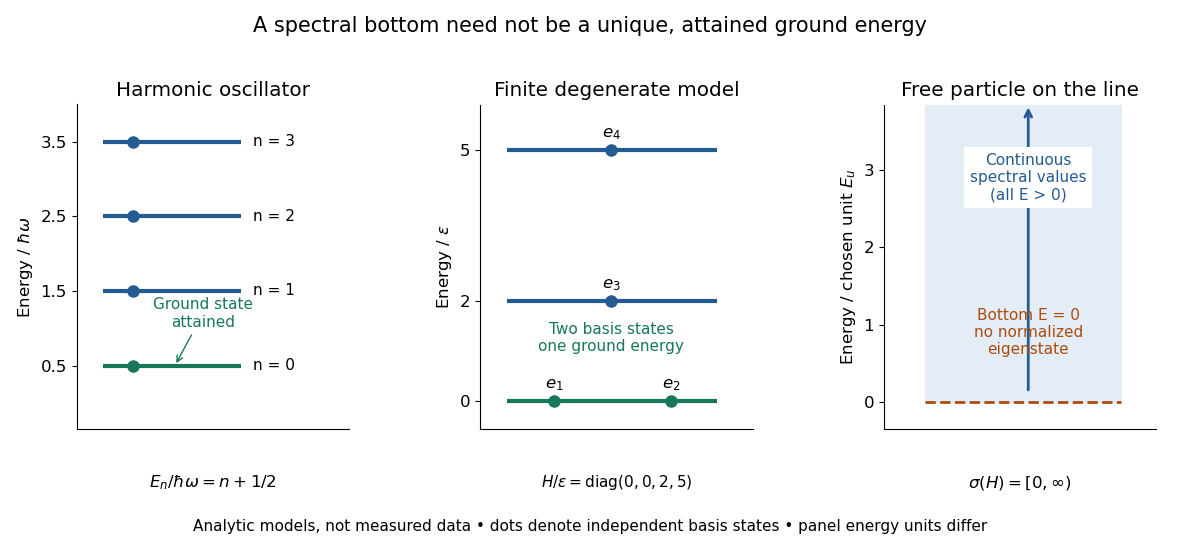
Attained ground energies, ground-state degeneracy, and an unattained spectral bottom
. Exact analytic models, not measured data. The quantum harmonic oscillator has an attained ground-state energy. The finite diagonal matrix has two independent ground states at one energy eigenvalue. The whole-line free particle has continuous spectrum beginning at zero and no normalizable zero-energy energy eigenstate; the shaded interval denotes spectral values, not a collection of normalized energy eigenstates. Each panel uses its own stated energy unit. Details.
Ground-state degeneracy matters when an interaction selects or splits previously equal energy eigenvalues. In the finite model, adding with gives the formerly lowest pair the distinct energies , leaving a unique ground state. This direct calculation illustrates why degenerate perturbation theory first examines the perturbation inside the whole ground-state subspace.
A classical continuous-symmetry model can instead have a manifold of minimizing configurations, such as the sphere of orientations of a Néel state in an isotropic Heisenberg antiferromagnet. That geometric description does not by itself count the dimension of a finite quantum ground-state subspace.
Articles by others on the same topic
There are currently no matching articles.