Excited-state intramolecular proton transfer
ID: excited-state-intramolecular-proton-transfer

Excited-state intramolecular proton transfer, abbreviated ESIPT, is transfer of a proton between sites within the same molecule after electronic excitation. A hydrogen bond can connect donor and acceptor sites, while excitation changes the energetic preference along the proton transfer coordinate. The resulting excited tautomer may emit at a different energy from the initially excited form.
The classic 3-Hydroxyflavone study by Pradeep K. Sengupta and Michael Kasha compared absorption, green emission in room-temperature solution, violet emission in a rigid matrix, excitation spectra and deuteration effects.[ref]
Excited state proton-transfer spectroscopy of 3-hydroxyflavone and quercetin by Pradeep K. Sengupta and Michael Kasha. Printed pp.382–384, Figures1–4
The change of emission did not require a change in elemental composition: it concerned different arrangements and electronic states of the same molecular system.A large Stokes shift is informative but is not a direct measurement of a reaction barrier. For an original example, absorbing a photon and emitting at corresponds to energies near and , using . Their difference, about , includes the overall relaxation and emission energy balance; it is not automatically the activation energy of the transfer step.
An original pulsed-excitation model makes a kinetic prediction. Let and denote populations of the normal and transferred excited forms, with and . Neglect reverse transfer and writewhere includes transfer and all other normal-state decay, is total transferred-state decay and . For ,If , the limiting expression is . The initially absent transferred form rises and then decays; its maximum occurs at for positive unequal decay rates.
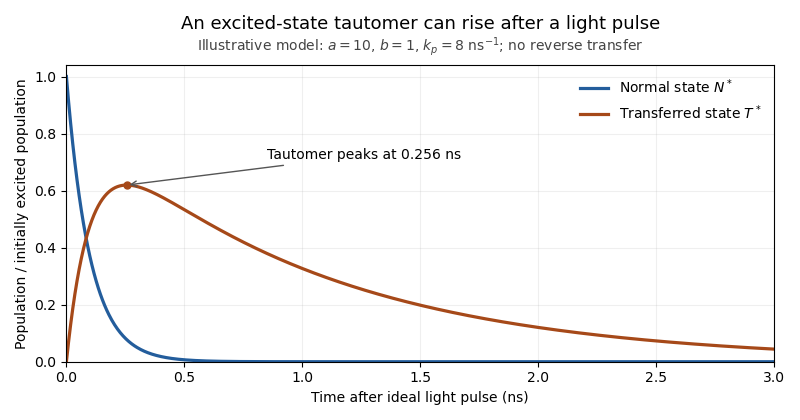

For chosen , and , the transferred population peaks at approximately . These are model values, not rate measurements from the historical experiment. Detected emission instead weights each population by its radiative rate and instrument response. Fluorescence lifetime and fluorescence instrument response must therefore be considered alongside spectral band ratios when testing a transfer mechanism.
New to topics? Read the docs here!