A hydrogen bond is an attractive association involving a hydrogen attached to another chemical atom, and an accepting atom or group. In the IUPAC 2011 definition, the atom in is more electronegative than hydrogen, and evidence of bond formation is required. The familiar strong examples use O–H or N–H groups, but restricting the concept to only nitrogen, oxygen and fluorine misses weaker cases. A short distance alone is not the entire definition.[ref]
https://publications.iupac.org/pac/pdf/2011/pdf/8308x1637.pdf. Arunan et al., Definition of the hydrogen bond, IUPAC Recommendations 2011
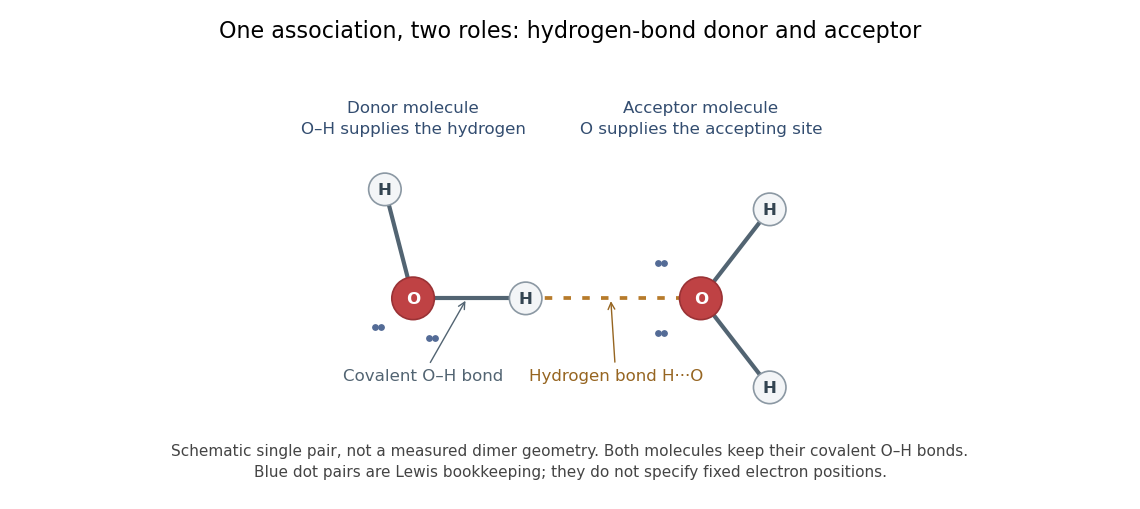
In the depicted water pair, one O–H group is the hydrogen bond donor; the other oxygen supplies the hydrogen bond acceptor. The solid O–H line denotes a covalent bond within a water molecule; the dotted H···O line denotes the hydrogen bond between them. One water molecule can play both roles in a larger arrangement because it has O–H groups and lone pairs.
This makes hydrogen bonds useful for understanding organization beyond a single molecular formula. They connect water molecules and contribute to protein folding and recognition between molecules. The same types of chemical atoms can support different associations depending on which donor and acceptor sites are exposed and how they are oriented. Alberts and colleagues discuss these noncovalent interactions in Molecular Biology of the Cell, the chemical components of a cell.
Hydrogen bonds are often directional, with an approximately straight donor–H–acceptor arrangement favourable in familiar cases; strength and preferred geometry depend on the system. The IUPAC definition uses converging experimental or theoretical evidence rather than one universal distance threshold. The author-hosted 2009 task-group draft, §§3.1–3.3 explains the definition and typical criteria leading to the recommendation.
Articles by others on the same topic


A hydrogen bond is a type of attractive intermolecular force that occurs between a hydrogen atom covalently bonded to a highly electronegative atom (such as oxygen, nitrogen, or fluorine) and another electronegative atom. In this interaction, the hydrogen atom carries a partial positive charge due to the difference in electronegativity between itself and the atom it is bonded to.