
For a real matrix and a vector , exactly one of the following systems has a solution:The linear inequalities here are componentwise. In the first system is nonnegative; in the second system is unrestricted in sign. The second system is a certificate that the first has no feasible point. This nonnegative-equations alternative is developed in Boyd and Vandenberghe, Convex Optimization slides, §5.34.
Build the target, or separate it. Write the columns of as . Then is a conic combination: its coefficients must be nonnegative, but need not sum to one. The obtainable targets form the finitely generated coneA solution explains how to build from those columns. A certificate instead defines a linear functional . The condition says that its dot product with every generating column is nonnegative, and hence with every point of . But places the target strictly on the other side of the hyperplane . Thus belongs to the dual cone of and rules out every allowed conic combination at once.
A certificate that can be checked by eye. Take the identity matrixHere is the nonnegative orthant. The equation forces , violating . The certificate givesThe linear functional simply reads the first coordinate: all allowed column combinations have a nonnegative first coordinate, while has first coordinate . For comparison, the target is obtained with .
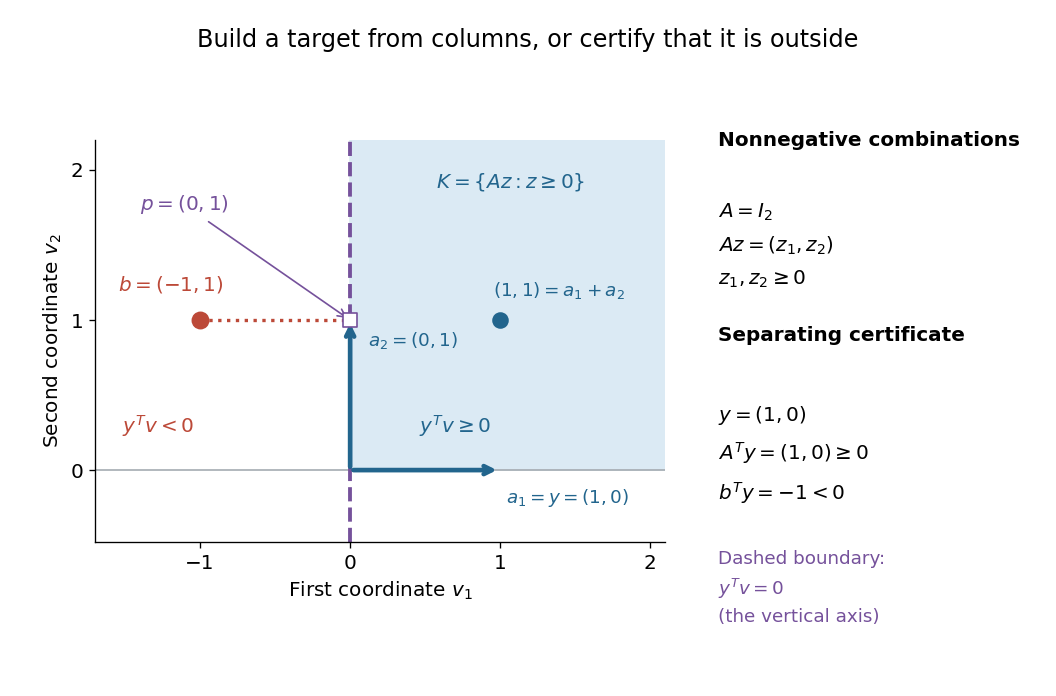

Why this is useful and striking. A successful search can exhibit one feasible point; an unsuccessful search alone cannot explain why every candidate fails. Farkas' lemma guarantees an equally concrete witness of impossibility for this finite linear problem. Once is supplied, verification needs only matrix multiplication, sign tests and one dot product. The same idea gives a Farkas certificate for linear inequalities and underlies linear programming duality.
Brief geometric proof. The two systems cannot both hold, because they would implyFor existence of a certificate when , closedness of finitely generated cones makes a closed convex cone, so separation from a closed convex cone supplies and for every . Testing each column gives . Concretely, let be the Euclidean projection onto a convex set of onto and set . The projection inequality gives for . Testing and gives , whence . In the example, and . Alternatively, the Fenchel-Moreau theorem applied to the cone's indicator functional proves the same separation through its polar cone.
New to topics? Read the docs here!