Field-cooled Meissner experiment
ID: field-cooled-meissner-experiment

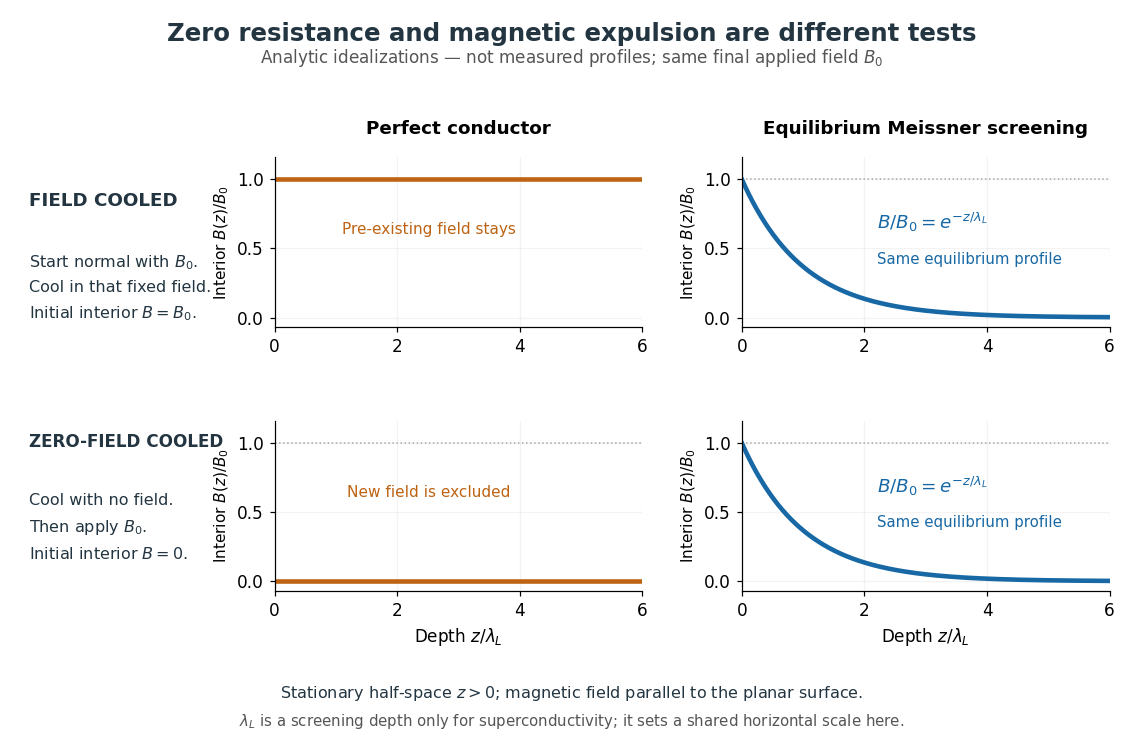
The Field-cooled Meissner experiment starts above the superconducting transition temperature with a weak, steady applied magnetic field already penetrating a solid sample. Cooling while keeping the applied magnetic field fixed tests whether the interior magnetic flux changes. This is the decisive contrast with cooling in zero magnetic field and switching the magnetic field on afterwards. The diagram shows the two histories for the same final applied magnetic field.

Meissner and Ochsenfeld reported magnetic expulsion in 1933, showing that the transition involves more than vanishing electrical resistance. A modern motivating version appears in MIT's lead-sample experiment: surround the sample with a solenoid supplying a steady magnetic field and a separate pickup coil connected to a recording instrument. Apply the magnetic field while the lead is still normal, then cool through its transition without changing the solenoid electric current. Expulsion produces a transient pickup-coil electric potential difference; warming through the transition produces the opposite sign as magnetic flux returns. MIT also checks the signal direction by switching off the applied magnetic field while the sample is normal. [ref]
https://hoffman.physics.harvard.edu/materials/SCintro.php. Hoffman laboratory, magnetic-expulsion discovery
[ref]Faraday's law of induction explains the readout. For a stationary -turn pickup coil, with the same linked magnetic flux per turn and a fixed orientation,Thus a transient measures a change in linked magnetic flux, not directly the static magnetic field at every point in the sample. For stipulated and per turn, the signed pulse area is . The apparatus geometry determines how a change in interior magnetic field contributes to that linked magnetic flux. Keeping the applied magnetic field fixed, repeating on warming, and checking a normal-state control make the expulsion interpretation testable; a stationary pickup coil has no sustained signal after the magnetic flux has stopped changing.
Why does the preparation history matter? In the stationary, ideal perfect conductor model, the interior electric field is zero. The differential form of Faraday's law of induction then givesIf the interior magnetic field was when perfect conduction began, it remains ; if it was zero, it stays zero when an external magnetic field is subsequently applied. Both a perfect conductor prepared in zero magnetic field and a sample exhibiting the Meissner effect can therefore exclude a newly applied weak magnetic field. Only the field-cooled comparison tests expulsion of an already present magnetic field. This argument concerns a stationary sample and the ideal zero-electric field model, not a moving conductor.
The equilibrium London equations supply the additional constraint. In a homogeneous region without penetrating flux tubes, they imply . For a half-space with a magnetic field parallel to its flat boundary, fixed surface value , and a bounded solution deep inside, this givesAt only of the surface magnetic field remains. The screening electric currents near the surface produce this reduction. Unlike the frozen interior magnetic field of a perfect conductor, this equilibrium profile does not retain an arbitrary initial . The extra constitutive relation, and not zero electrical resistance by itself, selects the screened state. Expulsion occurs during the transition, when transient electric fields can be present; the steady-state zero-electric field argument does not describe the process of establishing superconductivity. The diagram gives equilibrium end states, not transition kinetics. [ref]
https://doi.org/10.1098/rspa.1935.0048. F. and H. London (1935), magnetic screening beyond the acceleration equation
These ideal comparisons concern a solid sample in equilibrium and a sufficiently weak magnetic field. Stronger magnetic fields can destroy superconductivity or permit magnetic flux to penetrate parts of a sample, so complete bulk expulsion is not a claim about every superconducting state. [ref]
https://www.ocw.mit.edu/courses/6-763-applied-superconductivity-fall-2005/41b2882232b1b43823ec488969c21b6d_lecture1.pdf#page=6. Terry P. Orlando, Applied Superconductivity, Lecture 1 (2005), mixed-state magnetic penetration
A hole in a superconducting loop can retain magnetic flux even while the material surrounding it screens its own interior; see flux conservation in a superconducting loop. The hole is not superconducting material, so its retained magnetic flux does not contradict the Meissner effect. [ref]https://www.feynmanlectures.caltech.edu/III_21.html#Ch21-S7. Feynman, Leighton and Sands, III.21.7: field cooling a superconducting ring
New to topics? Read the docs here!