
A differential form is a smooth field of alternating multilinear maps that can be integrated over an appropriately oriented manifold of matching dimension. A one-form measures a directed displacement; a two-form measures an oriented area element. The point is to express what is being accumulated along a curve or over a surface without tying the answer to one set of coordinates. This makes line integrals, surface integrals, and the integral theorems of vector calculus parts of one construction.
For a concrete one-form, take in the plane. Travel from to along the bottom and then the right edge of the unit square. The horizontal leg contributes zero because ; the vertical leg has and contributes . Taking the left and then the top edge instead gives zero: the vertical leg has , and the horizontal leg again has . The two paths have the same endpoints but different integrals.
Now replace with the exact differential . Both paths give , because integrating an exact differential along a curve gives the endpoint difference of its potential. Here that difference is . This is the fundamental theorem of calculus applied to a function along a parametric curve, and is the basic reason conservative vector fields have path-independent work.
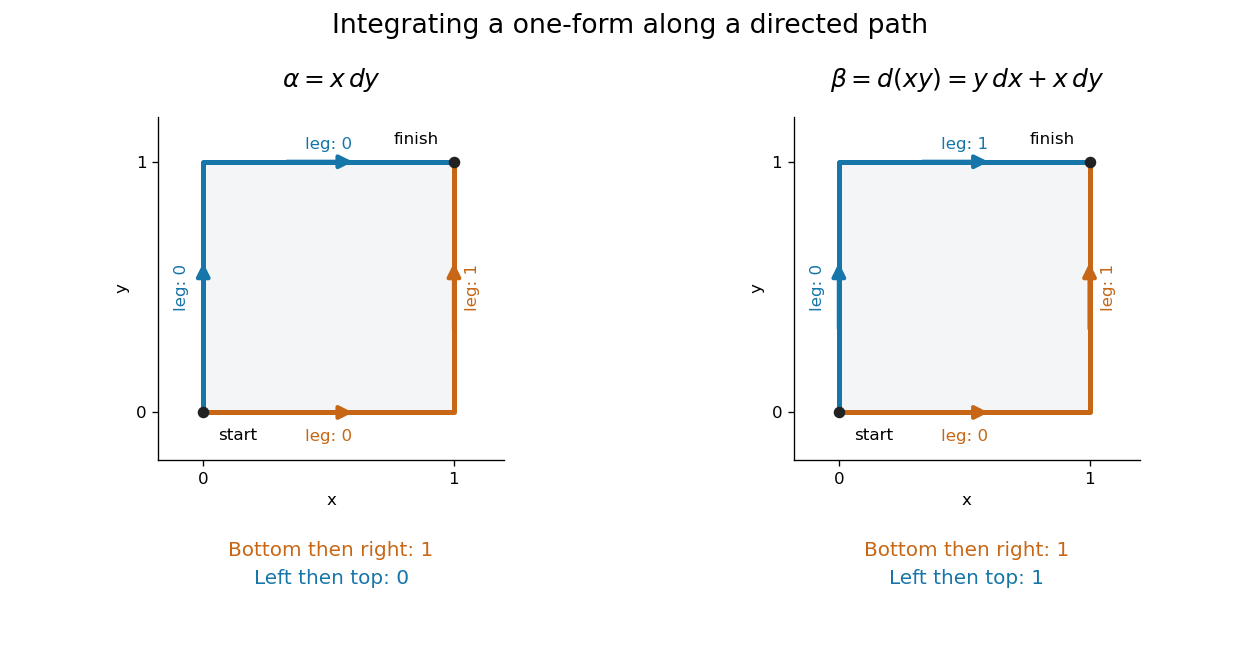
Two routes between the same endpoints distinguish a path-dependent one-form from an exact differential
. Details. The exterior derivative records the local obstruction in the first example: . The Generalized Stokes theorem turns the difference between the two path integrals into the integral of this two-form over the square, whose oriented area is . Interior edges cancel when adjoining pieces are added; only the outer boundary survives. That cancellation connects a local calculation with a global measurement.
More precisely, a degree- differential form assigns to each point a multilinear scalar-valued function of tangent vectors at . Interchanging two arguments changes its sign. A one-form is therefore a covector field, while a two-form vanishes on a pair of parallel vectors. Degree zero simply means a smooth function. The space is a vector space; the wedge product of differential forms combines degrees, and the exterior derivative raises degree by one.
The usefulness goes beyond bookkeeping. Pullbacks of a differential form supply the right transformation law automatically under a coordinate change. The Generalized Stokes theorem unifies the fundamental theorem of calculus, Green theorem, Stokes theorem, and divergence theorem. Meanwhile, the distinction between closed differential forms and exact differential forms detects holes through de Rham cohomology. Reyer Sjamaar develops these connections in sections 5.4 and 9.3 of his university notes. [ref].


Differential forms are an essential concept in differential geometry and mathematical analysis. They generalize the idea of functions and can be used to describe various physical and geometric phenomena, particularly in the context of calculus on manifolds. Here's an overview of what differential forms are: ### Definition: A **differential form** is a mathematical object that is fully defined on a differentiable manifold.
New to topics? Read the docs here!