Finite greedy basis extension and choice
ID: finite-greedy-basis-extension-and-choice

For an explicit basis extension in , start with , where . Its linear span is the line . Adding preserves linear independence, because is outside that line, and gives a basis. Every vector has the finite linear combinationThe vector cannot be added while preserving linear independence: it is already in the linear span. Many choices outside the line work, so maximality does not select a unique basis.
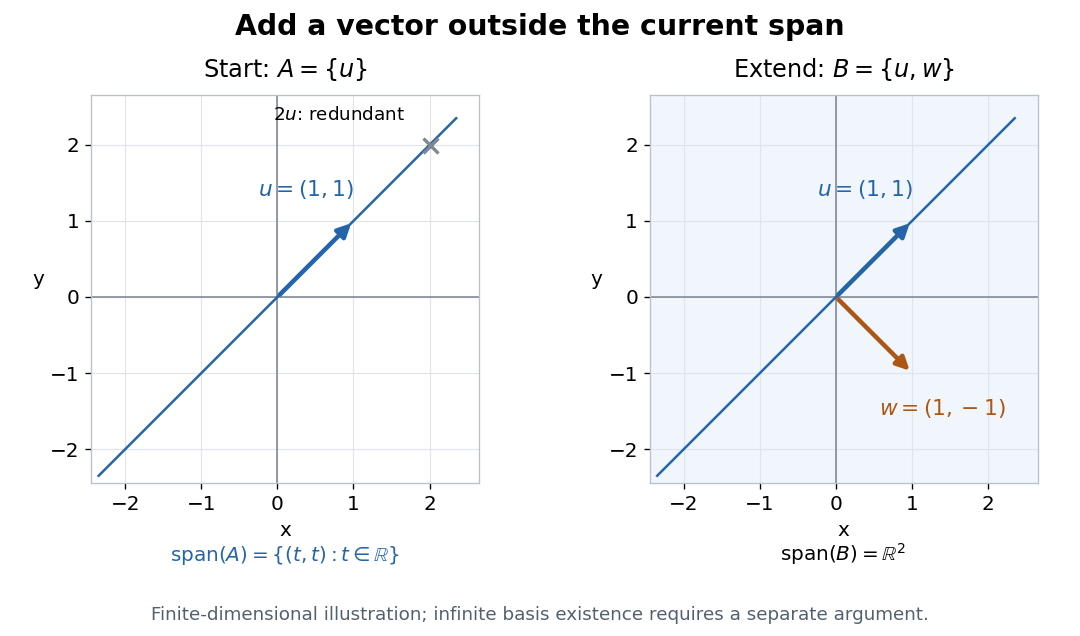

For a finite-dimensional vector space with a supplied finite spanning set, a greedy algorithm scans the list, retaining each vector precisely when it is outside the linear span of those already retained. Starting with a linearly independent , the same scan adjoins only the needed vectors. Retained vectors remain linearly independent, and every skipped vector is in the final linear span, so the result is a basis containing . Finite reasoning needs no axiom of choice.
For an arbitrary vector space, this finite stopping argument is unavailable. Accepting Zorn's lemma asserts existence of a maximal element once every chain in a partial order has an upper bound; it supplies no general computational recipe. Over ZF, Zorn's lemma, the axiom of choice and the well-ordering theorem are equivalent. Particular infinite vector spaces can still have explicit bases, such as for the vector space of univariate polynomials over a specified field; infinity alone does not force a nonconstructive argument.[ref]
How to use Zorn’s lemma by Timothy Gowers. How to use Zorn’s lemma, “Further general remarks”, immediately after Example 1 continued: equivalence with choice and well-ordering
New to topics? Read the docs here!