The least upper bound in a partially ordered set of a subset , when it exists. It bounds every element of and is at most every other upper bound. For two elements it is written ; an empty join is a least element.
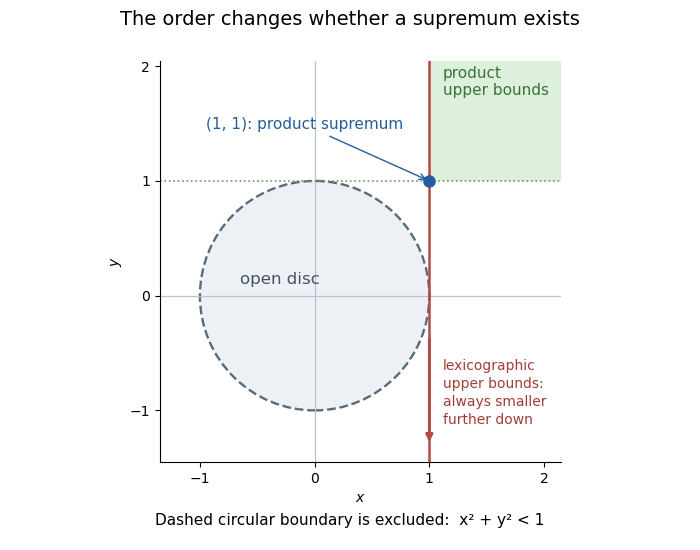
For , the product order gives least upper bound , because each coordinate has supremum one. The lexicographic order instead has no least upper bound. Every point is an upper bound, but is a strictly smaller upper bound; a point with first coordinate below one cannot bound the disc. The same geometric set therefore has different order-completeness behavior under the two partial orders. Neither conclusion is determined by the usual drawing alone.

Articles by others on the same topic
There are currently no matching articles.