Finite-time ambiguity between stiffness and slow filling
ID: finite-time-ambiguity-between-stiffness-and-slow-filling

Finite-time ambiguity between stiffness and slow filling means that a small volume response at one time can come from a stiff compartment or from a more compliant compartment that has not finished filling. In a passive single-compartment pressure-step model,One observation supplies one equation for equilibrium lung compliance and time constant . It does not generally identify both.
An original family makes the ambiguity exact. For an observed , choose any and setEvery choice reproduces the observation. At s and stipulated , equilibrium compliances 0.12, 0.20 and 1.00 correspond to time constants about 0.558, 1.443 and 9.491 s. Their agreement at one time does not imply agreement about equilibrium volume response.
Later measurements distinguish these particular models. At , the predicted response isThe three examples predict approximately 0.1167, 0.1500 and 0.1900 in compliance units. Those differences motivate observing more than one stage of the transient. They do not prove that a one-compartment model is adequate for an actual lung.
Early-time resistance dominance of a filling response explains the limiting behavior. Expanding the exponential for givesThe leading response depends on resistance rather than equilibrium compliance. As grows in the indistinguishable family, and tends to . Much larger equilibrium compliance can therefore be hidden behind similar early filling.
The primary respiratory pilot study discusses estimates based on expiratory time constants and why deflation need not be uniexponential.[ref]
Static and Dynamic Measurements of Compliance and Driving Pressure: A Pilot Study by Pierre Tawfik and others. Introduction, Method D; Study Procedures; Discussion of multiple time constants
An experiment should constrain its pressure step, observation duration and model class. A fitted finite-time response is not automatically an identified equilibrium material property.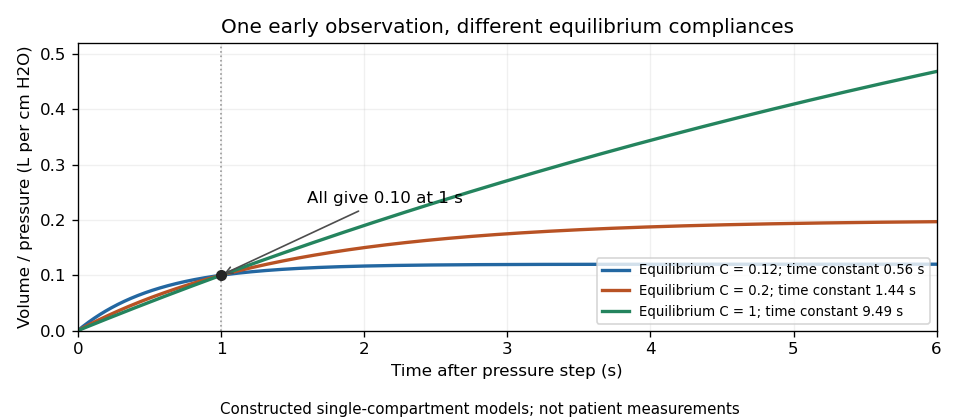
Original passive models sharing one early response while predicting different equilibrium lung compliances and time constants
. Details. 
New to topics? Read the docs here!