Fixed-temperature electrical substitution example
ID: fixed-temperature-electrical-substitution-example

Stipulate a model receiver held at with a reference at . Choose , so outward thermal conduction is . Ignore other heat transfer, take in both states, and stipulate perfect optical/electrical thermal equivalence. These values specify an original example; they are not measurements or claimed performance of a NIST instrument.
With the beam blocked, supply . With light admitted, the required heater power is . For stipulated radiometric absorptance at the chosen single wavelength,The illuminated receiver still gets of heating. The remaining of incident radiant flux escapes without heating it. Calling the measured heater reduction “incident power” would underestimate the stipulated incident radiant flux by .
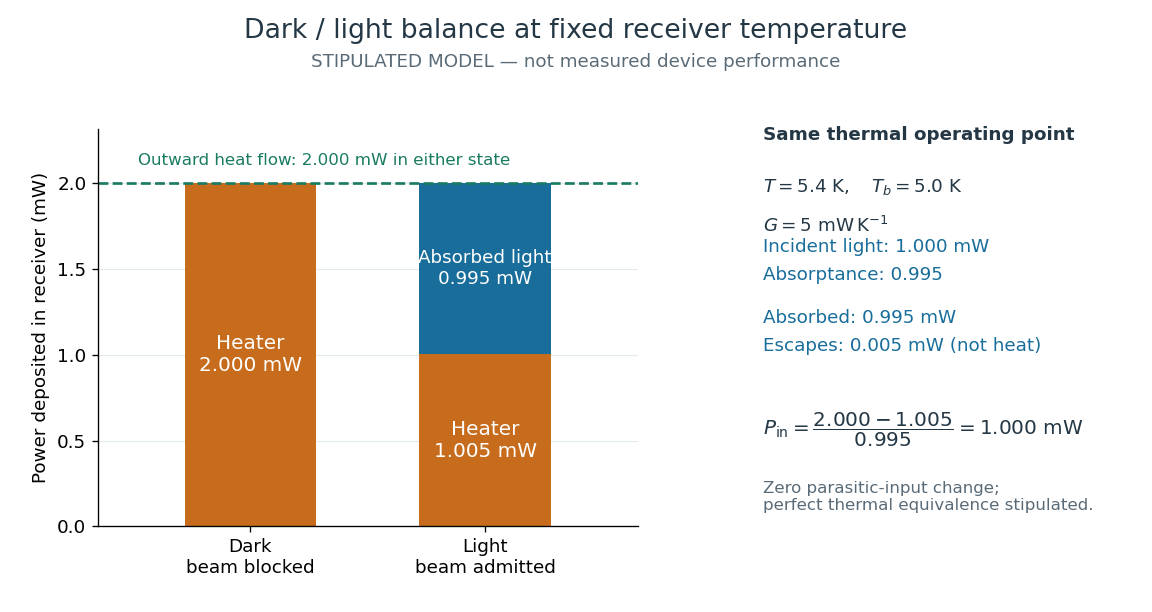
The same receiver temperature with different electrical and optical heating
. Original stipulated steady-state example, not experimental data. Both columns total of deposited heating and balance the same outward thermal conduction. Incident radiant flux is , of which is absorbed; the that escapes is outside the heating column. No response time or measured uncertainty is implied. Details.
Two variations expose different pitfalls. First, if admitting the beam also adds of stray heating while the same is absorbed from the intended beam, the heater falls to . The apparent reduction is now ; subtracting recovers the beam's absorbed power. Second, keep the original heater readings but stipulate a light-state receiver offset at fixed reference temperature. The link carries an extra ; the inferred absorbed power becomes , and incident radiant flux becomes . This second variation deliberately violates exact fixed-temperature substitution.
The heater can supply only nonnegative power in this model. Consequently an absorbed beam above the available dark heater power cannot be compensated at the chosen setpoint merely by reducing the heater. The operating point, link, or admitted radiant flux must change; zero heater demand is a range boundary, not evidence of greater radiant flux sensitivity.
New to topics? Read the docs here!