Flips versus erasures in a binary channel
ID: flips-versus-erasures-in-a-binary-channel

A binary erasure channel marks its failed transmissions with a special output symbol, whereas a binary symmetric channel changes a bit without announcing whether it changed. At the same nominal failure probability , the two communication channels therefore leave different uncertainty. With a fair input, an unerased output determines the input exactly, while the erasure flag leaves one bit of conditional entropy. Thus and for the binary erasure channel. This is the binary case of capacity of a finite-alphabet erasure channel.
For the binary symmetric channel at , neither possible received symbol rules out either input, and . Its channel capacity is only . A receiver benefits from knowing where information was lost, even when the fraction of affected transmissions is the same.
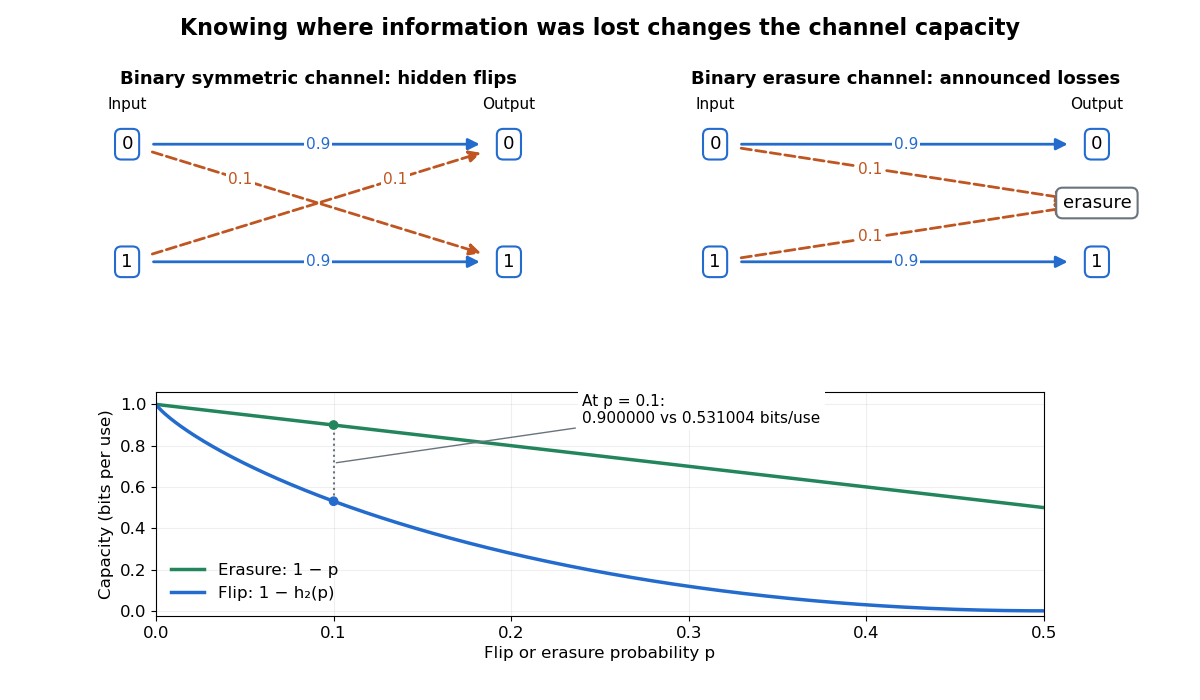

This comparison concerns the specified transition probabilities, rather than a general ordering of every error mechanism. In particular, at , an erasure flag conveys no input information, while deterministic inversion still conveys a full bit. Reporting only an error percentage loses the distinction between hidden corruption, announced loss, and a predictable reversible transformation.
New to topics? Read the docs here!