Force-displacement curve
ID: force-displacement-curve

A force-displacement curve records how a measured force varies with a specified displacement during loading or unloading. The choice of displacement matters: it can describe specimen extension, motion of a machine crosshead or another reference. A curve can reveal resistance to motion, nonlinear response and differences between loading and unloading.
A concrete apparatus uses a moving crosshead, specimen fixtures and a load cell. The University of Illinois describes an Instron 4483 frame whose ball screws move the crosshead, whose load cell measures force, and whose encoder records crosshead position; an extensometer can separately measure specimen length change. The acquisition system converts those signals into engineering units and records them.[ref]
Load Frames at the Mechanical Testing Instructional Laboratory. Load Frames, apparatus and measurement-channel description
Those displacement channels need not agree. Crosshead motion can include mechanical compliance of the machine, grip seating and deformation elsewhere in the load train. A specimen extensometer therefore answers a different geometrical question from the crosshead encoder.[ref]
Extensometers in the Instron documentation. Passage on crosshead displacement, machine compliance, grip seating and load-train deflection
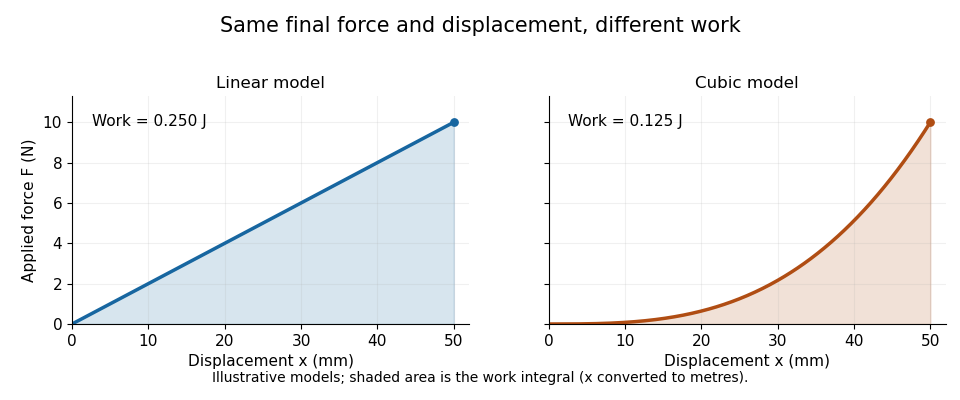
For a monotonic loading branch, the local slope is a tangent stiffness, while the ratio from a chosen zero point is a secant stiffness. These coincide for the linear model but can differ for a nonlinear curve. The force here is the applied loading force in the positive displacement direction; a spring's restoring force has the opposite sign.
The work supplied along this one-dimensional branch isFor an own linear example, and give final force and workThe nonlinear model , with , reaches the same final force but givesIts final secant stiffness is , while its tangent stiffness is . A final force and displacement therefore do not determine either the full curve or its work integral.

When loading and unloading follow different branches, a single-valued relation between force and displacement may be insufficient. Hysteresis records that path dependence; relating a cycle's work to dissipation also requires an energy balance and the relevant state assumptions. Report the measured displacement channel, sign convention and loading path before treating a curve as a material property independent of its apparatus.
New to topics? Read the docs here!