A force-displacement curve records how a measured force varies with a specified displacement during loading or unloading. The choice of displacement matters: it can describe specimen extension, motion of a machine crosshead or another reference. A curve can reveal resistance to motion, nonlinear response and differences between loading and unloading.
A concrete apparatus uses a moving crosshead, specimen fixtures and a load cell. The University of Illinois describes an Instron 4483 frame whose ball screws move the crosshead, whose load cell measures force, and whose encoder records crosshead position; an extensometer can separately measure specimen length change. The acquisition system converts those signals into engineering units and records them.[ref]
Load Frames at the Mechanical Testing Instructional Laboratory. Load Frames, apparatus and measurement-channel description
Those displacement channels need not agree. Crosshead motion can include mechanical compliance of the machine, grip seating and deformation elsewhere in the load train. A specimen extensometer therefore answers a different geometrical question from the crosshead encoder.[ref]
Extensometers in the Instron documentation. Passage on crosshead displacement, machine compliance, grip seating and load-train deflection
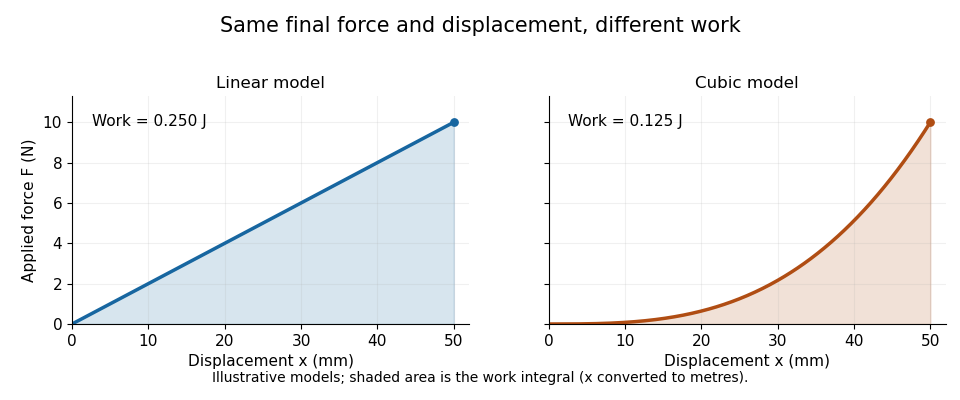
For a monotonic loading branch, the local slope is a tangent stiffness, while the ratio from a chosen zero point is a secant stiffness. These coincide for the linear model but can differ for a nonlinear curve. The force here is the applied loading force in the positive displacement direction; a spring's restoring force has the opposite sign.
The work supplied along this one-dimensional branch isFor an own linear example, and give final force and workThe nonlinear model , with , reaches the same final force but givesIts final secant stiffness is , while its tangent stiffness is . A final force and displacement therefore do not determine either the full curve or its work integral.

When loading and unloading follow different branches, a single-valued relation between force and displacement may be insufficient. Hysteresis records that path dependence; relating a cycle's work to dissipation also requires an energy balance and the relevant state assumptions. Report the measured displacement channel, sign convention and loading path before treating a curve as a material property independent of its apparatus.
The secant stiffness of a one-dimensional force-displacement curve, relative to a chosen reference , isIt is the slope of the secant line joining the reference to the point of interest. With an unloaded reference , , this becomes . Its units are force per displacement. Unlike tangent stiffness, it describes the accumulated change from the reference rather than the local response to an arbitrarily small change.
For an original nonlinear model,take . The force is and the origin-based secant stiffness is . The tangent stiffness at the same point isFor a linear curve through the reference, both reduce to the same constant stiffness. The interpretation of a measured force-deflection slope as structural stiffness also incorporates geometry, rather than specifying a material constant alone.[ref]
Structural Stiffness Concept by TU Delft OpenCourseWare. Force-deflection slope and axial stiffness EA/L
Changing the reference changes the secant. In the same model, , so the chord from to has slope , rather than .
Nor does an endpoint secant stiffness determine the work needed to get there. Here the exact loading work isApproximating it by would instead give . The endpoint ratio does not replace the complete force-displacement curve.
The tangent stiffness at a point on a differentiable force-displacement curve is its local slope,It governs the first-order response to a small displacement change:The graphical interpretation is the slope of the tangent line. Structural stiffness measured from force-deflection behaviour includes geometry as well as material response.[ref]
Structural Stiffness Concept by TU Delft OpenCourseWare. Discussion following the axial force-displacement relation
For the illustrative model , choose and . At , the tangent stiffness is . An additional therefore predicts a force increase of to first order. Direct substitution gives ; the difference is the higher-order contribution omitted by the tangent approximation. The secant stiffness from the origin is only at this point.
In a displacement-controlled experiment, one can estimate the local slope with a central finite difference,Making smaller reduces the approximation error for a smooth exact curve, but measured differences can become dominated by measurement uncertainty. The force channel, displacement channel and loading branch must therefore be specified. Crosshead movement can include machine mechanical compliance, while an extensometer records a selected specimen extension.[ref]
Extensometers in the Instron documentation. When to use an extensometer: machine compliance, grip seating and load-train deflection
For a curve with hysteresis, loading and unloading can have different local slopes at the same displacement. At a sharp corner a unique derivative may not exist, and a finite-interval slope should be reported as such.
Articles by others on the same topic
There are currently no matching articles.