Work measures the energy transferred by a force as its point of application moves. For a point mass following a path , add the contribution of the force along each small displacement:This line integral uses the actual path, and the dot product selects the component of force along the motion. A large force perpendicular to every small displacement does zero work; holding something still also does zero mechanical work on it, even if holding it feels tiring. The SI unit is . [ref]
The usefulness of work is that it connects a description in terms of forces and distances to one in terms of energy. The work-energy theorem gives the change in kinetic energy from the total net work, often without solving for the entire motion. The work of one selected force equals that change only when the other forces contribute zero total work.
The work done by a uniform pressure on an expanding boundary is . With internal energy , the first law of thermodynamics for an adiabatically expanding region reads . For a homogeneous cosmological perfect fluid, and give the cosmological continuity equation .
When a vacuum vessel's window shatters, a nearly atmospheric initial pressure difference gives inward pressure force on frontal area . Dividing by the glass mass estimates its initial collective acceleration. An ideal atmospheric pressure-work budget for vessel volume would give a collective kinetic energy estimate if assigned entirely to the fragments. This is a model-dependent energy budget, not a universal bound on every fragment's speed: air motion, fragmentation, pressure equalization and wall impacts alter the transfer, and unequal sharing can accelerate a small fragment faster than the collective estimate.
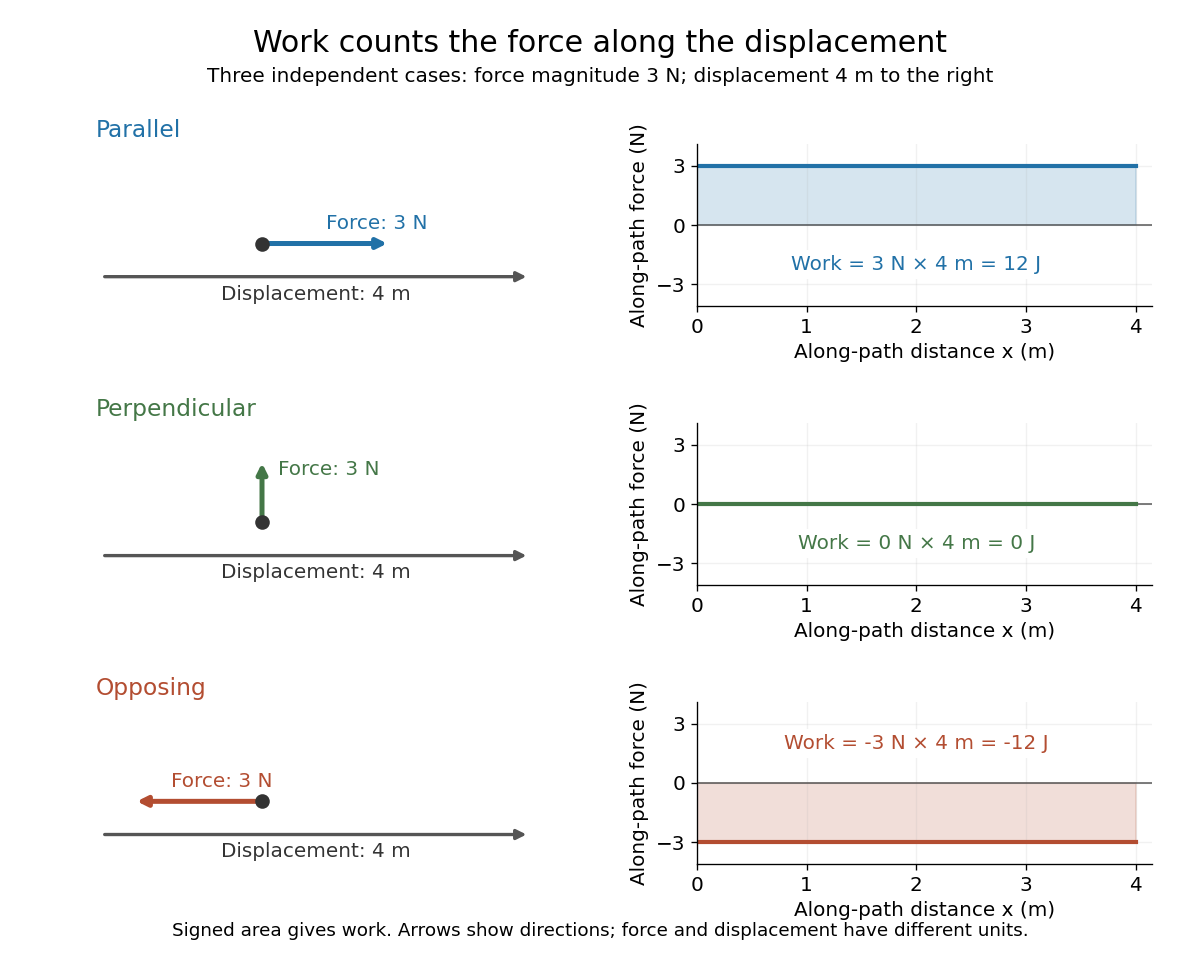
For a fixed force and endpoint displacement , the line integral reduces to a dot product:Here is the angle between the force and the displacement. For straight motion, is also the distance traveled. A force acting along a displacement does of work. Turning the same force perpendicular to the displacement gives and zero work; reversing it gives and . At , the work is . These signs describe energy transferred to or from the moving body. [ref]

For a point mass of constant mass observed in an inertial frame, the net work along its actual path equals its change in kinetic energy:The middle expression is a line integral; the dot product selects the component of force along the displacement. Positive net work increases speed, negative net work decreases it, and zero net work leaves the endpoint speeds equal. Equal endpoint speeds do not imply equal velocities: a perpendicular force can continually change direction while doing zero work. [ref]
https://ocw.mit.edu/courses/8-01sc-classical-mechanics-fall-2016/mit8_01scs22_chapter13.pdf. MIT mechanics, Chapter 13, section 13.11
The bridge to Newton's second law is short: take the dot product of with velocity. The chain rule gives , equating the rate of change of kinetic energy to instantaneous power. Integrating gives the theorem. No conservative force assumption entered this argument; friction also contributes to the net work.
For the harmonic oscillator with spring stiffness , release a mass from rest at . The spring exerts . Its work before the first passage through isThus gives speed there. The velocity is negative on this passage because the position is decreasing. The energy calculation alone determines its magnitude, so the direction still requires information about the motion.
For a time-independent potential energy , the conservative force contributes work . Separating all other work as gives . Consequently conservation of mechanical energy requires zero net other work; the work-energy theorem itself does not require that conservation. With damping, mechanical energy decreases even though the theorem remains valid. [ref]
https://ocw.mit.edu/courses/8-01sc-classical-mechanics-fall-2016/mit8_01scs22_chapter14.pdf. MIT mechanics, Chapter 14: mechanical energy and nonconservative work
Power describes how quickly energy is transferred. For mechanical work, the instantaneous power supplied by a force isThe SI unit is , distinct from the velocity unit . The italic symbol for work and the upright unit for power mean different things. Two processes can transfer the same energy while requiring different powers: doing of work in requires an average , whereas doing it in requires an average . [ref]
The instantaneous rate of energy transfer through a circuit port is , with positive electric current entering the positive voltage terminal for the passive sign convention. Peak phasors in sinusoidal steady state give . The factor is absent for root mean square phasors.
Power output or input divided by the relevant mass, commonly expressed in watts per kilogram. Device-level and active-material values cannot be compared without stating their different mass bases.
Instantaneous power is power at a particular moment. Consider a point mass with mass , initially at rest, acted on by a constant net force along a straight path. Newton's second law gives constant acceleration , hence velocity andThe instantaneous power starts at zero even though the force is nonzero, because the initial velocity is zero. At distance , the kinetic energy example below gives speed , so the final instantaneous power is . Negative instantaneous power means the selected force is removing energy at that moment.
Average power divides the work over a nonzero interval by the elapsed time. For the same point mass driven from rest through by a net force, the displacement is . ThusThis average power is half the final instantaneous power because is a linear function of time, starting at zero. Its graph of a function bounds a triangle of area ; the horizontal line at average power encloses a rectangle with the same area. In general, an endpoint value of instantaneous power does not determine average power. [ref]
Articles by others on the same topic
There are currently no matching articles.