Fundamental strip of a Mellin transform
ID: fundamental-strip-of-a-mellin-transform

The fundamental strip of a Mellin transform is the interior of the set of real parts for whichViewed in the complex plane, it is a vertical strip ; either bound may be infinite, and the interior may be empty. Both endpoints of the improper integral must be checked. Convergence on a boundary line, whether absolute convergence or conditional convergence, requires a separate test. The Mellin transform is holomorphic throughout a nonempty fundamental strip.[ref]
NIST Digital Library of Mathematical Functions. Chapter 2, §2.5(i), equation 2.5.1 and the following description of the vertical domain of analyticity
A practical sufficient test uses Big O notation: if near zero and near infinity, with real , then comparison with elementary improper integrals givesThus guarantees absolute convergence. These upper bounds on need not locate the maximal Mellin fundamental strip; faster actual decay can widen it. The strip property itself follows by bounding the weight at any intermediate by the sum of two weights already known to be integrable. On a closed narrower strip, neighboring integrable weights also dominate the natural logarithm factors introduced by differentiation under the integral sign, making the transform a holomorphic function.
An exact two-endpoint example isHere both bounds are sharp: at the zero-end absolute convergence test contains , and at the infinity-end test contains . The displayed rational function continues meromorphically outside the Mellin fundamental strip and has simple poles at and . Its other finite continued values outside the strip are values of a meromorphic continuation, not of a convergent defining integral. More general endpoint information leads to meromorphic continuation of a Mellin transform from an asymptotic expansion.
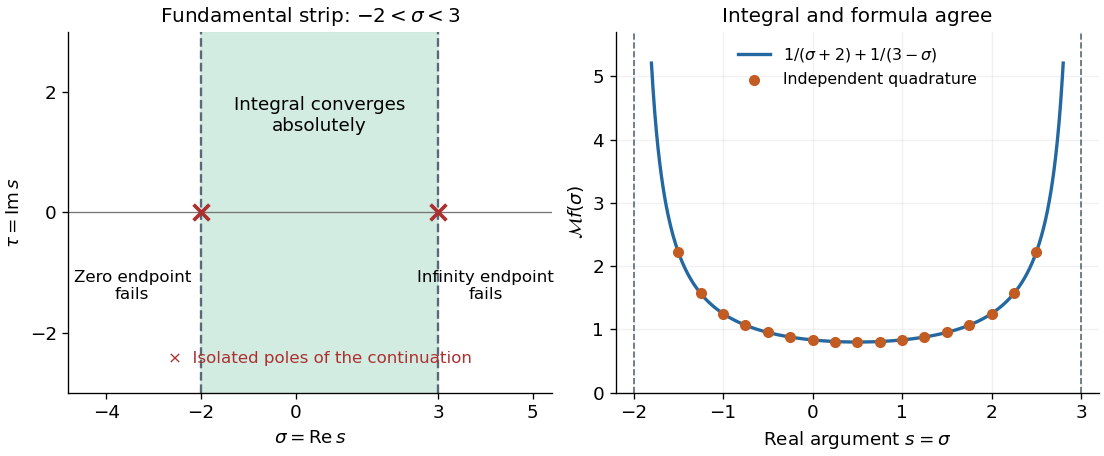
Two endpoint conditions define the Mellin fundamental strip
. Left: the Mellin fundamental strip for below one and above one is . Crosses mark the two poles of the continued rational function, not whole lines of isolated singularities. Right: the formula and independently computed integrals agree on the real slice inside the strip. The curve is drawn only where the defining integral converges. Details.
New to topics? Read the docs here!