The natural logarithm is the logarithm with base Euler's number, and the inverse function of the real exponential function. A particularly geometric definition isFor , it is the area under the hyperbola from to . For , the reversed integration limits give a negative value. The fundamental theorem of calculus gives , so the natural logarithm is increasing, while gives concavity.
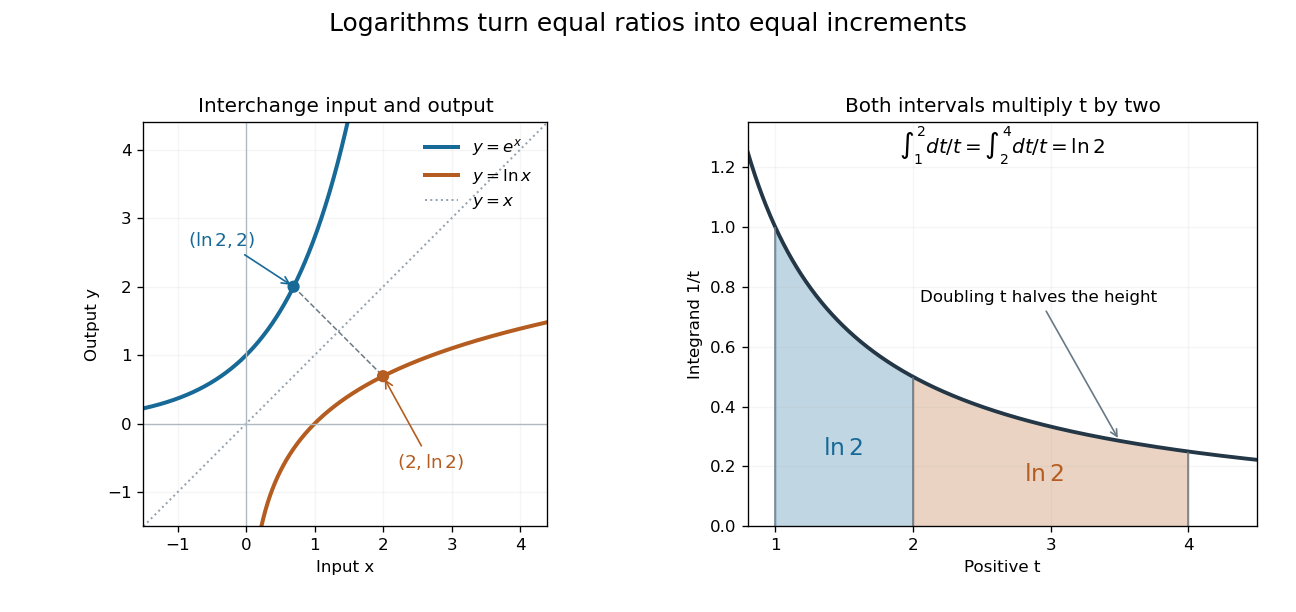
Exponential function and natural logarithm graphs reflect across ; equal multiplicative intervals have equal logarithmic areas
. Details. The change of variables shows for . Thus the intervals from to and from to each contribute area , explaining . Equal ratios give equal increments on a logarithmic scale, even though the ordinary differences grow. This makes the natural logarithm useful for comparing multiplicative changes and solving for time in exponential growth or exponential decay. The integral construction and inverse function properties are discussed in OpenStax, the natural logarithm as an integral.
Integrating the geometric series for from zero to gives the displayed power series for . It has radius of convergence one. At the alternating series test gives conditional convergence to ; at the negative harmonic series diverges. Replacing by gives . An expression formed by substituting a nonlinear function for need not have the same convergence range after it is re-expanded as a Taylor series in the new variable.
The natural logarithm has the parameter-integral representationFor , the identity shows convergence: the absolute value is at most , which is integrable when . At , the apparent singularity is removable, with limiting value .
Write the left side as . On a compact parameter interval with , its differentiated integrand is bounded by the integrable function . The dominated convergence theorem justifies differentiation under the integral sign, giving . Since , the fundamental theorem of calculus gives . At , the original improper integral diverges as , and it also diverges for .
Articles by others on the same topic

The natural logarithm is a logarithm that uses the mathematical constant \( e \) (approximately equal to 2.71828) as its base. It is denoted as \( \ln(x) \), where \( x \) is a positive real number. The natural logarithm answers the question: "To what power must \( e \) be raised to obtain \( x \)?

