Gaussian diffusion of a smooth initial profile
ID: gaussian-diffusion-of-a-smooth-initial-profile

For diffusion with a constant diffusion coefficient and no sources, the model flux is . A continuity equation gives . This proportionality is a constitutive assumption about transport; the continuity equation expresses conservation. If varies with position, it must remain inside the divergence, giving instead.[ref]
An exact constructed heat equation example on the whole plane uses dimensionless coordinates with and the smooth initial Gaussian function . Set . For ,Direct differentiation verifies both the initial condition andThe center decreases, while the region increases at that instant. The sign-change circle expands with radius . A fixed outer location can initially increase and later decrease as this circle passes it.
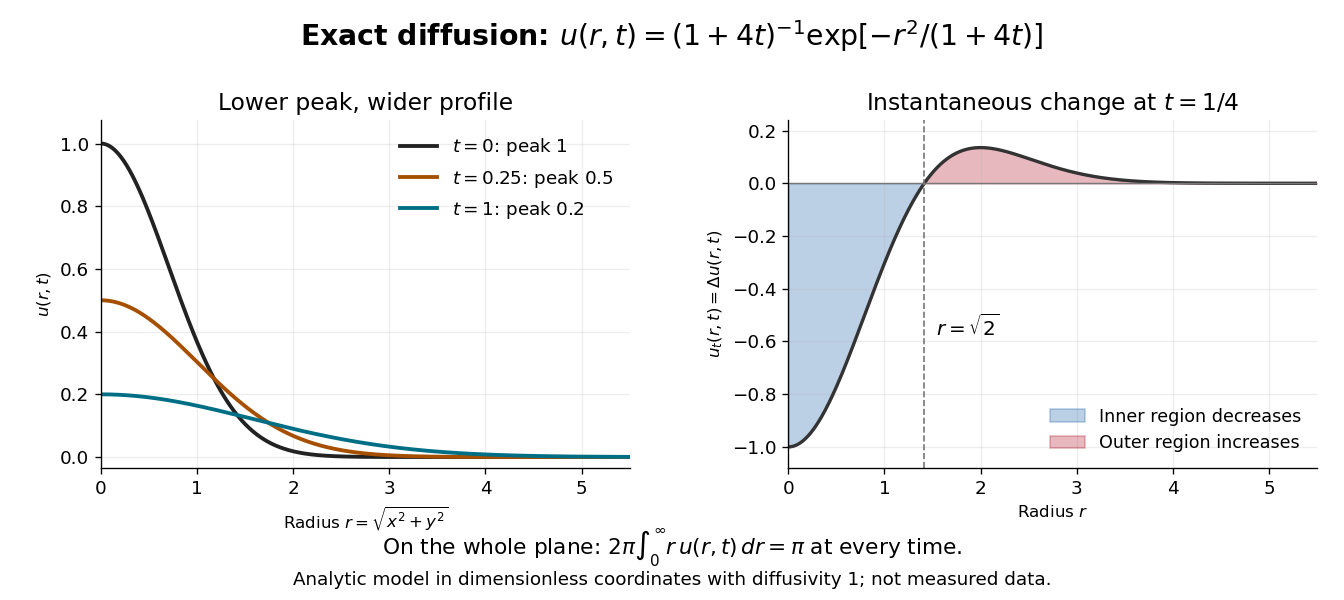

At time , the peak is , and the radius where the profile is times its peak is . The width grows as the height falls. Integration in polar coordinates givesThus a decreasing peak is compatible with a conserved spatial integral. Dividing by makes a probability density function with coordinate variances , connecting the same spreading to Brownian motion with diffusion coefficient one. Equivalently the profile is evolved by the Gaussian heat kernel with time parameter , since that article uses generator .
New to topics? Read the docs here!