Hypergeometric distribution
ID: hypergeometric-distribution

The hypergeometric distribution counts marked objects in a uniformly chosen sample of fixed size from a finite population, using sampling without replacement. Let be the population size, let objects be marked, and sample distinct objects. If counts the marked objects selected, its probability mass function isThe bounds describe the support of a probability distribution and must be an integer; the mass is zero elsewhere. The denominator counts all size- subsets, while the numerator counts choices of marked and unmarked objects using binomial coefficients. This counting argument requires every size- sample to have the same probability.[ref]
https://web.mit.edu/14.380/www/handouts/hypergeometric.pdf. MIT 14.30, hypergeometric distribution handout, §§1–4
For a constructed example, a box contains ten labelled objects, four red and six blue. Select five without replacement. There are possible samples. The probabilities for areIn particular, . Five red objects are impossible because the box only contains four. The expected value is , and the variance is .
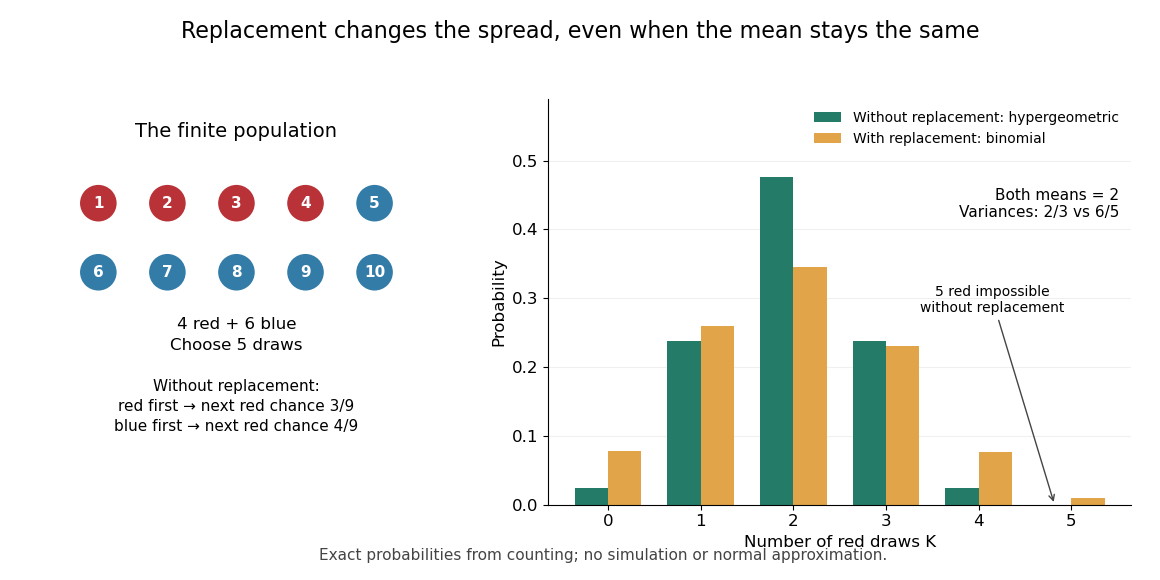
Five draws from four red and six blue objects: replacement preserves the mean but changes the spread
. Details. The count law also answers a detection question: what is the chance that five draws find at least one red object? By the complement rule of probability, it is , approximately . This can model inspecting five distinct objects from a known finite collection, with a mark indicating the property we want to detect. If repeated inspections can select the same object again, the replacement model instead gives . Equal expected values therefore do not imply equal chances of detecting a marked object.
The corresponding binomial distribution counts red draws when each selected object is put back before the next independent draw: . It has the same expected value , but variance , and it permits five red draws. Without replacement, a red first draw leaves red probability for the next draw; a blue first draw leaves . This statistical dependence pulls the total toward the fixed composition of the population, producing the finite population correction.
The useful modelling question is whether previously selected objects remain available. A fixed-size sample of distinct items calls for a hypergeometric distribution; fresh independent trials with constant success probability call for a binomial distribution. When the population grows with while stays fixed, the hypergeometric masses tend to the corresponding binomial distribution masses: removing finitely many objects has an increasingly small effect on the next draw's probability.


The Hypergeometric distribution is a probability distribution that describes the likelihood of a certain number of successes in a sequence of draws from a finite population without replacement. It is particularly useful in scenarios where you are interested in sampling a small number of items from a larger group without putting them back into the group after each draw. ### Parameters of the Hypergeometric Distribution The Hypergeometric distribution is defined by the following parameters: 1. **N**: The population size (the total number of items).
New to topics? Read the docs here!