On a connected open interval, if , every antiderivative of has the form , where is a constant function. Indeed, two solutions satisfy : the zero derivative on a connected open set principle makes their difference constant. In one dimension, the mean value theorem proves this on any closed subinterval. [ref]
https://www.jirka.org/ra/html/sec_mvt.html. Lebl, Basic Analysis I, Proposition 4.2.6: zero derivative on an interval
An initial condition or boundary condition can determine . If a particular antiderivative is and , thenFor , and , this gives . Without that reference value, choosing simply selects one member of the family.
The freedom has a physical meaning in a simple kinematic model. A velocity , with constant acceleration , determines position only as . The initial condition selects ; changing the starting position does not change the prescribed velocity.
For the differential equation on , the antiderivative is . The boundary condition gives . Discarding the constant of integration therefore needs a specified condition or an approximation that quantifies its effect. On a domain with several connected components, the freedom is larger: antiderivatives on disconnected domains require a separate constant on each component.
Let be an open subset of the real line, and let be antiderivatives of the same function on . Each connected component is an open interval. On that component, , so the mean value theorem gives . The constants on different components are independent: there is no subinterval inside joining them. Conversely, adding any chosen constant on each component preserves the derivative everywhere on .
For example, the domain of is . Every antiderivative on this domain has the formwith arbitrary real . The logarithm of the absolute value differentiates to on each side. The function with and is therefore a valid antiderivative, although it cannot be written as with one global constant.
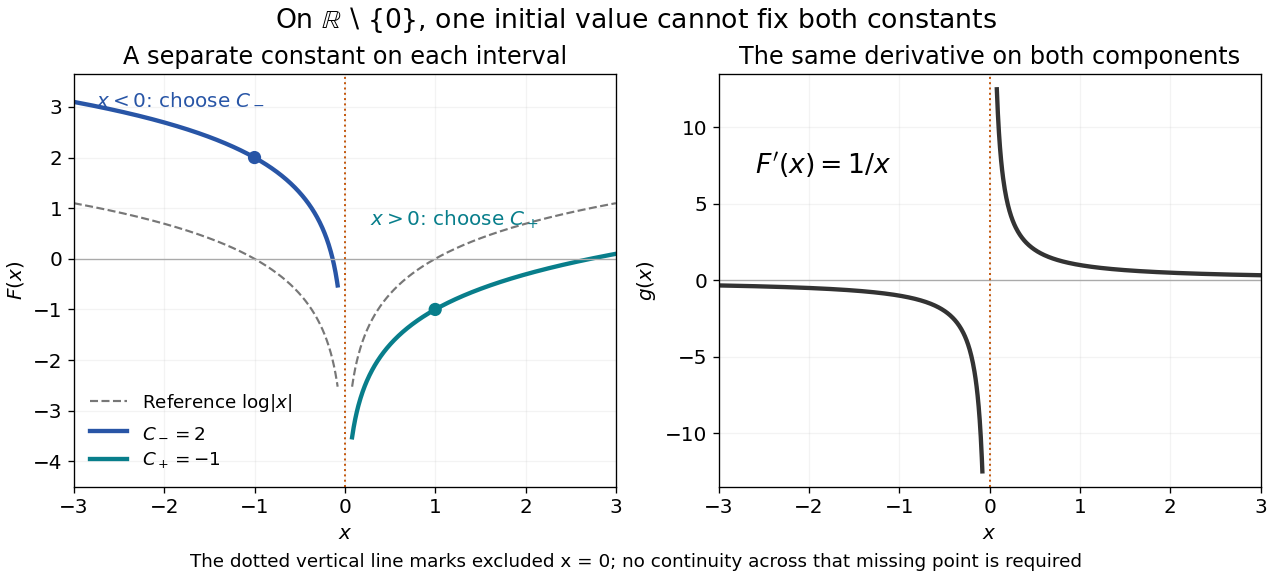
Two disconnected intervals allow independent constants while the derivative stays the same
. Details. 
An initial condition at fixes and leaves free. Fixing both constants requires one reference value in each connected component, or additional conditions that couple the components. The locally constant function captures this remaining freedom.
Articles by others on the same topic
There are currently no matching articles.