Interface phase matching
ID: interface-phase-matching

At a stationary, uniform planar boundary, incident and transmitted plane waves have the same variation of wave phase along the interface and in time. The figure marks places where equal-wave phase wavefronts meet the boundary. Although their perpendicular spacing differs, their intersections must advance along the boundary together. This is the local mechanism behind Snell's law.[ref]
Laws of Geometric Optics. equations 946–950: common angular frequency and matching tangential wavevector components
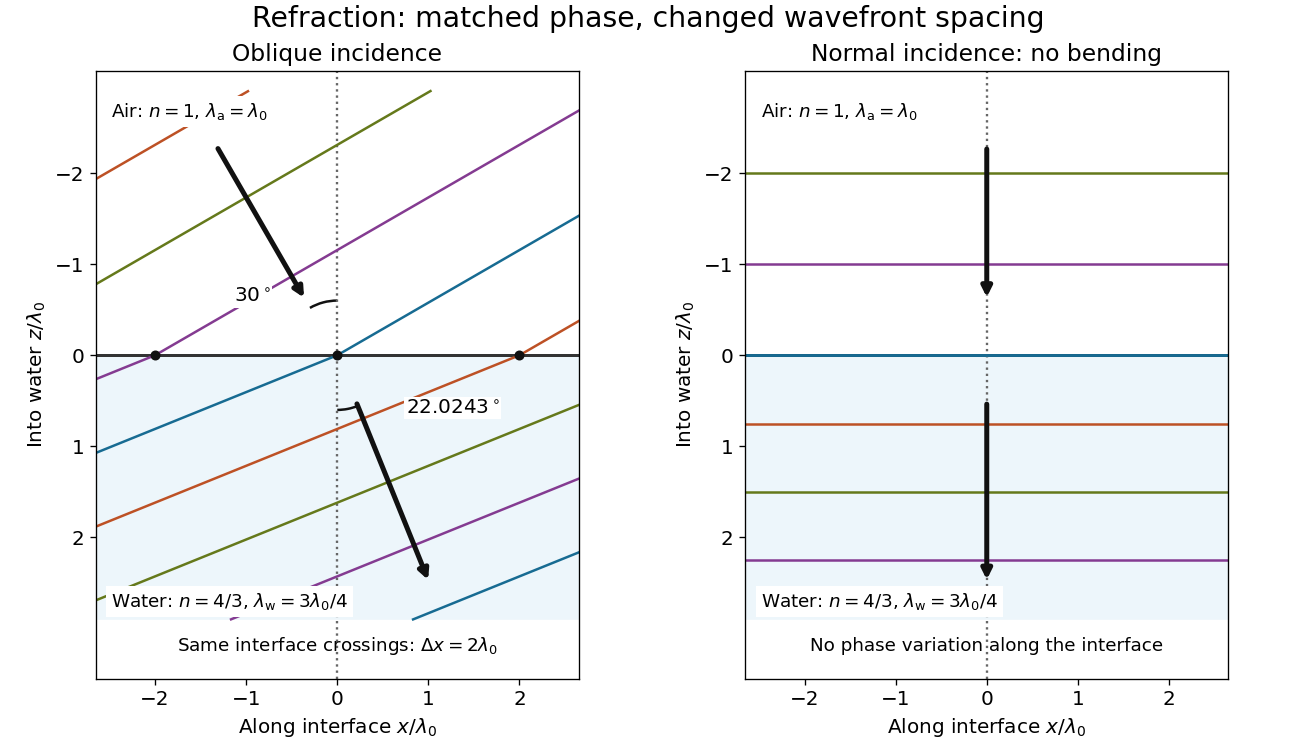
Wavefront spacing changes while interface wave phase matches
. Original plane wave construction for , and air incidence . Both panels have equal horizontal and vertical coordinate scales in units of vacuum wavelength . Coloured lines join at identical interface crossings; arrows show propagation perpendicular to each wavefront. The reflected branch is omitted. At normal incidence, the wavefronts stay parallel to the boundary and only their spacing changes. Details.
For a short derivation, let run along the interface and increase into the transmitted medium. Write each wave phase as . The electromagnetic boundary conditions must hold at every on ; their matching requires and . Constant offsets and wave amplitudes are determined separately. Since , this givesFor nonzero tangential wavenumber, the spacing of equal-wave phase intersections along the interface is . It is not the perpendicular wavelength. At normal incidence, the tangential wavenumber vanishes and the interface is uniform in wave phase.[ref]
New to topics? Read the docs here!