Ionospheric interference fringe spacing
ID: ionospheric-interference-fringe-spacing

Consider an original two-path model with a locally flat ground baseline and a symmetric equivalent return height . Replace the skywave by two straight segments traveling at the speed of light , and replace the ground wave by a straight segment of length . Their lengths and positive excess distance areThis is an equivalent geometric construction, not a metallic layer overhead. It neglects the curvature of Earth, refraction within the return region, ground-induced wave phase shifts and optical dispersion.
For received complex amplitudes and , absorb their constant relative wave phase into and choose their magnitudes nonnegative. An ideal detector reading proportional to squared received field hasAssume and are independent of frequency across the sweep, with slowly changing amplitudes. Consecutive maxima differ by in phase difference, soThe often-used approximation therefore carries a frequency-independent-path assumption. Counting complete fringe periods between and gives ; equivalently, when the vacuum wavelength is . Count whole periods, not maxima plus minima as though each were a whole period.
Choose and , with . Then , and . A sweep covers four full fringe periods. Conversely, the inferred equivalent height isThese chosen values illustrate the inversion; they are not a transcription of the 1924 measurements. With and , the normalized reading ranges from to : incomplete cancellation does not remove the distance information.
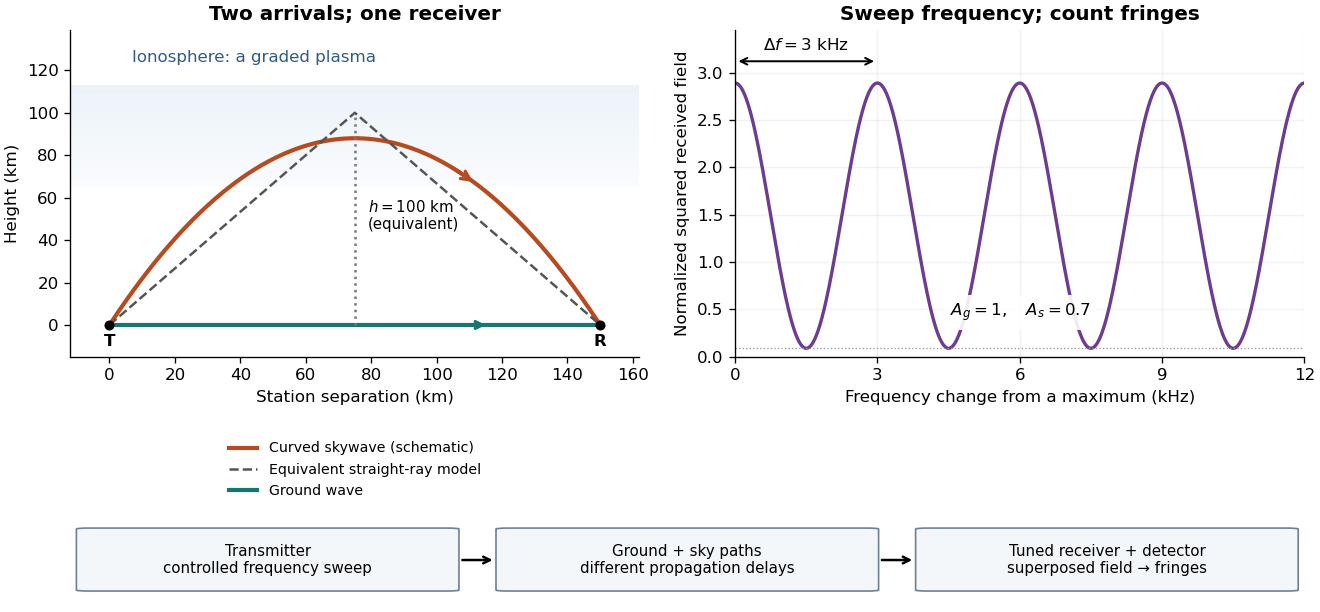

For a sweep with linearly changing frequency and two constant delays , the received instantaneous frequency difference has magnitude . In this model , giving a beat frequency . Equivalently, traversing each of the sweep crosses one fringe. This calculation requires a sufficiently slow sweep that propagation, tuning and amplitude changes can be treated consistently; it is not a beat between two independent transmitters.
More generally, measure the total phase difference , including propagation and any reflection or apparatus contribution. Define the differential group delayFor a locally monotone wave phase with slowly varying derivative, the local spacing is . If , this becomesHere is a phase-equivalent optical path difference, not necessarily the geometric excess distance . A drifting ionosphere, several simultaneous skywaves, changing wave polarization, a frequency-dependent reflection wave phase or significant loss can invalidate the simple constant-spacing inversion.
New to topics? Read the docs here!