
For the first-order ordinary differential equation defined on an open subset of the plane, an isocline of slope is the level setHere is a constant. At every point of this isocline, the direction field prescribes a tangent vector proportional to for a solution of a differential equation. It does not generally prescribe the tangent line of the isocline itself. The level set can have several components or fail to be a smooth curve, and points outside are excluded.
For example, take on the whole plane. Its isoclines are the parallel straight linesEach line has slope , while the direction field along it has slope . Thus the isocline carries horizontal segments even though the line itself rises. A function graph of a solution of a differential equation follows the segments, rather than following this line. Only the isocline with , namely , is also a solution of a differential equation.[ref]
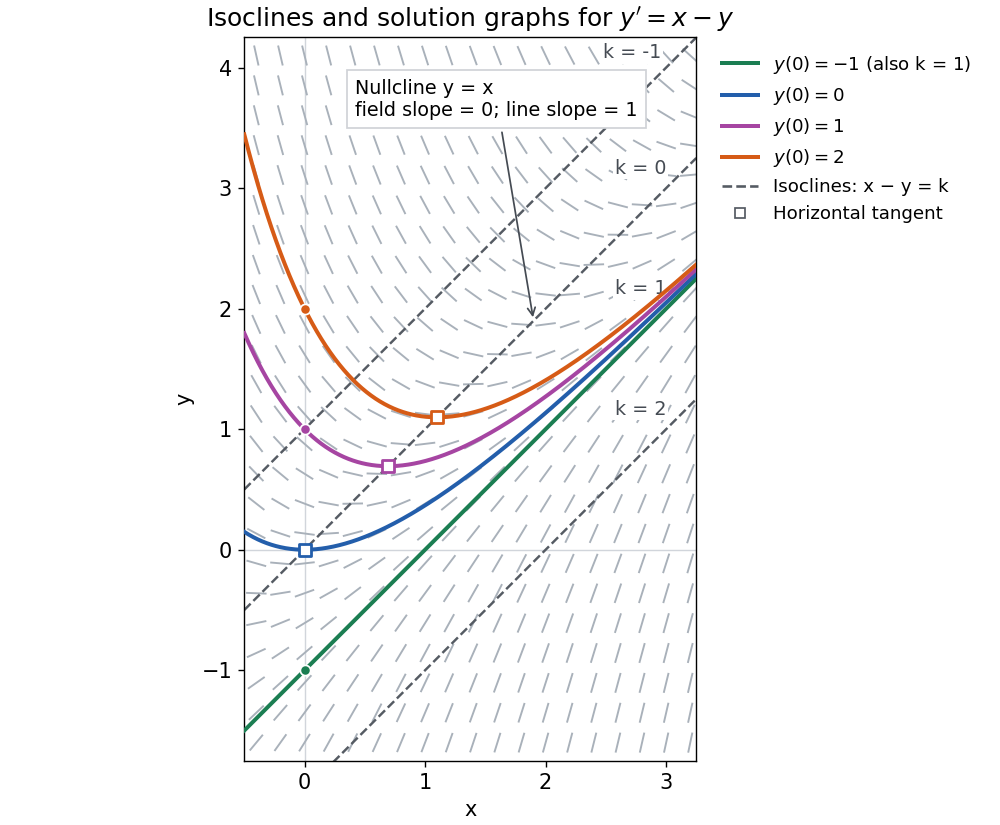

The first-order linear differential equation has the exact familyThe initial condition selects and hence a unique solution of a differential equation for every real . The picture shows . For the solution of a differential equation stays on the isocline; for other it moves through different isoclines. These formulas check the pictured trajectories by direct differentiation, independently of how the direction field was sampled.
The zero-slope isocline is called a nullcline. Below the nullcline in this example, ; above it, . For , the solution of a differential equation meets it at , where and , a strict local minimum. The nullcline is therefore a useful guide to turning points, although it is not itself a solution of a differential equation. In the equivalent planar autonomous differential equation , , it is the nullcline for the second component; there is no equilibrium point, because the first component never vanishes.
This makes isoclines useful even when no explicit solution of a differential equation is available: organize a direction field by common slopes, read where function graphs rise or fall, and identify possible turning points on nullclines.
New to topics? Read the docs here!