Isotope shift of a linear rotor
ID: isotope-shift-of-a-linear-rotor

Changing an isotope changes a mass and therefore the moment of inertia. If the bond length is held fixed, and every corresponding transition shifts by the same fractional amount. This leading inverse-reduced mass scaling is also used in the more complete diatomic formulation.[ref]
1Σ-Ground State Molecules. §2a, equations (4)–(5): isotope dependence of rotational constants and reduced mass
For a deliberately stipulated carbon monoxide example, take , , , , for both isotopic forms, and . The integer masses are simplifying inputs, not accurate isotopic atomic masses; the shared bond length is an imposed model assumption. Calculation givesIn particular,The heavier form's calculated line is rather than , a decrease of about . These are model predictions from the stated inputs, not published measured frequencies. An isotope changes the spacing as well as the first line; the shift is not a fixed additive offset for the whole spectrum.
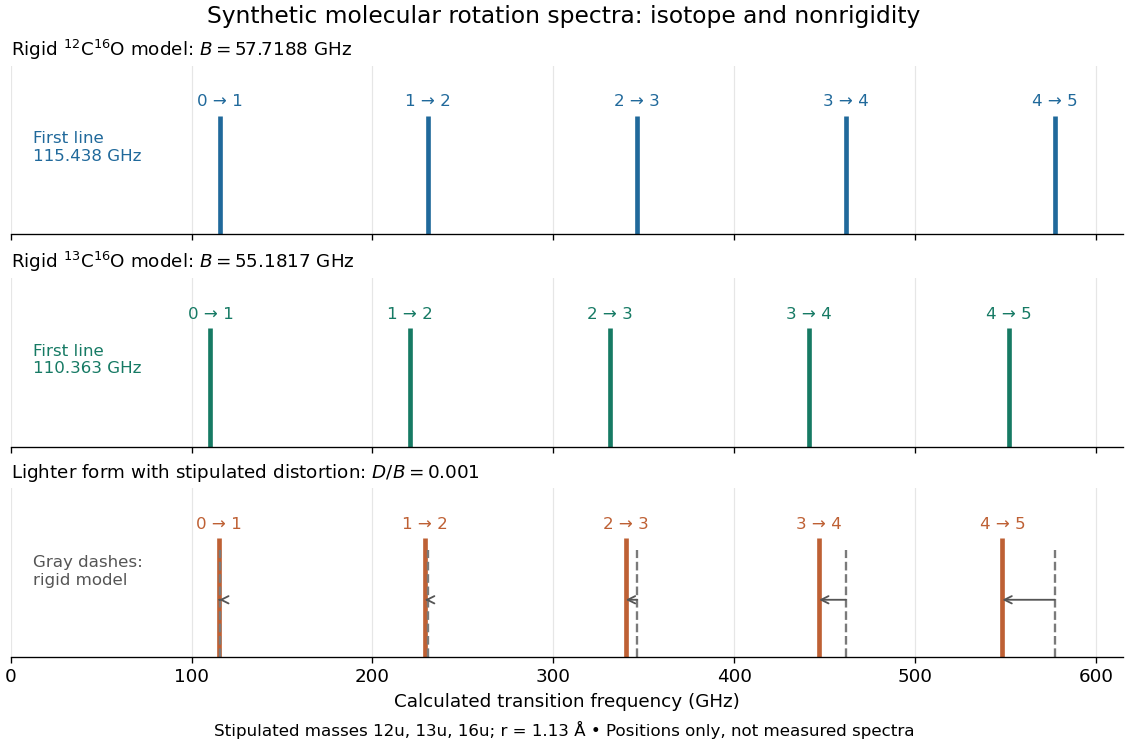
Synthetic rotational spectroscopy comparison: a heavier isotope compresses the rigid spectrum, while centrifugal distortion bends the spacing pattern
. Original equal-height sticks for through , using only the stipulated masses and bond length above. The lower panel additionally stipulates for the lighter form and compares with dashed rigid positions. Neither heights, distortion constant nor line frequencies are measured data; no thermal-population or instrument model is included. Details.
New to topics? Read the docs here!