Legendre least-squares projections of a cubic
ID: legendre-least-squares-projections-of-a-cubic

Take the polynomial on with unit weight. Using the four Legendre polynomials above, direct integration givesFor example, : the omitted odd terms have zero integral. Dividing by gives . Substituting all four coefficients proves the exact identity
The successive orthogonal projections onto degrees at most are thereforeHere is the squared L2 norm, without division by the interval length. Each row retains the previous Legendre polynomial coefficients and appends one new term. The ordinary power coefficients can change: adding changes the constant from to , and adding changes the linear coefficient from to . Independence belongs to the chosen orthogonal polynomial coordinates.
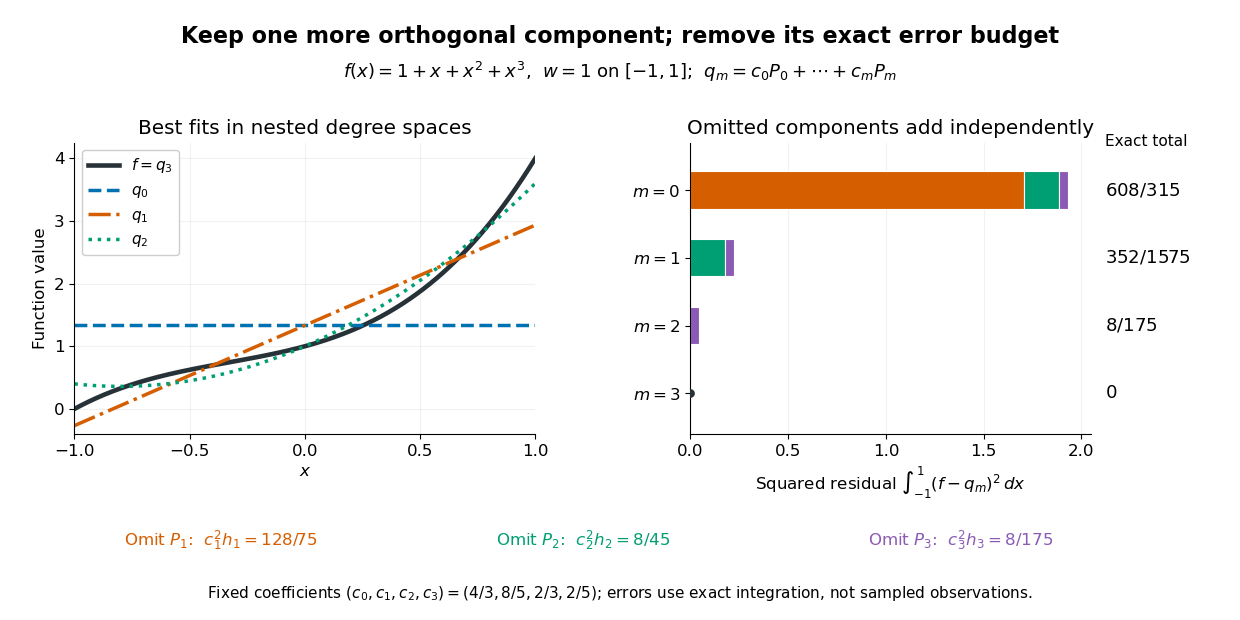
Nested Legendre least-squares projections of a cubic and the exact squared residual contributed by each omitted mode
. Details. 
The full squared L2 norm is , equal to . The residual budgets are the omitted terms:For a direct check independent of summing the budgets, , and integrating its square gives . This residual is orthogonal to , exactly the conditions for the best quadratic least-squares solution. An orthogonal projection need not be a polynomial interpolant: for example, while . The approximation allocates error across the interval according to the chosen weighted inner product.
New to topics? Read the docs here!