Lithium proton reaction energy
ID: lithium-proton-reaction-energy

The nuclear reactionconserves electric charge and total nucleon count: and . Its nuclear reaction Q-value is the initial minus final rest energy. It is additional to the incoming beam kinetic energy; the accelerator triggers a rearrangement whose products can carry much more kinetic energy than the incident proton.
Use one consistent set of neutral-atom isotope masses, in unified atomic mass units, from the National Institute of Standards and Technology:These are isotope masses, not element-averaged atomic weights.[ref]
Atomic Weights and Isotopic Compositions for All Elements by National Institute of Standards and Technology. Atomic Weights and Isotopic Compositions for All Elements, entries atomic number 1 mass number 1; atomic number 2 mass number 4; atomic number 3 mass number 7
With ,[ref]CODATA recommended values of the fundamental physical constants: 2022 by National Institute of Standards and Technology. CODATA recommended values of the fundamental physical constants: 2022, atomic mass constant, energy equivalent in MeV
The four electron rest masses cancel between sides. Differences of total electronic binding energies do not cancel exactly: this atomic-mass result approximates the bare-nucleus nuclear reaction Q-value at the displayed scale, not at arbitrary precision. No mixture of rounded nuclear binding energies is needed. At chosen incident kinetic energy on a stationary target, the two outgoing alpha particles together carry approximately before losses in the target and detector window.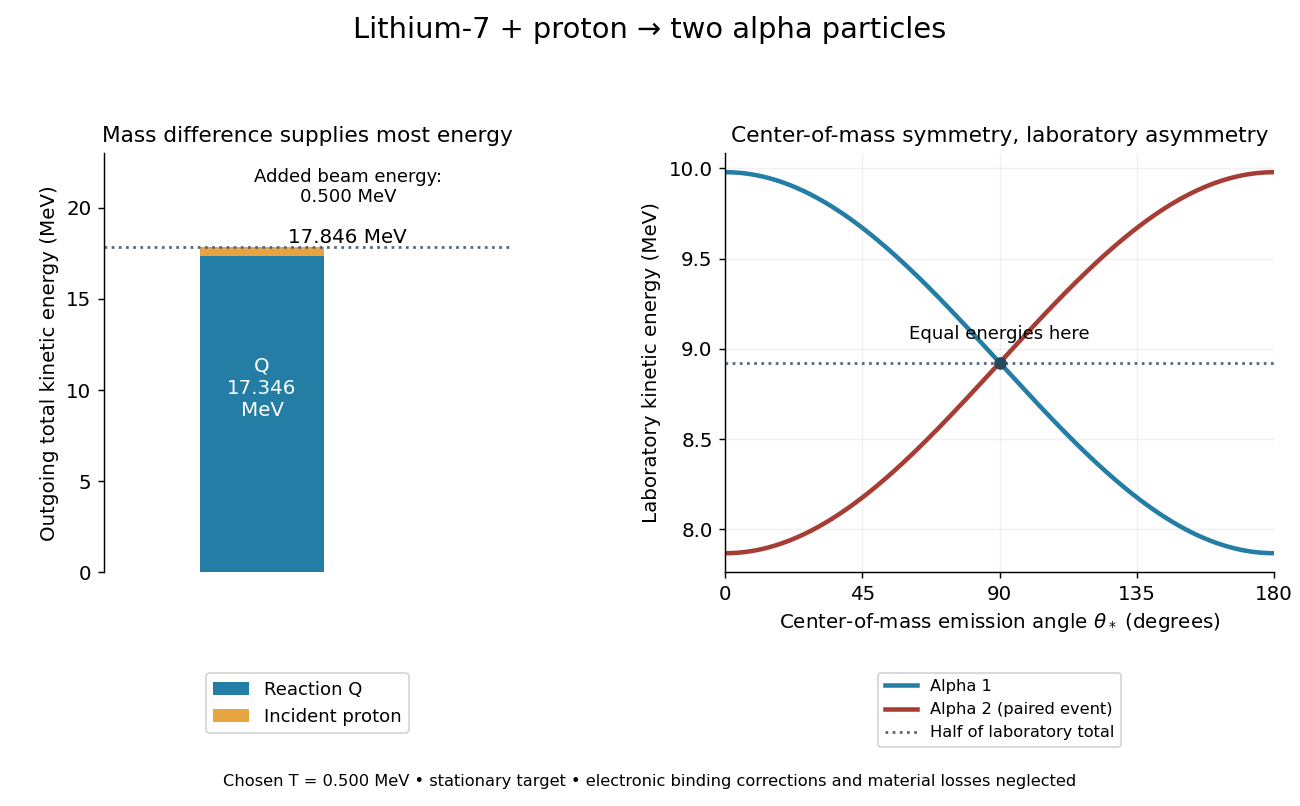

New to topics? Read the docs here!