Local subtraction with a sharp momentum cutoff
ID: local-subtraction-with-a-sharp-momentum-cutoff

The following scalar toy isolates one step in renormalization: removing a local divergence while retaining a finite dependence on a physical mass. For and a sharp cutoff regularization in Euclidean space with momentum bound , define the dimensionless Feynman integralThis is a zero-external-momentum scalar bubble integral stripped of coupling and combinatorial factors. Using the three-sphere area and reduces the integral toThe antiderivative follows by writing . At large the divergent part is , with the logarithm's dimensionful argument understood only within the displayed ratios. It has no external-momentum dependence. In a four-scalar-field vertex this structure can therefore be removed by a local operator proportional to , rather than a momentum-dependent nonlocal interaction.
Choose the fixed reference mass and subtract . If the loop contribution to a chosen four-point vertex coefficient is , choose the additive counterterm in that same coefficient as , where includes its stated diagram factors. This defines a finite subtraction prescription:The renormalization condition for this toy loop contribution is . The reference mass stays fixed when is varied; finite dependence on survives. A different finite subtraction changes the renormalization scheme, and the defined renormalized coupling must change consistently.
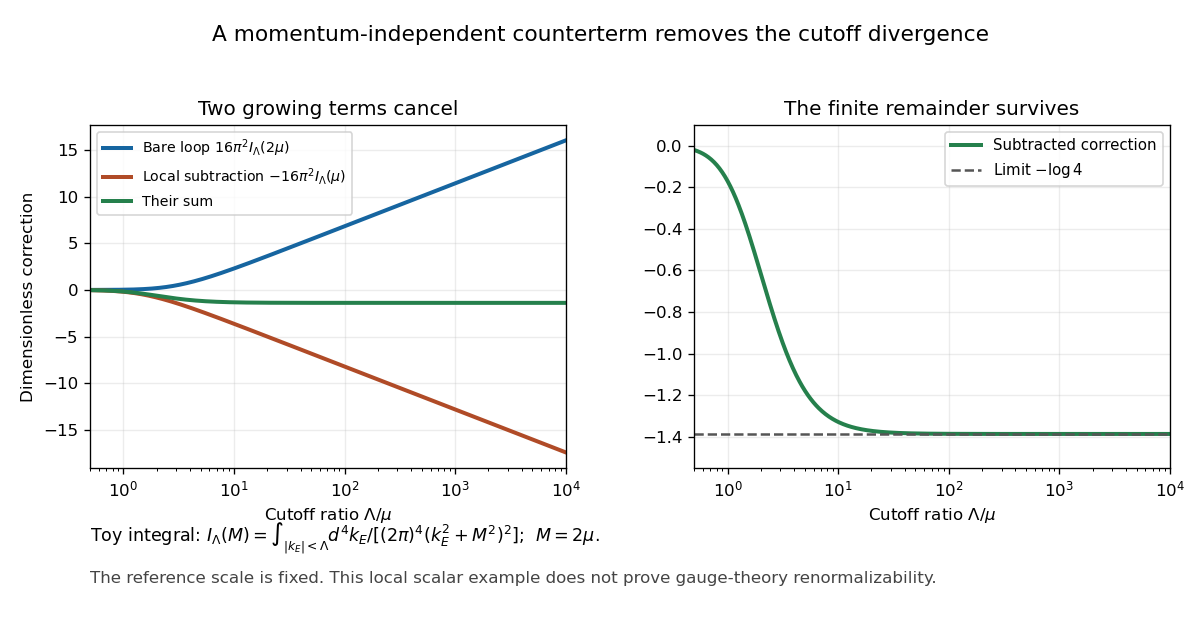

For , the limiting result is . At , the exact regulated difference is about ; at , it is about . Expanding the exact expression gives the leading residual in . This explicitly separates finite-cutoff error from the chosen finite renormalization condition.
A sharp cutoff regularization is convenient for this scalar demonstration, but shifts of a divergent loop momentum can change its integration domain. A gauge theory calculation cannot assume that it preserves the Ward identities. The toy contains no interacting gauge bosons, ghost loops or overlapping ultraviolet subdivergences, so its successful subtraction does not prove Non-Abelian gauge theory renormalizability.
New to topics? Read the docs here!