Lossless two-channel thickness scattering model
ID: lossless-two-channel-thickness-scattering-model

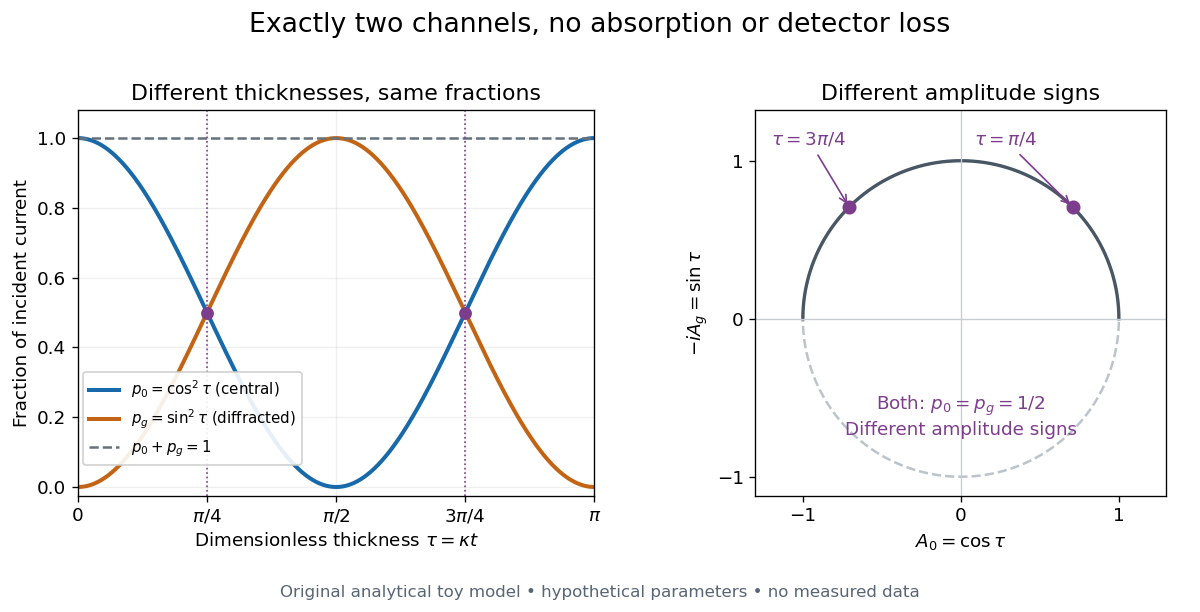
Consider an original illustrative model with exactly two outgoing scattering channels: a central beam and one diffracted beam . Let be specimen thickness and a constant coupling with units of inverse length. Normalize the probability amplitudes to incident probability current, assume equal longitudinal speeds, and specifyThese ordinary differential equations define a lossless toy model, not a fit to the silicon example or a complete theory of crystal scattering. Differentiating once more gives , soThe identity expresses conservation within these two scattering channels. Alternatively, substituting the ordinary differential equations into makes the two cross terms cancel. Here ideal bright-field transmission electron microscopy accepts fraction and rejects fraction ; ideal dark-field transmission electron microscopy accepts precisely the rejected channel. This complementarity requires the declared two-channel completeness and absence of loss.
Even with known , thickness is ambiguous: and both give . Near , ; extending that approximation through a full oscillation would erase the ambiguity incorrectly. The model isolates reversible transfer between probability amplitudes; it does not say that every thicker specimen must look darker.

Real dark-field transmission electron microscopy usually collects only a subset of the directions rejected in bright-field transmission electron microscopy. Other elastic scattering directions, inelastic scattering and detector losses prevent a general two-image conservation rule. To keep loss and background separate, extend the counting model explicitly. Let be the fraction absent from both recorded beam channels, describe the remaining fraction, be incident count per exposure, the detector efficiency and its mean additive background. Then the expected value of recorded count isFor separately acquired equal-illumination exposures with known , the two corrected mean counts sum to , not necessarily . Removal from these channels is not synonymous with physical absorption: an Electron can leave the chosen acceptance or change kinetic energy without being stopped in the specimen. Background subtraction removes a mean offset, but its counting variance remains.
New to topics? Read the docs here!