Magnetic field of a finite straight wire
ID: magnetic-field-of-a-finite-straight-wire

Take a wire segment on the axis, with source positions for , and positive electric current along . Observe at , where is the perpendicular distance to the wire's supporting line. Choose rightward and upward, so points out of the page. ThenThus the magnetic field points into the page by the right-hand rule. The Biot-Savart law and an elementary antiderivative giveFor an original worked example, choose , , , and . Use for these rounded calculations. Each endpoint contributes , soThese are calculated inputs and output, not laboratory data. The two endpoint angles measured from the perpendicular each have sine ; this recovers the equivalent endpoint-angle formula without depending on a diagram's angle-sign convention.
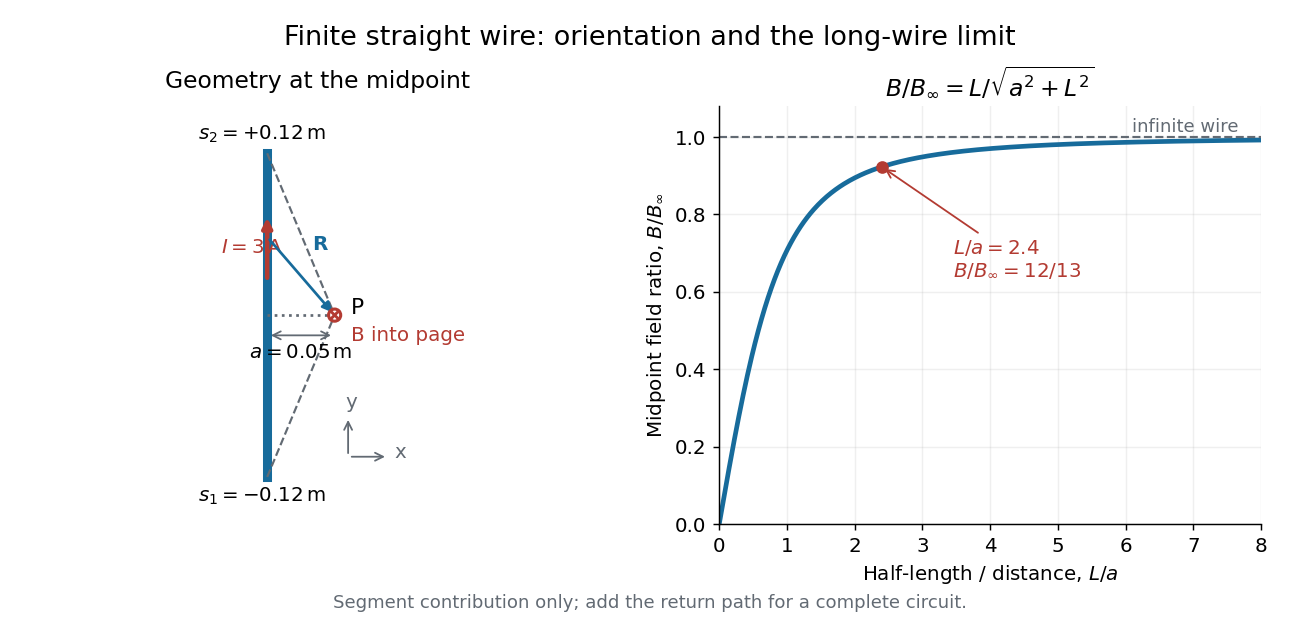

For a segment centered on the perpendicular foot, , . Its magnetic field magnitude isThe limit gives , consistent with Ampère's circuital law for an infinite straight wire. In the example, and : the infinite-wire value overestimates the segment value by , or about of the segment value. For , the isolated segment contribution instead behaves as . The complete localized electrical circuit has a different far-field behavior: return-path contributions cancel this leading segment term, leaving a magnetic dipole field when its magnetic dipole moment is nonzero. Segment and whole-circuit limits must be distinguished.
The SI units check directly: has units , the tesla. The apparent divergence as is a failure of the thin-wire model near the conductor, not a prediction of infinite magnetic field inside a real wire. This calculation gives only this segment's contribution; include the return wires before comparing with an apparatus.
New to topics? Read the docs here!