An electrical circuit connects components that carry electric current and sustain electric potential difference differences. Its dynamics may couple electrical resistance, inductance and capacitance.
Consider two voltage dividers across a common source, with impedances in one branch and in the other. Equal midpoint voltage phasors imply . If , and , then separating real and imaginary parts proves and . The topology, especially the parallel standard arm, is essential.
A null electrical circuit for measuring a lossy inductor against a standard capacitor. If opposite arms are and , and the remaining arms are , balance requires their products to agree. Consequently and . Two independent real adjustments are necessary; changing the source frequency does not change the ideal balance conditions.
A bridge driven between top and bottom nodes has equal resistors on its left arms, upper-right electrical impedance and lower-right electrical impedance . A zero detector electric current requires . Equating real parts and imaginary parts gives and , requiring . Its open-circuit right-minus-left junction voltage is , whereas a connected ideal ammeter has zero terminal voltage at every angular frequency. This distinction separates a null-current measurement from an unloaded voltage measurement.
The fraction of an operating cycle spent in a specified active state. For two constant-current states, average current is ; wake-up transients require an additional energy term.
Alternating an active mode with a lower-power mode to reduce average demand. Sleep current and transition overhead prevent average power from falling indefinitely in direct proportion to active time.
An ideal short circuit fixes zero electric potential difference across a terminal pair, corresponding to zero load electrical impedance. At the end of a lossless transmission line, its voltage-wave reflection coefficient is and the terminal voltage is zero. The available current is still limited by source and circuit impedances; real short circuits can dissipate substantial Joule heating.
An ideal open circuit permits no conduction electric current through a terminal pair, corresponding to infinite load electrical impedance. At the end of a lossless transmission line, its voltage-wave reflection coefficient is and the terminal current is zero. Real open terminals may retain parasitic capacitance and radiation loss.
A circuit node held close to zero electric potential by active feedback, without being directly connected to the reference conductor. In an ideal linear operational amplifier with its non-inverting input grounded and stable negative feedback, while neither input draws electric current. External branch currents meeting the inverting node therefore obey Kirchhoff's current law without flowing into the amplifier input. Equality of the input potentials fails when the output saturates or the feedback ceases to enforce linear operation.
An alternating-current electrical circuit comparing a parallel resistor-capacitor arm with a series resistor-capacitor arm. Let the upper-left arm have electrical impedance , the lower-left arm , and the upper-right and lower-right arms have electrical resistances . For input between the upper and lower nodes and an unloaded difference measurement between the arm junctions, voltage divider balance requires . Separating real and imaginary parts givesThe balance angular frequency is positive for positive components. Equal and require and . Reversing which reactive arm is upper changes the divider ratios, so the connections must always be specified.
Use the equal-component Wien bridge with upper-left parallel arm and lower-left series arm. Let be the left arm junction, the upper input node, and the upper-minus-lower input electric potential difference. With , the unloaded transfer ratio is the displayed expression. Its band-pass filter magnitude is , maximal at with . One continuous wave phase is , tending from at low positive frequency to at high frequency. Reversing the measured output polarity multiplies by and shifts its phase by without changing its magnitude.
A two-port network relates voltage and current, or incoming and outgoing travelling-wave amplitudes, at two pairs of electrical terminals. Power-normalized scattering parameters obey . In a reciprocal network with equal reference impedances, . A load reflection at port 2 can return through both transmission coefficients to port 1.
A connection in which branches share both terminal nodes and therefore the same electric potential difference. Branch electric currents add. For sinusoidal signals, the total electrical admittance is the sum of branch electrical admittances; ideal capacitances add.
An ideal electrical circuit exchanges energy between an inductor and a capacitor. With no electrical resistance or applied drive, the electric charge obeys , giving angular frequency . A series RLC circuit adds dissipation and can include an external drive.
An ideal inductor and capacitor in parallel have electrical admittance for phasors with time dependence . The branch currents cancel at angular frequency , giving zero total electrical admittance and an infinite limiting electrical impedance. Below this resonance its electrical reactance is positive; above it the electrical reactance is negative. Losses make the peak finite.
An ideal voltage source drives a series resistor feeding a parallel inductor and capacitor. In the convention, the branch voltage ratio is the title expression. It is a band-pass response with unit peak at , phase from through zero to , and half-power bandwidth . At resonance the input current vanishes while equal and opposite inductor/capacitor currents remain finite. Reactive branch-current magnitudes must be combined as phasors, not added as positive scalars.
A diode is a two-terminal component with an asymmetric current-voltage characteristic: reversing its terminal electric potential difference need not reverse its electric current with the same magnitude. Name the terminals diode anode and diode cathode . Define using their electric potentials, and take positive electric current from to . The bar in the diode symbol marks . Positive is the forward direction; negative is the reverse direction.[ref]
The asymmetry makes a rectifier possible: a sinusoid can drive electric current through a resistor on one half of each cycle. An ordinary resistor obeying Ohm's law instead reverses its electric current when the applied electric potential difference reverses. The useful idea is directional selection; the ideal diode model captures it, while the Shockley diode equation describes a smooth exponential function rather than an abrupt switch.
The terminal of a diode at which positive forward electric current enters, with the orientation used in the ideal diode model.
The terminal of a diode at which positive forward electric current leaves. The bar in the diode symbol identifies this terminal.
The ideal diode model sets the conducting electric potential difference to zero and the blocking electric current to zero. With the stated orientation,[ref]
The Junction Diode by W. Marshall Leach, Jr.. The Junction Diode, §1.12.1, printed p. 30: zero forward voltage and zero reverse current idealization
The surrounding electrical circuit chooses the state and remaining value. The two branches meet at . Their product vanishes, so the ideal diode dissipates no power: .
The ideal diode model omits forward drop, reverse leakage, diode reverse breakdown and switching delay.
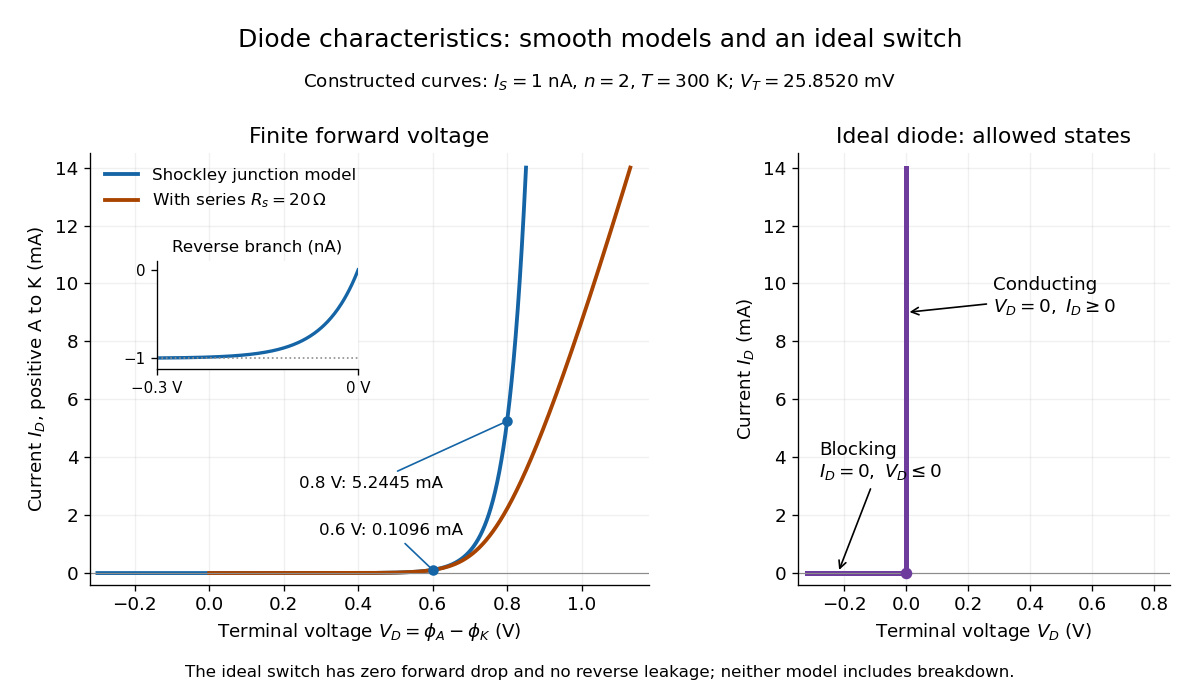

For a p-n junction at fixed temperature, the Shockley diode equation models its electric current asHere is the diode saturation current, the diode ideality factor, the thermal voltage, the Boltzmann constant, and the elementary charge.[ref]
The Junction Diode by W. Marshall Leach, Jr.. The Junction Diode, §1.2, printed p. 4, equation (1.1) and parameter definitions
For an original model example, choose , , and . Using and gives . Then gives , whereas gives . These are predictions of the declared model. There is no universal turn-on electric potential difference: solving the Shockley diode equation for the value needed at a chosen electric current givesAt , increasing by multiplies the electric current by approximately . At the same model gives . Its reverse branch approaches ; it cannot describe diode reverse breakdown.
A constructed extension adds internal series electrical resistance to a junction whose electric potential difference is . Applying the Kirchhoff cycle law givesFor and the same , sustaining needs : across the junction plus across its internal electrical resistance. The derivativeshows why the current-voltage characteristic becomes nearly a straight line when the internal series electrical resistance dominates. This is still a fixed-temperature model; self-heating can change , and . Real diodes also have leakage and charge-storage effects omitted here.[ref]
The Junction Diode by W. Marshall Leach, Jr.. The Junction Diode, §§1.3, 1.8 and 1.11: temperature dependence, charge storage and series bulk resistance
For a long, nondegenerate, ideal p-n junction under low injection, the diode saturation current is set by minority carriers supplied from the neutral regions. Their equilibrium densities are and . Solving the steady diffusion and recombination equations gives , where is junction area, are diffusion coefficients, and are diffusion lengths. Reverse bias suppresses opposite majority-carrier injection exponentially while collecting this minority supply. Thus is approximately bias independent before breakdown, but depends strongly on temperature through and on transport, doping, and geometry.
The positive electric current scale in the Shockley diode equation.
In a diffusion-dominated p-n junction, with a transport prefactor determined by minority-carrier diffusion and dopant densities. Combining this with the intrinsic carrier concentration gives, for fixed gap and effective masses,The slope against is . A measured diode ideality factor helps identify the transport regime: generation or recombination current can have a different dependence on , so its activation slope cannot automatically be interpreted with the diffusion formula.
The dimensionless parameter adjusting the forward slope in the Shockley diode equation. Its ideal junction law sets .
A sufficiently large reverse electric potential difference can produce a rapidly increasing reverse electric current. Both the ideal diode model and the unextended Shockley diode equation omit this behavior.[ref]
The Junction Diode by W. Marshall Leach, Jr.. The Junction Diode, §1.7, printed p. 17: breakdown after the small reverse-current region
The New Jersey Institute of Technology laboratory uses a silicon 1N4148 diode. For its forward current-voltage characteristic, the supply operates in current-source mode; a benchtop voltmeter independently reads the diode electric potential difference. Small electric current steps resolve the steep branch. For reverse measurements, a sensitive ammeter sits in series; the handout suggests a – series resistor. Reversing the applied polarity supplies the comparison. Meter placement must avoid counting the voltmeter's own electric current, and the zero reading may have an offset. The same diode is then measured with an Agilent U2722A source measure unit for graphical comparison.[ref]
Part B Semiconductor Devices: Diodes 1 by New Jersey Institute of Technology. Part B, Experiments with Semiconductor Diodes, items 1 and 2(a): preparation, current control, independent voltage readout, reverse series resistor and same-device comparison
The prescribed analysis uses a logarithmic scale for forward electric current to infer and from the straight region. Large-electric current departures can indicate series electrical resistance. The handout cautions that the accessible range may not determine it precisely; meter loading also matters. This is a measurement procedure, without a published set of device readings.[ref]
Part B Semiconductor Devices: Diodes 1 by New Jersey Institute of Technology. Experiments with Semiconductor Diodes, item 1, parameter extraction and high-current trend-line limitations; Report and Analysis
The reason for the logarithmic scale follows directly from the Shockley diode equation. If and series electrical resistance is negligible,where is a fixed reference electric current making the logarithm dimensionless. The slope is , so extracting needs the junction temperature. Fitting only an appropriate interval matters: a straight-looking subset cannot establish the model at all electric currents.
A rectifier converts an alternating input into a unidirectional output. Diode orientation selects which direction of electric current is transmitted.[ref]
An electrical circuit that uses diodes and capacitors to produce an output electric potential difference larger in magnitude than the input peak. The attainable output depends on the circuit arrangement, electric current drawn by the load, capacitance and input frequency; an ideal unloaded result does not specify the output under load.
For an original ideal example, let an ideal voltage source supply the sinusoid , with and angular frequency . Connect its positive reference terminal to the diode anode, the diode cathode to the upper terminal of a load resistor with electrical resistance , and the lower terminal to the source return. Let be the upper-minus-lower load electric potential difference, and the downward load electric current. Assume the ideal diode model, zero source electrical resistance, and no filter capacitor, inductor or switching delay.
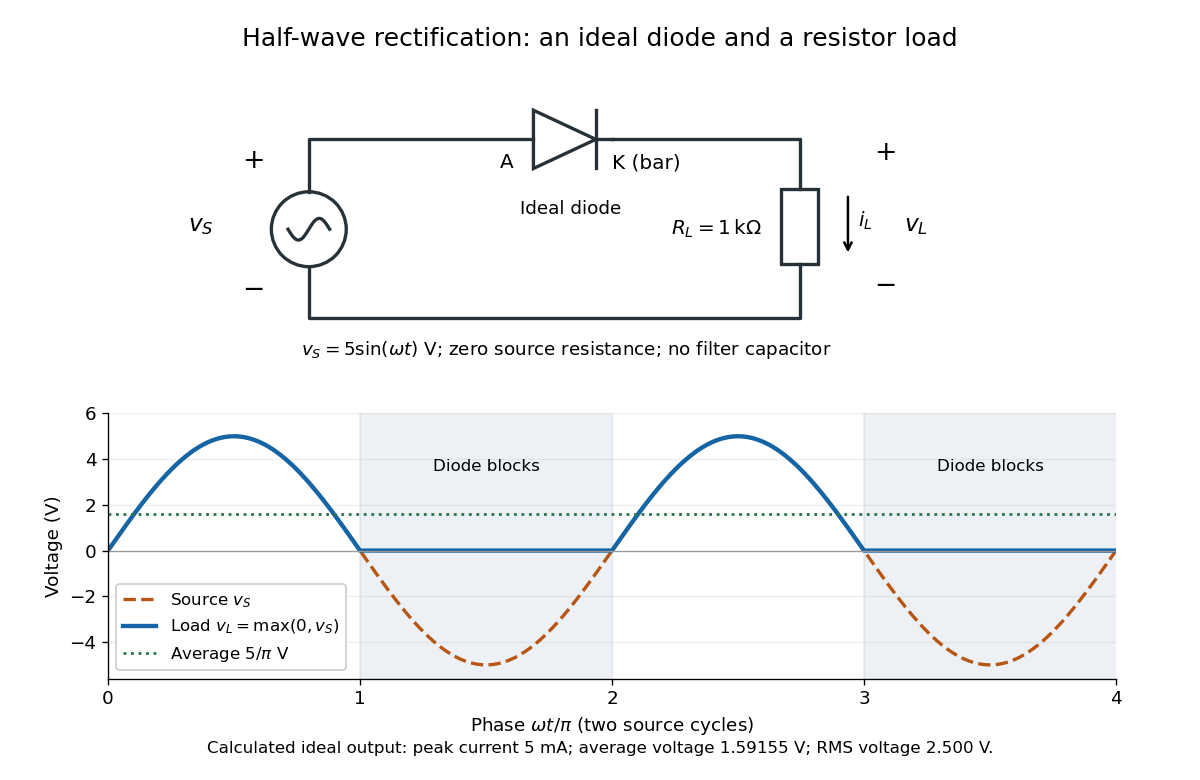
An ideal half-wave rectifier selects the positive half-cycle
. Original schematic and calculated load electric potential difference for and . The diode cathode is the bar at ; positive load electric current flows downward through the resistor. Dashed orange: source sinusoid. Blue: load output, zero during the negative half-cycle. Green: its cycle-average electric potential difference . No smoothing capacitor is present; these are ideal model predictions. Details.
The Kirchhoff cycle law gives , and Ohm's law gives . If , the blocking assumption would give , contradicting the ideal diode model, so the diode conducts with . If , conduction would give , also forbidden, so the diode blocks. At the crossings both values vanish. ThusThe peak load electric current is . The output is unidirectional but still varies in time, reaching zero throughout every negative half-cycle. Over a period of a function , write the wave phase as . Its average value of a function and root mean square follow from two integrals:Consequently the average load power is , not . The ideal diode has zero loss; the resistor converts supplied energy into Joule heating. The same switching argument predicts when the diode is reversed. Directional selection changes the waveform and its average value of a function; it does not by itself produce a constant output.
A light-emitting diode is a semiconductor diode producing electroluminescence under electric current. Forward bias injects electrons and electron holes; radiative electron-hole recombination emits photons. A double heterostructure uses band offsets to retain both charge carriers in an active layer. A sufficiently thin layer is a quantum well.[ref]
https://journals.aps.org/rmp/pdf/10.1103/RevModPhys.87.1139. §I, p. 1139, Fig. 1; §IV.A, pp. 1143–1144: injection, active layer and quantum-well distinction
The optical and electrical questions are different: photon energy sets a color scale, while light-emitting diode efficiency determines how much supplied energy escapes as light. The blue light-emitting diode made compact white light-emitting diodes and full-color displays practical. A modulated light-emitting diode can also supply the optical signal in a chopped-light lock-in experiment.
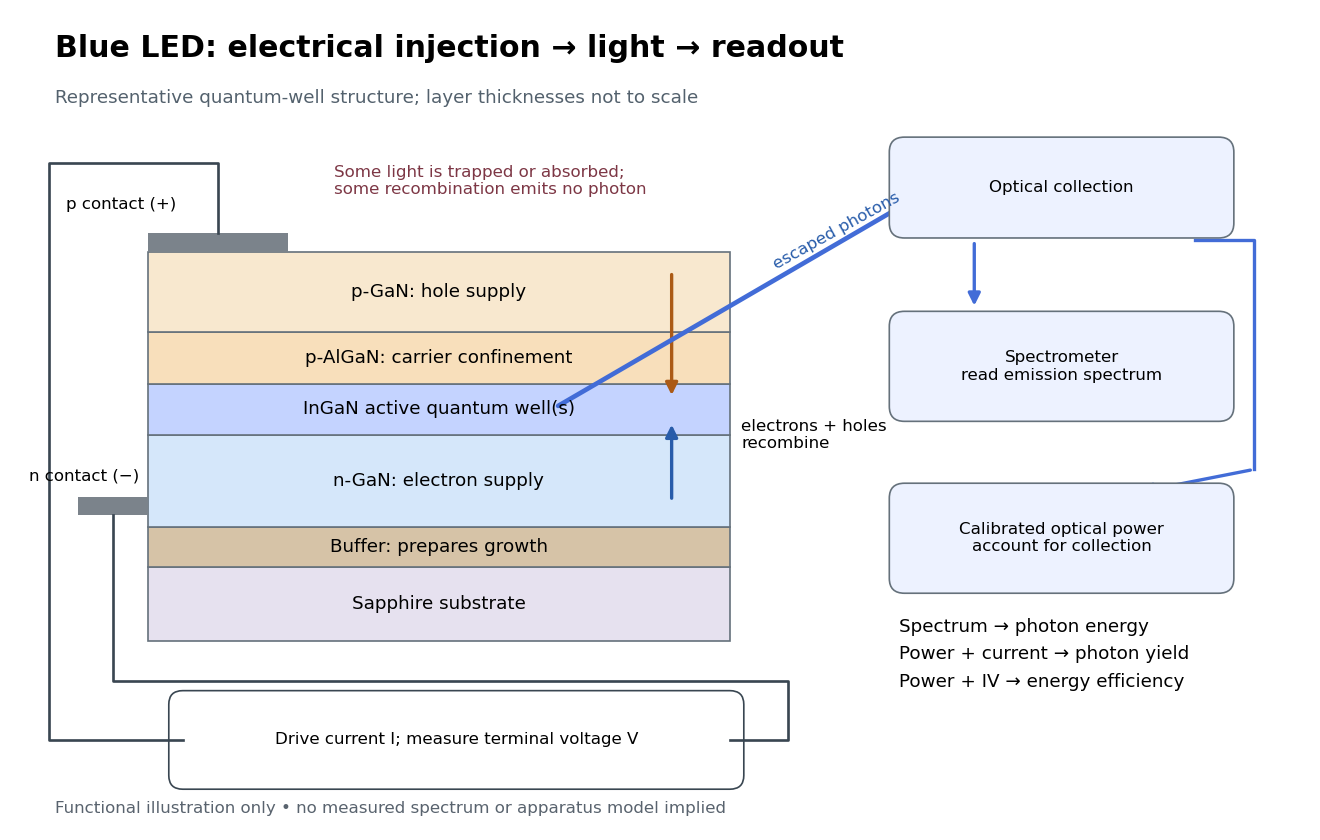
Blue light-emitting diode: carrier injection, emitting structure and optical readout
. Original functional schematic of a representative indium gallium nitride quantum well device on sapphire, not a reconstruction of the 1989 or 1994 devices. Layer thicknesses are schematic. Separate electrical and optical readings determine different properties: terminal electric potential difference and electric current, spectrum, and calibrated escaping optical power. The arrows represent routes through the device rather than a calculated energy band profile. Source. Details.
Blue transitions motivate wide-bandgap semiconductors, but a large band gap alone cannot guarantee efficient emission. Gallium nitride has a direct band gap; indium gallium nitride composition tunes the transition energy.[ref]
https://www.kapitza.ras.ru/~glazkov/students/Nobel-akasaki-lecture.pdf. §2, printed pp. 8–10: direct/indirect gaps and nitride composition range
For an emitted photon, with frequency and vacuum wavelength ,where is the Planck constant and the vacuum speed of light. Multiplying energy by wavelength gives . Thus chosen wavelengths and correspond to and : blue requires more energy per photon than red. A stipulated transition energy instead gives , in the ultraviolet. These are conversions, not measured emission lines.
For near-edge emission, estimates the photon energy from the emitting material's band gap. Quantum well confinement or impurity transitions can change it. The 1994 blue light-emitting diode used zinc-doped indium gallium nitride, emitting below its near-edge transition.[ref]
Candela-class high-brightness InGaN⁄AlGaN double-heterostructure blue-light-emitting diodes by Shuji Nakamura and others. p. 1688, Fig. 2 discussion: Zn-related emission
The measured forward terminal electric potential difference is also not fixed by , where is the elementary charge. It depends on electric current, temperature, contacts and series electrical resistance. Even the simple Shockley diode equation with series electrical resistance has , whereas an optical transition does not acquire an extra energy merely because the contact drop increases. Consequently, extracting a band gap from one terminal-voltage reading is not justified.
Isamu Akasaki chose metalorganic vapour-phase epitaxy and sapphire, which tolerated hot ammonia. Large lattice mismatch hindered film growth. In 1985, Hiroshi Amano and Isamu Akasaki's group developed an aluminium nitride epitaxial buffer layer deposited before hotter gallium nitride growth. The buffer supplies initial growth sites; growing islands join into a continuous film. It improves growth without making the lattices identical. Isamu Akasaki separately credits Shuji Nakamura's 1991 gallium nitride buffer.[ref]
https://www.kapitza.ras.ru/~glazkov/students/Nobel-akasaki-lecture.pdf. §§3.2–4.2, pp. 13–20, Figs. 7–11: growth sequence and microscopy
The 1986 growth paper reports a vertical metalorganic vapour-phase epitaxy reactor, source gases mixed just before delivery to slanted sapphire, and subsequent gallium nitride growth over aluminium nitride. Surface microscopy, X-ray diffraction and photoluminescence tested different aspects of the result. Buffered and unbuffered growth supplied the comparison. Its reported preparation conditions should not be replaced by one universal buffer temperature: the later lecture's account of the first low-temperature trial and the paper's parameter study describe different stages of development.[ref]
Metalorganic vapor phase epitaxial growth of a high quality GaN film using an AlN buffer layer by Hiroshi Amano and others. p. 353, Fig. 1 and Table I; p. 354, surface and diffraction comparisons
A magnesium acceptor impurity in gallium nitride accepts a valence band electron, leaving a mobile electron hole. Hydrogen passivation of magnesium acceptors in gallium nitride suppresses this activity. Post-growth activation restores existing impurities' electrical activity; ionization of active acceptor impurities supplies mobile electron holes. Adding magnesium alone is insufficient.[ref]
In 1989, Hiroshi Amano, Masahiro Kito, Kazumasa Hiramatsu and Isamu Akasaki obtained p-type semiconductor conduction in magnesium-doped gallium nitride using low-energy electron beam irradiation. Hiroshi Amano recalls initially resistive samples, an unreliable hot-probe test, then Masahiro Kito's Hall effect confirmation. A junction irradiated in an M-shaped region emitted in that pattern. Treatment, carrier-sign measurement and spatial emission supplied different evidence. Earlier zinc-doped samples brightened under irradiation without becoming p-type semiconductors: brightness alone did not prove the carrier sign.[ref]
https://journals.aps.org/rmp/pdf/10.1103/RevModPhys.87.1133. §V, pp. 1135–1136, Figs. 3–4; authors of 1989 paper in references, p. 1137
Shuji Nakamura, Takashi Mukai, Masayuki Senoh and Naruhito Iwasa's 1992 thermal-activation paper established another route using annealing in nitrogen. Their companion study compared already conducting films heated in nitrogen with films heated in ammonia: the latter became highly resistive again. Its hydrogen-complex explanation connected this atmosphere dependence to acceptor impurity passivation. These are thermal treatment and atmosphere comparisons, distinct from the earlier electron beam intervention; neither observation alone images an individual hydrogen complex.[ref]
Thermal Annealing Effects on P-Type Mg-Doped GaN Films by Shuji Nakamura and others. abstract: nitrogen annealing above 700 degrees Celsius and electrical changes
[ref]Hole Compensation Mechanism of P-Type GaN Films by Shuji Nakamura and others. p. 1258, abstract and §§1–2: activation history, nitrogen/ammonia comparison and hydrogenation hypothesis
Shuji Nakamura's two-flow metalorganic chemical vapor deposition reactor, gallium nitride buffer, thermal activation and improved indium gallium nitride growth enabled bright double heterostructure devices, followed by thinner quantum well devices.[ref]
The original 1994 paper by Shuji Nakamura, Takashi Mukai and Masayuki Senoh describes a sapphire/gallium nitride-buffer device with zinc-doped indium gallium nitride emission and aluminium gallium nitride confinement. After nitrogen annealing, etching exposed the n-side for a separate contact. At room temperature, varied forward electric currents gave emission spectra and optical-output curves alongside a current-voltage characteristic. At : output, peak wavelength, terminal electric potential difference. The peak stayed nearly fixed across the current series. The paper omits a complete calibrated collection apparatus; comparisons with earlier devices change several preparation details.[ref]
Candela-class high-brightness InGaN⁄AlGaN double-heterostructure blue-light-emitting diodes by Shuji Nakamura and others. pp. 1687–1688, fabrication and Figs. 1–4
Efficiency has several denominators. Specify a steady electric current , positive terminal electric potential difference , and a simplified narrow emission spectrum with photon energy . Assume at most one radiative photon per injected electron and electron hole pair. Let be the fraction of the electrical pair-supply rate reaching the active layer, the fraction of those pairs recombining radiatively, and the fraction of internally emitted photons that escape. Then counting the successive events givesDefine internal quantum efficiency here conditionally on pairs reaching the active layer: . The internal photon yield per electrical pair is instead . Stating this convention matters when another definition folds injection into internal quantum efficiency. The external quantum efficiency and wall-plug efficiency areThese are photon-count and energy-flow identities for the declared model. For a broad spectrum, replace by the mean escaping photon energy, weighted by photon number, when computing optical power.
A stipulated example chooses , , , , and . For every 100 electrical pairs, 90 reach the active layer, 72 emit internally, and 36 photons escape. Thus , not . Using givesThe dimensional analysis is transparent: , , and . The optical and electrical efficiencies differ because differs from the chosen .
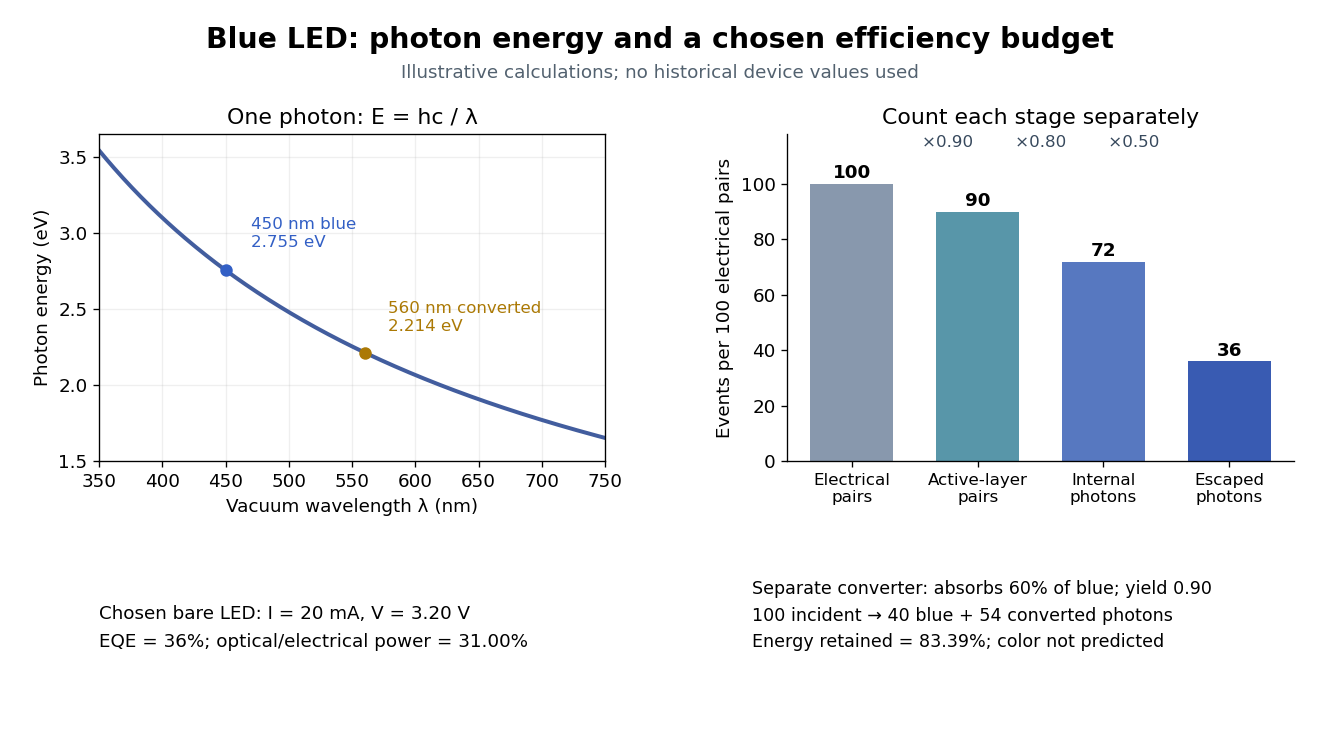

The factors suggest different improvements. Better confinement can reduce injection leakage; suppressing nonradiative recombination raises the radiative fraction; improving light extraction efficiency helps already-emitted photons escape. A photon trapped by total internal reflection has already passed the radiative step and can still be lost through absorption. Improving extraction therefore need not change the internal radiative fraction.
Shuji Nakamura's lecture cautions that why indium gallium nitride emits efficiently despite many defects was not completely settled in that account.[ref]
https://journals.aps.org/rmp/pdf/10.1103/RevModPhys.87.1139. §IV.B, pp. 1144–1145: high defect density, localization hypothesis and stated uncertainty
As an independent consistency check on the 1994 reported values, treating its broad spectrum as monochromatic at the peak givesThis agrees at the quoted precision with the reported . Its optical/electrical power ratio is instead . The first estimate uses a peak in place of a photon-number-weighted mean, so agreement is a consistency check rather than an exact reanalysis of the measured spectrum.
For the convention used in light-emitting diode efficiency, the internally generated photon rate divided by the rate of electron and electron hole pairs reaching the emitting layer. Its denominator must be stated when comparing measurements.
The rate of escaping photons divided by the electrical pair-supply rate in a light-emitting diode. This counts photons rather than comparing optical and electrical power.
The fraction of internally emitted photons that escape a light-emitting diode across the specified optical boundary. Collection by a particular detector adds another factor unless the measurement accounts for all escaping light.
The emitted optical power divided by electrical input power. For the bare-device calculation in light-emitting diode efficiency, ; a complete lamp also consumes power in its driver. Luminous efficacy, measured in lumens per watt, additionally weights the spectrum by human visual sensitivity and is a different quantity.
An additive color display mixes separate red, green and blue emitters. A phosphor-converted white light-emitting diode converts some blue photons to longer-wavelength light in a phosphor, mixing it with unconverted blue to produce perceived white. Hiroshi Amano distinguishes display and phosphor-lighting applications.[ref]
https://journals.aps.org/rmp/pdf/10.1103/RevModPhys.87.1133. §I, p. 1133: full-color displays and phosphor-based white light
To isolate conversion losses, suppose a converter receives 100 blue photons at , absorbs a fraction , and has fluorescence quantum yield : 0.90 converted photons per absorbed blue photon. Stipulate that every converted photon has , that unabsorbed blue is transmitted, and that both outputs escape without further losses. The output is then 40 blue and 54 converted photons. The total photon yield is , while the retained optical energy fraction isThe lower energy of each converted photon matters even if . Combining this stipulated converter with the preceding chosen light-emitting diode gives and an overall optical/electrical power ratio . These chosen narrow lines and photon counts illustrate conversion accounting; they do not establish a white appearance, color quality or luminous efficacy. Those require the full spectrum and a model of human visual sensitivity.
An amplifier that converts input charge to voltage through a feedback capacitance; used to read a piezoelectric stress sensor while controlling electrical loading.
An operational amplifier is a differential electronic amplifier whose unloaded voltage is modeled in its linear regime by . Its large open-loop gain, large input impedance and small output impedance make negative feedback useful for setting a reproducible transfer function with external components. Supply voltages bound the available output swing; the linear model does not apply after saturation.
For an ideal operational amplifier with grounded non-inverting input, connect an input capacitor to the inverting input and a feedback resistor from output to that input. The virtual ground and Kirchhoff's current law give . The ideal response amplifies high-frequency noise, so practical differentiators restrict its operating band and maintain feedback stability.
An inverting operational amplifier can combine currents from several input resistors at one virtual ground. Kirchhoff's current law and negligible amplifier input current give the displayed weighted sum. Replacing the feedback resistance by a capacitor gives a weighted op amp integrator. The formulas assume stable negative feedback and operation within the amplifier's linear output range.
The closed-loop gain from an equivalent differential input-voltage disturbance to the output is the noise gain. For an ideal-input inverting amplifier, and , although the voltage gain is . A dominant-pole amplifier has approximate closed-loop bandwidth when loop gain is large at low frequency and the circuit is stable.
An operational-amplifier configuration applying the signal to the non-inverting input and returning a fraction of output to the inverting input. In stable unsaturated ideal operation, zero input current and equal input voltages give the displayed voltage gain. The feedback resistor connects output to the inverting input and connects that input to the reference wavefunction node.
In amplifier saturation, the requested output lies outside the amplifier's linear operating range, such as when supply rails limit output voltage. The negative feedback virtual short approximation then need not hold. Output swing, current drive and recovery behaviour depend on the device and load; finite slew rate is a separate dynamic limit even when the output has not reached a rail.
Return a fraction of the output to the inverting input so that it opposes the input difference. Large stable loop gain makes the closed-loop gain depend mainly on the external feedback ratio rather than the uncertain open-loop gain. Frequency-dependent phase lag can destabilize the loop; saturation and finite slew rate also limit the approximation.[ref]
The closed-loop gain is the input-to-output transfer after closing the feedback connection. In the elementary noninverting voltage model it tends to for large stable loop gain, rather than retaining the uncertain open-loop gain . A frequency-dependent transfer must be checked for stability before that approximation is used.
The loop gain is the product of the forward amplifier response and the return-network fraction, with the summing-junction minus sign kept explicit. Closed-loop poles are determined by in this convention. Large low-frequency magnitude controls gain error, while frequency-dependent phase affects stability.
The phase margin measures the remaining phase lag before a negative-feedback loop reaches the critical phase at unity loop magnitude, using a continuous phase convention. Positive adequate margin is a useful stability and transient-response design diagnostic for standard single-crossover amplifier loops. More general unstable open-loop systems and multiple crossovers require the full stability criterion.
A voltage-feedback operational amplifier driven at its noninverting input, with a feedback divider at its inverting input, has ideal gain under stable negative feedback.
A voltage-feedback operational amplifier with its noninverting input grounded and input and feedback resistances has ideal gain . Virtual short and negligible input current give the result by node-current balance.
An ideal operational amplifier with a series input resistor and capacitor, resistive feedback and a grounded noninverting terminal realizes the displayed high-pass filter. Virtual ground and Kirchhoff's current law give . Its phase is in the convention. Equal resistances do not make its phase frequency independent.
With the noninverting input grounded, a differential input impedance draws current from the summing node. For zero output impedance, and Kirchhoff's current law gives . Eliminating yields the displayed voltage gain. The resistor-ratio result requires as well as stable, unsaturated operation. The same expression applies to small-signal phasors with complex .
An ideal inverting operational amplifier with series input and parallel feedback has the displayed transfer function, where and . Its peak is at with voltage gain . A wide input-high-pass/feedback-low-pass separation produces a broad plateau, not a narrow resonance. Validity requires stable negative feedback, sufficient loop gain and linear output operation.
For a response proportional to with positive time constants, its half-power width is . Combining with the geometric-mean centre frequency gives the displayed quality factor; the arithmetic-geometric mean inequality proves the bound. Equality requires matched time constants and gives half-power frequencies . Adjusting gains does not make this topology a high-Q resonant filter.
An ideal operational amplifier with a grounded noninverting input, input resistor , and parallel feedback resistor and capacitor implements a low-pass filter. The virtual short and Kirchhoff's current law give , where . The DC gain magnitude is and the cutoff frequency is . The capacitance reduces high-frequency feedback electrical impedance, causing the gain magnitude to fall.
Under stable negative feedback and within its linear operating range, an ideal voltage-feedback operational amplifier has equal input voltages. This relation is a consequence of large open-loop gain, and does not imply current flow between the inputs.
An op amp integrator places a resistor between the input source and the inverting input of an operational amplifier, and a feedback capacitor between that input and the output, with the non-inverting input grounded. For an ideal operational amplifier, Kirchhoff's current law gives , henceThe initial capacitor charge supplies the integration constant. A parallel feedback resistor replaces the transfer by : the direct-current gain becomes finite while integration is recovered when . This limits offset-driven saturation. [ref]
https://wiki.analog.com/university/courses/electronics/text/chapter-2. Analog Devices, Chapter 2, integrator and parallel feedback resistance
Consider an op amp integrator with infinite input impedance, an internal controlled voltage where is the inverting-input voltage, and a series output impedance equal to a resistance . Assume no external output load. Writing for the output, Kirchhoff's current law givesEliminating and yieldsThe expression at is obtained by its limit. In particular, constant gain and give : a finite direct-current gain followed by an integrating regime. For the dominant-pole model and ,If and , there are separated turnover frequencies near and . The gain magnitude is respectively constant, proportional to and proportional to . With the convention a continuous phase choice passes from through to . If and , capacitive feedthrough instead gives the ultimate limit . Specifying finite gain alone therefore does not specify a unique high-frequency response.
The slew rate bounds the large-signal output-voltage change per unit time. It is distinct from a small-signal gain-bandwidth product. A sinusoidal output of amplitude and angular frequency needs below the available slew rate to avoid this source of distortion.
An input bias current is a direct-current component drawn by an input terminal of a real operational amplifier. Through a source resistance it produces a voltage error, and through the feedback capacitor of an op amp integrator it can produce an output ramp. Its magnitude and sign depend on the amplifier technology and operating conditions.
The input offset voltage of an operational amplifier is the differential direct-current input voltage needed to make its output zero at a specified operating point. Its effect resembles a small unwanted input signal and can cause sustained output drift in an op amp integrator.
The open-loop gain of an operational amplifier is the ratio of its output voltage to its differential input voltage before an external feedback control connection is applied. A common small-signal model is , with a large direct-current gain and a dominant pole at . Above its magnitude falls approximately inversely with angular frequency.
For a dominant-pole voltage-feedback operational amplifier with and , the unity-gain angular frequency is approximately . In the range where this pole dominates, a roughly constant closed-loop noise gain gives a bandwidth approximately . This approximation depends on the amplifier model and feedback control circuit; it is not a universal statement about all amplifiers or all frequency-dependent feedback networks. [ref]
https://wiki.analog.com/university/courses/alm1k/alm-lab-gbw. Analog Devices, Activity: Op-Amp Gain Bandwidth Product, dominant-pole gain and unity-gain frequency
An ideal operational amplifier has infinite open-loop gain and input impedance, zero output impedance, unlimited response speed and zero input offset voltage and input bias current. Its input currents vanish. In a stable linear circuit with negative feedback and a finite output, its differential input voltage tends to zero as the open-loop gain tends to infinity. Thus and are the familiar conditional circuit rules. The equality of the input voltages cannot be imposed on an open-loop, unstable or saturated circuit.
Connect a resistor from the input source to the inverting input, a feedback resistor from output to that same input, and ground the non-inverting input. For ideal linear operation the inverting node is a virtual ground. Kirchhoff's current law gives , yielding the displayed voltage gain. The source sees input impedance , even though the amplifier input itself has infinite input impedance.
The ratio of output to input signal electric potential difference for specified source and load conditions. A signed voltage gain records whether the output reverses polarity; its value can depend on frequency.
The ratio of output to input signal electric current, with specified reference directions and load conditions. A large current gain alone does not determine power gain.
The ratio of signal power delivered to a specified output load to signal power accepted at a specified input, with . An amplifier draws additional energy from its supply, so a power gain above one does not create energy.
A lock-in amplifier measures the component of an input signal synchronized with a reference at a chosen frequency. It multiplies the input by a reference sinusoid, then uses a low-pass filter to retain the slowly varying product. Two references in phase quadrature recover both amplitude and phase difference. A shared timing source keeps the relative wave phase stable: this is coherent detection.[ref]
Model SR830 DSP Lock-In Amplifier manual by Stanford Research Systems. Model SR830 DSP Lock-In Amplifier manual, revision 2.5, printed pp. 3-1–3-2: multiplication, filtering, reference locking and dual-phase detection
The useful trick is to move the wanted frequency to zero before averaging. An electronic amplifier alone enlarges both the wanted signal and unwanted noise; a lock-in amplifier instead selects a component by its timing. A photodiode's electric current can first be converted to an electric potential difference, so the same calculation can measure weak modulated light. The chopped-light lock-in experiment makes this selection tangible.
phase-sensitive detection correlates an input with a synchronized reference and filters the product. Sinusoidal quadrature references recover both signal amplitude and relative phase. Narrow detection bandwidth rejects incoherent noise but cannot reject a background coherent at the same frequency; changing the integration time also changes settling and tracking speed.[ref]
Let the input electric potential difference be , with peak amplitude , angular frequency , and phase difference relative to . For an observation interval containing an integer number of cycles, each lasting one period of a function, , define the lock-in quadratures in a peak convention:These integrals average the products with dimensionless references and ; and have the input's units. The minus sign makes positive give positive . The trigonometric functions giveThe oscillating terms have zero integral over the stated interval, proving and . Their orthogonality turns an oscillating signal into two constant coordinates.
Represent those coordinates as a vector, or as the complex number . Its modulus and complex argument recover the peak amplitude and phase difference:Here selects the angle with the correct signs of both coordinates, rather than applying the arctangent to and losing the quadrant. When , the amplitude is zero and the phase difference is undefined. When , despite a nonzero signal; measuring prevents this blind spot. Rotating both references by a fixed angle rotates the coordinate vector but preserves .
The factors of two above deliberately recover peak amplitude. The SR830 instead reports the selected sinusoidal component in root mean square units: in a calibrated, zero-offset display, . For this is , while the peak-to-peak span of that component is . Display normalization, reference sign, gain and angle units must be checked for the particular instrument.[ref]
Model SR830 DSP Lock-In Amplifier manual by Stanford Research Systems. Model SR830 DSP Lock-In Amplifier manual, printed p. 3-3, “RMS or Peak?” and “Degrees or Radians?”; pp. 3-13–3-14, output scaling and display offsets
Consider this original constructed input electric potential difference, with in seconds and :The unwanted component has three times the reference frequency and more than twice the wanted peak amplitude. Nevertheless, the lock-in quadratures over are exactlyso and . This is a peak amplitude calculation, not an SR830 display prediction.
To see why the larger component vanishes, multiply by each reference:Each sinusoid has zero average value of a function over a whole reference cycle. More generally, a component with integer gives products at and , whose integrals vanish over any integer number of reference cycles. This is the orthogonality behind selecting a Fourier coefficient with sinusoidal references. A nonsinusoidal reference can contain additional frequencies and need not have the same rejection property.
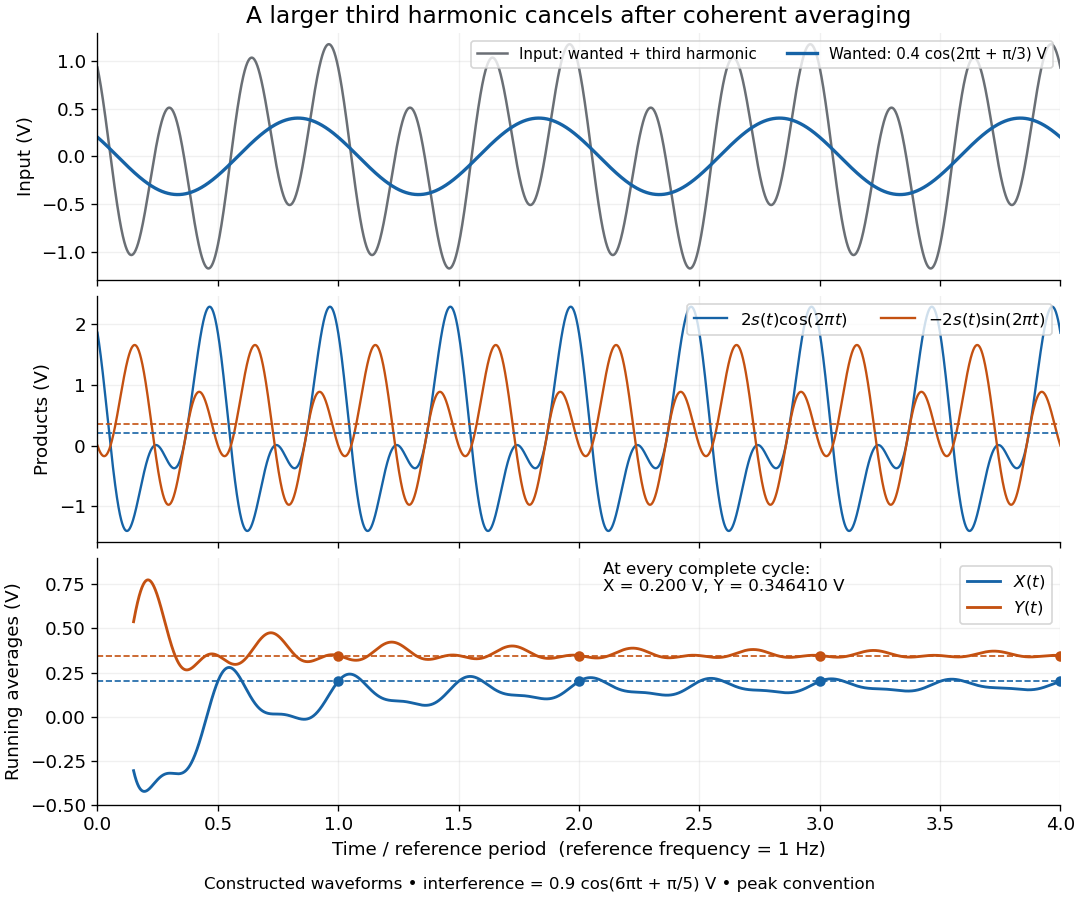

An unwanted component at the reference frequency survives. If is added to the input, its coordinate vector adds to the wanted one:For example, adding with to the wanted component gives , , , and phase difference . Longer averaging cannot separate these two synchronized contributions.
An observation interval of finite duration is not an infinitely sharp frequency selector. Combine the lock-in quadratures intoFor unwanted electric potential difference , where is an angular frequency offset and , expansion into complex exponentials gives the exact responseThe sinc function formula follows by integrating the exponential function and factoring ; its value at zero follows from a limit. The first term changes slowly after multiplication; the second oscillates at the sum frequency. It vanishes at exact matching when is an integer number of reference cycles, each lasting one period of a function, but cannot generally be discarded in a short-window calculation.
For and many reference cycles, the first term usually dominates: its modulus is and its complex argument includes . Thus gives almost no rejection. A longer observation separates closer frequencies, with the first zeros of this term at . Those zeros are not a brick-wall cutoff: the sinc function has nonzero lobes beyond them. At a synchronized contribution remains however large becomes.
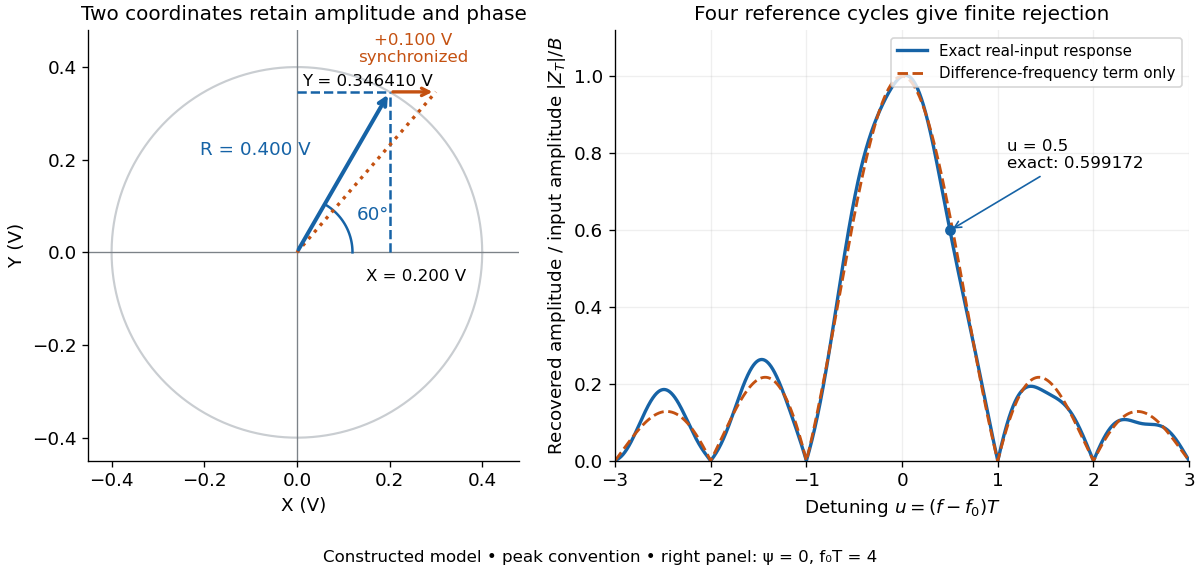

For a numerical check, use , , and an unwanted frequency . Then and the exact expression giveswhereas the difference-frequency term alone gives . An interference amplitude therefore contributes to in this constructed example. A nearby frequency can survive strongly even though the three-times-frequency component in lock-in harmonic rejection cancels exactly.
A practical lock-in amplifier's low-pass filter weights past products differently from this rectangular observation interval. Its time constant and roll-off determine near-reference rejection and settling time; narrowing detection slows the response.[ref]
Model SR830 DSP Lock-In Amplifier manual by Stanford Research Systems. Model SR830 DSP Lock-In Amplifier manual, printed p. 3-2, “Narrow band detection”; pp. 3-11–3-12, time constants and filter roll-off
The University of California, Berkeley guide LLS - Measuring the Light Signal from a Diode, in Experimental Setup and Experiments X–XI, documents an experiment using a red light-emitting diode amid room-light background. An optical chopper, controlled by an SR540, periodically interrupts its light. A PIN-10DP photodiode sends electric current to an SR570 preamplifier, which converts it to an electric potential difference for an SR760 spectrum analyzer and an SR830 lock-in amplifier. The SR540 supplies the external reference. Preparation includes aligning the photodiode and its shielding cone and choosing gain to avoid overload. One comparison first searches for the source frequency without the chopper reference, then checks against that external reference; switching off the LED tests the candidate spectral peak. The measurement procedure varies chopper frequency and preamplifier filtering, then records repeated lock-in readings with selected averaging settings. These are prescribed observations to make, not published numerical results.[ref]
LLS - Measuring the Light Signal from a Diode, University of California, Berkeley. LLS - Measuring the Light Signal from a Diode, Experimental Setup; Block Diagram I; Experiment X, steps 2 and 9–13; Experiment XI, steps 1–8
The guide notes nearly triangular chopping because slit and emitter sizes are comparable. Its interpretation requires detector conversion, preamplifier gain and waveform geometry to infer optical power from the selected component.[ref]
LLS - Measuring the Light Signal from a Diode, University of California, Berkeley. Experimental Setup, waveform discussion; Interpreting the Data, points 1–3 and collection-geometry discussion
The inference is therefore specific: synchronized electric potential difference supports the presence of a modulated optical component at the reference frequency. It does not by itself give total emitted optical power. The photodiode's spectral responsivity, collected fraction of the light, and conversion from the measured Fourier coefficient to the chopped waveform must enter that calibration. The finite-window lock-in response also explains why a frequency-search reading can drift when the reference is not synchronized. An LED-off comparison tests background at the same timing; it cannot guarantee that every synchronized disturbance disappears when the desired source is present. Overload before multiplication destroys information that later averaging cannot restore.
A spark gap separates two electrodes; sufficient electric potential difference can cause an electrical discharge through the intervening gas.
An induction coil uses a changing electric current and Faraday's law of induction to produce a high output electric potential difference.
The passive sign convention defines terminal electric potential difference and positive electric current entering at . Then is absorbed electrical power: positive means the component receives energy, negative means it supplies energy. Reversing both reference directions leaves the product unchanged. For a positive electrical resistance obeying Ohm's law, both and reverse together and Joule heating remains .
Electrical impedance is the ratio of terminal electric potential difference and electric current phasors at one specified positive angular frequency . For an electrical circuit modeled as a linear time-invariant system, use the sinusoidal steady state after any decaying transient has settled. With the passive sign convention, positive electric current enters the terminal assigned positive electric potential difference. Define peak complex amplitudes byThe physical and are real; the complex numbers encode their amplitudes and wave phases. The unit of electrical impedance is the ohm, . Both phasors may instead use root mean square magnitudes, with the same ratio . A nonlinear diode can generate additional frequencies; a single then does not describe the whole response.
Write the electrical impedance in Cartesian and polar forms asHere is the resistive real part, the signed electrical reactance, and the voltage-minus-current phase difference, defined modulo a full turn. The Pythagorean theorem gives the modulus from a right triangle in the complex plane. The complex argument gives the rotation from the current phasor to the voltage phasor. Thus , while negative means electric current leads terminal electric potential difference. For , lies between and ; outside that case, use the quadrant of the complex number rather than a bare inverse tangent. The geometric magnitude and phase difference are the two pieces of the AC relation.[ref]
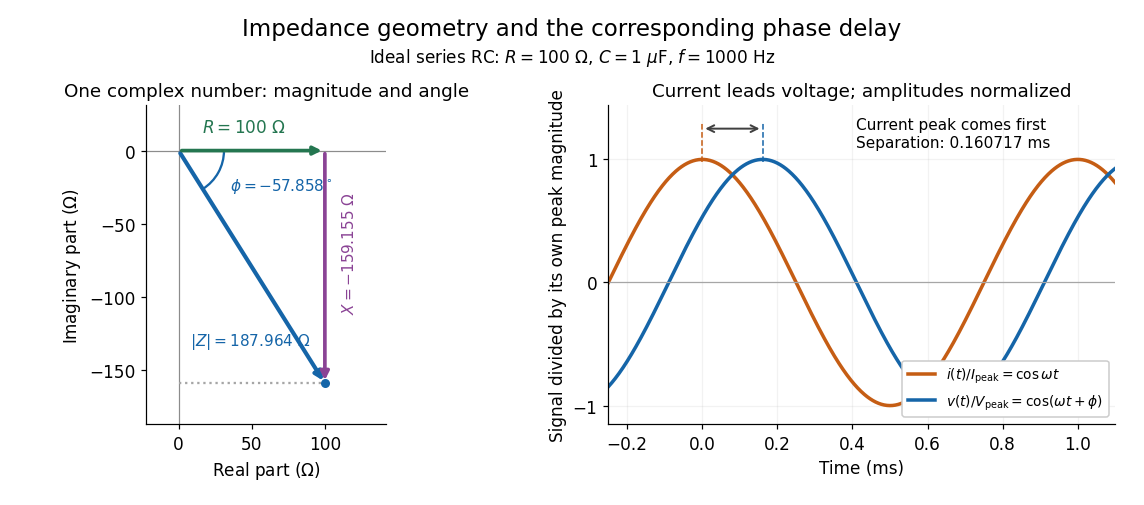

Multiplication by acts on phasors, not on instantaneous physical signals. For example, when ,The second term is in phase quadrature with electric current; it cannot be represented by pointwise multiplication when . This is the useful compression: one complex multiplication replaces separate amplitude and phase difference calculations, while the real part restores the physical signal.
An ideal resistor, inductor and capacitor have , and . Their electrical impedances add in a series RLC circuit, giving . The current amplitude is , so cancellation of the imaginary parts explains the resonant series RLC response. The component-law derivation and opposite complex exponential convention are in reactance phase convention.
For an ideal capacitor in series with a parallel resistor and inductor, . A finite positive frequency with real input impedance exists precisely when . At that frequency and . The resistor's voltage can exceed the source voltage because the reactive voltage drops cancel in the series sum; all average dissipation is still supplied by the source.
Two parallel branches with complex impedances and have a real input impedance , since their admittances have cancelling imaginary parts. For , adding a series resistance gives total impedance . With source voltage amplitude , each branch-resistor drop and the series-resistor drop has amplitude , despite their different phases.
The impedance magnitude of a linear electrical circuit in sinusoidal steady state is the ratio of voltage amplitude to electric current amplitude. For complex impedance , it is , whereas the dissipative electrical resistance is . Measuring only amplitudes does not separately determine and ; a phase shift measurement supplies the missing information.
Input impedance is the ratio of a small applied input-voltage phasor to the resulting input-current phasor, with the output termination and operating point specified. A finite input impedance loads a voltage source. For an ideal operational amplifier the input impedance is infinite, so neither input terminal draws current.
For a source with internal electrical impedance , conjugate matching maximizes delivered mean power when the source is fixed. For a purely resistive source and equal load electrical resistance , the load sees half the open-circuit voltage. A Johnson-Nyquist noise source with open-circuit mean-square voltage therefore delivers to the matched load, rather than .
A load matched to a source receives the maximum available power in the stated circuit model. For a real source resistance and open-circuit root mean square voltage , a load receives voltage and power . For complex impedances, maximum power transfer instead uses conjugate matching under the usual linear-source assumptions.
A Thévenin equivalent voltage source with positive source resistance supplies load power to a real resistive load. Differentiating gives its maximum at . With reactive impedances and fixed source impedance, conjugate matching maximizes the average delivered power. Maximum delivered power is distinct from maximum efficiency; at a real resistive match half of the source's internally generated power is dissipated in .
A lossless intermediate section of positive real characteristic impedance matches unequal real exterior characteristic impedances when and its propagation wave phase is an odd multiple of . The length is an odd quarter of the internal wavelength. This principle also applies to the characteristic impedance of a stretched string.
For a uniform intermediate string of length , put . Continuity of displacement and transverse force gives the displacement reflection coefficientAt real positive mechanical impedances, the denominator never vanishes. Its numerator vanishes only if and . Thus unequal exterior strings require the quarter-wave condition. Equal exterior strings with a different middle string instead transmit perfectly at integer half-wavelengths; if all three mechanical impedances agree, every frequency is matched.
A series circuit comprising electrical resistance and inductance , placed in a parallel circuit with capacitance , has electrical admittance . Vanishing imaginary part at nonzero angular frequency gives the displayed condition, requiring . It defines zero voltage-current phase difference, which need not coincide exactly with the maximum of impedance magnitude when loss is present. At this frequency the electrical impedance is real and equals .
For series resistance R and inductance L in parallel with capacitance C, suppose the applied voltage amplitude V is fixed. The DC current gives . If the high-frequency current is , then . At the nonzero zero-phase frequency, current amplitude determines . The condition must hold. The inferred zero-phase frequency is ; it is not automatically the exact frequency of minimum current magnitude.
The reciprocal of electrical impedance, relating electric current and electric potential difference phasors by . Its unit is the siemens, . Electrical admittances add for branches in a parallel circuit.
In the phasor convention, electrical admittance is , with conductance and electrical susceptance . An ideal capacitor has and an ideal inductor has . electrical susceptances add for parallel branches; their cancellation gives a purely resistive input admittance.
Consider a stipulated series circuit containing an ideal resistor of electrical resistance and an ideal capacitor of capacitance . The same electric current passes through both. Their terminal electric potential differences add by Kirchhoff's voltage law, soA quick derivation uses : taking the derivative of the complex exponential multiplies the capacitor voltage phasor by , hence . Dimensionally, has units , matching .
At frequency , the angular frequency is . The signed capacitive electrical reactance, modulus and complex argument of the total electrical impedance areApply across the complete series circuit. Its root mean square electric current isWith voltage as the zero-phase reference, the current phasor has complex argument : electric current leads. The phasor drops have moduli and ; these add as complex numbers, not as positive magnitudes. Their squared magnitudes sum to .
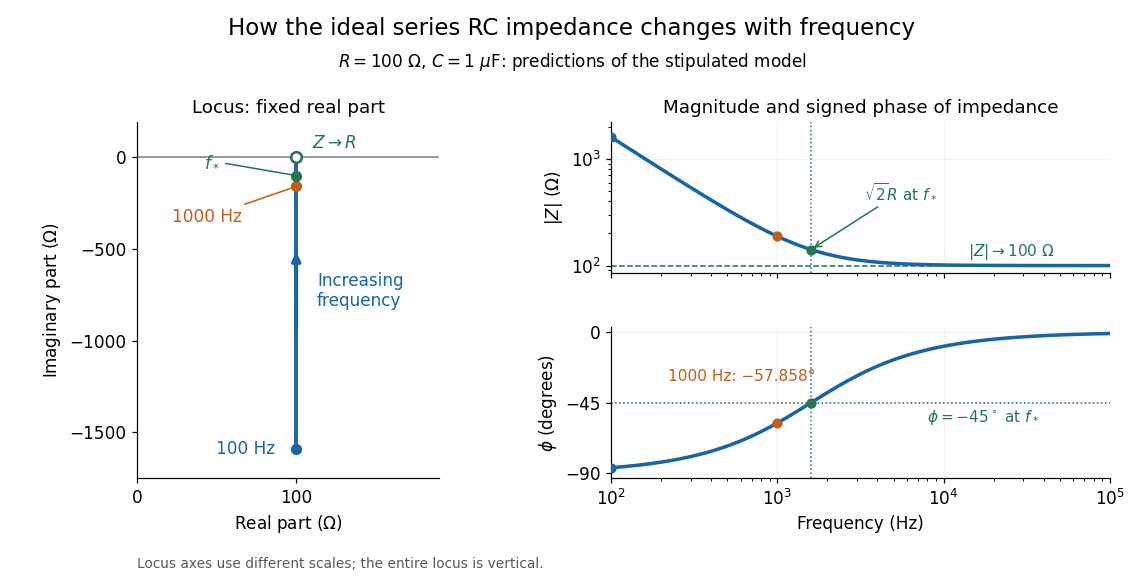

The mean absorbed power uses the root mean square values:The ideal capacitor has zero cycle-averaged absorbed power; all the mean absorbed power becomes Joule heating in the resistor.[ref]
University Physics Volume 2 by Samuel J. Ling and others. §15.4, equations 15.12–15.14 and the capacitor/inductor paragraph: RMS average power and zero ideal reactive average power
To see why the phase factor appears, average over a full cycle with and . The cosine addition formula reduces the average to ; the term at averages to zero. Independently, , and the capacitor energy returns to its starting value after each cycle.At fixed applied , the limit gives , and : the ideal capacitor blocks steady electric current. The limit gives , and . These are limits of the ideal lumped electrical circuit; unwanted lead inductance and component losses can invalidate that model at high frequency. At , the equal legs of the impedance right triangle give and without numerical evaluation. Measuring both the magnitude and the sign of the phase difference distinguishes this capacitor response from an equally large positive electrical reactance.
An actual teaching experiment turns the phasor definition into readings. Leipzig University's laboratory handout Measurements with an oscilloscope, experiment E 3e, uses a function generator, a two-channel oscilloscope, a known resistor and a capacitor. Figure 5 places the capacitor above the resistor, with a common return below the resistor. Channel 1 measures the applied terminal electric potential difference ; channel 2 measures . The handout asks for peak-to-peak values and relative timing, then comparison of measured and calculated electrical impedances with , at and . It also asks students to check the oscilloscope time base against a digitally counted generator frequency. These are apparatus and procedural specifications, not reported measured results.[ref]
Measurements with an oscilloscope, experiment E 3e, Physikalisches Grundpraktikum, Universität Leipzig. Measurements with an oscilloscope, E 3e, p. 1 tasks 1 and 4; pp. 5–6 Measurement of impedances, figure 5 and experimental comparison
For this arrangement, Ohm's law gives if probe loading and the sensing resistor's electrical reactance are negligible. Record both voltage magnitudes with the same convention: peak, peak-to-peak, or root mean square. After the transient settles, compare matched rising zero crossings of and of , with period . ThenThe recovered electrical impedance includes the known resistor. For a separate unknown component in series with that resistor, subtract from the inferred total electrical impedance. A current crossing earlier than the applied voltage crossing gives , hence negative . For the stipulated series RC impedance example at , this predicts ; it is a calculated timing, not a lab observation. Timing supplies the complex argument that an amplitude ratio alone cannot recover.
As additional measurement controls, first feed the same sinusoid to both channels to check relative delay and polarity; then replace the reactive chain with a known resistor, expecting nearly zero phase difference. Keep both probe returns at the common return shown in figure 5. A reversed voltage polarity adds half a turn to its inferred wave phase. Match crossings with the same slope and choose ; adjacent cycles otherwise change by a full turn. A sweep continuous in frequency helps track that branch. These controls test the signed inference rather than assuming that the scope's delay readout has the desired sign.
Measure the loaded terminal electric potential difference on channel 1 at every frequency. The generator's output impedance can change the applied magnitude; its front-panel setting is not the measured terminal value. The generator's internal electrical impedance is outside the terminal ratio above, while the known sensing resistor is inside it. Probe loading, finite timing resolution, component tolerances and distorted waveforms limit the inference. A repeat at lower drive amplitude tests whether one linear electrical impedance still fits. Electrical reactance bench measurement develops these loading and reference-direction issues further.
Electrical reactance is the signed imaginary part of electrical impedance , measured in ohms. It describes the part of the terminal electric potential difference in phase quadrature with the electric current in a sinusoidal steady state. In the convention, an ideal inductor has and an ideal capacitor has for . A large reduces electric current at fixed applied voltage, but an ideal purely reactive component returns the energy it receives over each cycle. This is why electrical reactance and electrical resistance have the same units yet describe different physical behavior. [ref]
https://www.feynmanlectures.caltech.edu/II_22.html#Ch22-S5. Feynman, Leighton and Sands, The Feynman Lectures on Physics, II.22.5: resistance, reactance and energy loss
.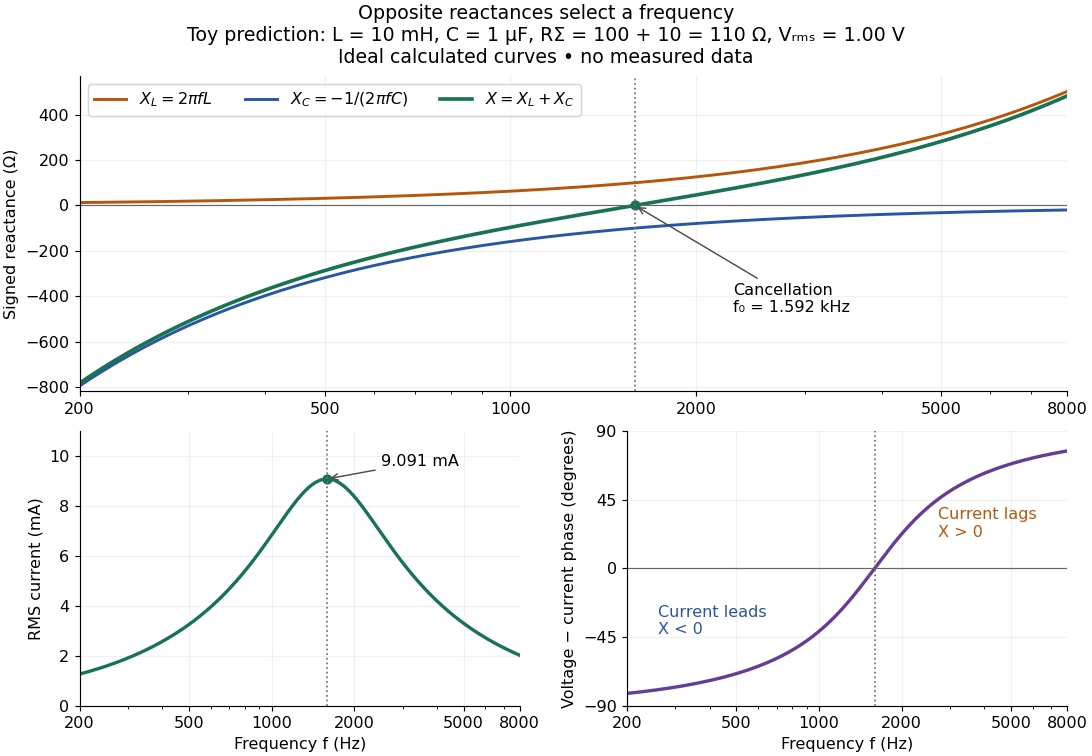

In a series RLC circuit, electrical impedances add because the same electric current passes through every component. For ideal positive inductance , capacitance , and total electrical resistance ,Here is voltage wave phase minus current wave phase. Below , and electric current leads terminal voltage; above it, and electric current lags. At , the two signed electrical reactances cancel, leaving and the maximum electric current at fixed terminal voltage. This is the resonant series RLC response. Electrical resistance does not cancel: the toy circuit gives and there. These numbers follow directly from the stipulated component values. [ref]
University Physics Volume 2 by Samuel J. Ling and others. Ling, Moebs and Sanny, University Physics 2, §15.3: series impedance and resonance
.Cancellation concerns terminal voltage, not the disappearance of stored energy. In the toy circuit at resonance, the individual inductor and capacitor voltages are each in root mean square magnitude, with opposite wave phases, while their sum is zero. Their peak stored magnetic energy and capacitor energy are each , attained at different times. With smaller positive , either component voltage can exceed the applied voltage. This ability to select a frequency while sustaining internal energy exchange connects electrical reactance to tuning and frequency response.
For an ideal inductor or capacitor, the absorbed instantaneous power equals the rate of change of stored energy:Positive power stores energy; negative power returns it. Over a periodic steady state, each stored energy returns to its initial value, so its cycle-averaged absorbed power is zero. An ideal resistor instead has , transferring energy into Joule heating. More generally, the average terminal power of this series RLC circuit isZero average power in an ideal reactive component does not imply zero instantaneous power, zero electric current, or zero stored energy. Real coils and capacitors have losses, so zero ideal reactive loss is a model assumption rather than a claim about every component. [ref]
University Physics Volume 2 by Samuel J. Ling and others. Ling, Moebs and Sanny, University Physics 2, §15.4: instantaneous and average AC power
.Use complex amplitudes only for signals at one common positive angular frequency . Define the real terminal voltage and electric current byThe complex amplitudes here use peak magnitudes; both can instead use root mean square magnitudes without changing their ratio. Choose positive electric current entering the terminal assigned positive voltage, so is absorbed power. For an ideal linear inductor and capacitor, their terminal laws and giveThe derivative multiplies a complex amplitude by : this single algebraic step explains both signs. Taking as a reference gives and for the sinusoidal response. Thus inductor voltage leads electric current by , while capacitor voltage lags electric current by . A constant offset or a free transient is outside this single-frequency representation. [ref]
https://www.feynmanlectures.caltech.edu/II_22.html#Ch22-S1. Feynman, Leighton and Sands, II.22.1: complex sinusoidal representation and component impedances
.With the alternative convention, the same real signals use conjugated complex amplitudes and , . Their physical leads and lags stay the same; the sign of changes. Also, some textbooks call the positive magnitude the capacitive reactance and write the series expression as . This article consistently uses signed and hence . [ref]
https://openstax.org/books/university-physics-volume-2/pages/15-2-simple-ac-circuits. Ling, Moebs and Sanny, University Physics 2, §15.2: positive capacitive-reactance magnitude and quarter-cycle phase relations
.The motivating observation is a pair of sinusoids on an oscilloscope: changing frequency changes both their relative amplitudes and their phase difference. Gary Tuttle's EE 201 laboratory uses resistor voltage as the current-phase reference, compares predictions with readings at several frequencies, and explicitly asks students to measure component values and account for coil electrical resistance. The following bench arrangement applies that method to a series RLC circuit; its component values and illustrated traces are our own toy example. [ref]
https://gtuttle.net/circuits/lab/ac_circuits_1.pdf. Gary Tuttle, EE 201 Lab 9: AC circuits, especially the notes and RC/RL measurements
.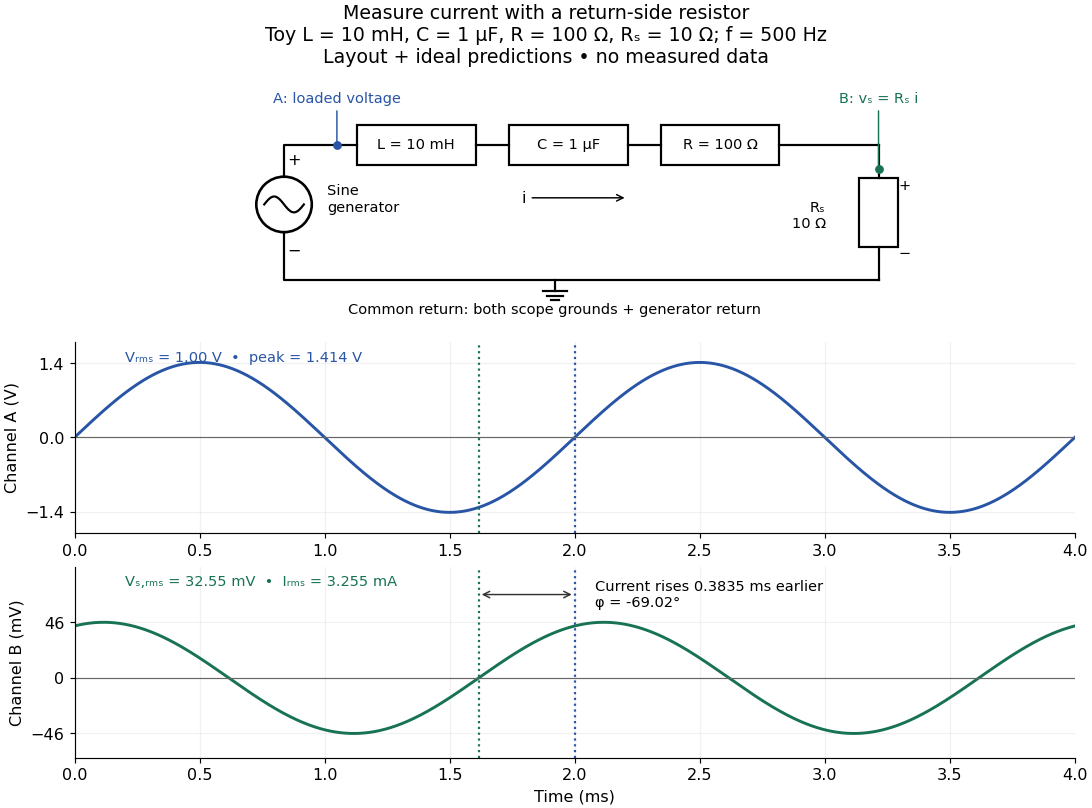
Toy AC bench arrangement and predicted voltage/current timing
. Top: a sine generator drives ideal , , , and current-sensing in series. Channel A measures loaded terminal voltage; channel B measures relative to the common return. Bottom: calculated separate voltage traces at and terminal , not an oscilloscope recording or measured data. The rising zero of channel B occurs earlier: and predicted . The two trace axes have different voltage scales. Details.
Connect a low-voltage sine generator to a series chain ending in a known sensing resistor at the common return. Use a resistor whose unwanted inductance is negligible over the chosen frequency range. An oscilloscope displays voltage against time: channel A reads the loaded voltage across the whole chain, and channel B reads the voltage across . Both channel ground connections and the generator return meet at that same node. Ordinary bench oscilloscope grounds are electrically common; attaching one to an intermediate circuit node would change the circuit. A separate floating component voltage needs a suitable differential measurement, rather than moving a ground clip. [ref]
https://www.tek.com/en/documents/technical-brief/floating-oscilloscope-measurements-and-operator-protection. Tektronix, Floating Oscilloscope Measurements and Operator Protection: ground-referenced inputs
.After the free transient decays, record frequency , period , both voltage amplitudes, and matched rising zero-crossing times . Check that the traces are sinusoidal. Define on the branch . With negligible probe loading and negligible sensing-resistor electrical reactance, , so channel B is the electric current reference, and in the reactance phase conventionA later current crossing gives , hence positive electrical reactance; an earlier crossing gives negative electrical reactance. Use the same amplitude convention for both channels. An amplitude-only ratio recovers , so it cannot distinguish the two signs: timing supplies the missing information. The formulas follow from and the chosen terminal orientation.
Begin with a known resistor replacing the reactive chain: its expected phase difference is approximately zero, testing channel polarity and relative delay. Measure the same signal with both channels to establish the instrumental delay baseline, then exchange probes to check that a phase offset does not belong to one channel. Next test an inductor and a capacitor separately with : after subtracting from the inferred real part, expect approximately and , respectively. Finally combine and sweep through the predicted resonance. These are proposed controls and consequences of the model, not reported observations.
For the toy series RLC circuit, the prediction at is , , , and . At , and . Near the model predicts zero phase difference and . Keep actual loaded fixed or normalize by it at each frequency; the generator's display alone does not establish that voltage. The sensing resistor is part of the total and therefore changes the predicted peak electric current.
Real components add unintended electrical impedance: coil wire has electrical resistance, nearby turns add capacitance, and capacitor leads add inductance. These effects can produce a component's own resonance, beyond which the ideal or approximation fails. Work in a range where that approximation is adequate, measure coil wire electrical resistance, and compare the inferred with the sensing resistor, intended resistor, and component losses. A measured nonzero real part is evidence of loss in the assembly, not negative or positive electrical reactance becoming heat. [ref]
https://www.keysight.com.cn/cn/zh/assets/7018-06840/application-notes/5950-3000.pdf. Keysight, Impedance Measurement Handbook, §§1.5.1 and 5.2.1: component frequency response and parasitic elements
; [ref]https://gtuttle.net/circuits/lab/ac_circuits_1.pdf. Tuttle, EE 201 Lab 9: parasitic coil series resistance
.The probes also add electrical resistance and capacitance to the measured nodes; their loading becomes more important as frequency increases. Use compensated probes with known input electrical impedance and short ground connections, and repeat with a smaller drive voltage to test whether the inferred depends on amplitude. [ref]
https://www.tek.com/en/documents/application-note/how-oscilloscope-probes-affect-your-measurement. Tektronix, How Oscilloscope Probes Affect Your Measurement: resistive and capacitive loading
. Record actual voltage and phase readings separately from calculated predictions, with component tolerances and timing uncertainty. A phase error alone produces approximately , so near zero electrical reactance, a small delay can imitate a small residual . Agreement within stated uncertainties tests the model; the smooth toy curves establish no experimental accuracy. Articles were limited to the first 100 out of 161 total.
Articles by others on the same topic
There are currently no matching articles.