
Two square matrices over the same field are similar if for an invertible matrix . They can describe one linear operator using two different ordered bases, with the same basis used for input and output in each description. Fix the convention : is the old coordinate vector, the new coordinate vector, and the columns of are the new basis vectors in old coordinates. This is the convention of the change-of-basis matrix.[ref]
Linear Algebra Done Right by Sheldon Axler (4th edition). §3D, Theorem 3.84, printed p. 93: change-of-basis formula; the matrix there converts in the opposite direction to our
For a concrete linear operator on the physical plane, let double horizontal components and multiply vertical components by five. In the old standard basis , its matrix of a linear map is . Choose the new ordered basis with , . ThenThe second column of says . Its off-diagonal entry records how the chosen basis vectors describe the output; the physical linear operator still stretches along the old horizontal and vertical directions.
Take the physical vector . Its two coordinate vectors, and the two descriptions of , areReconstruction gives . The output coordinate vectors differ, but the endpoint in the physical plane is the same.
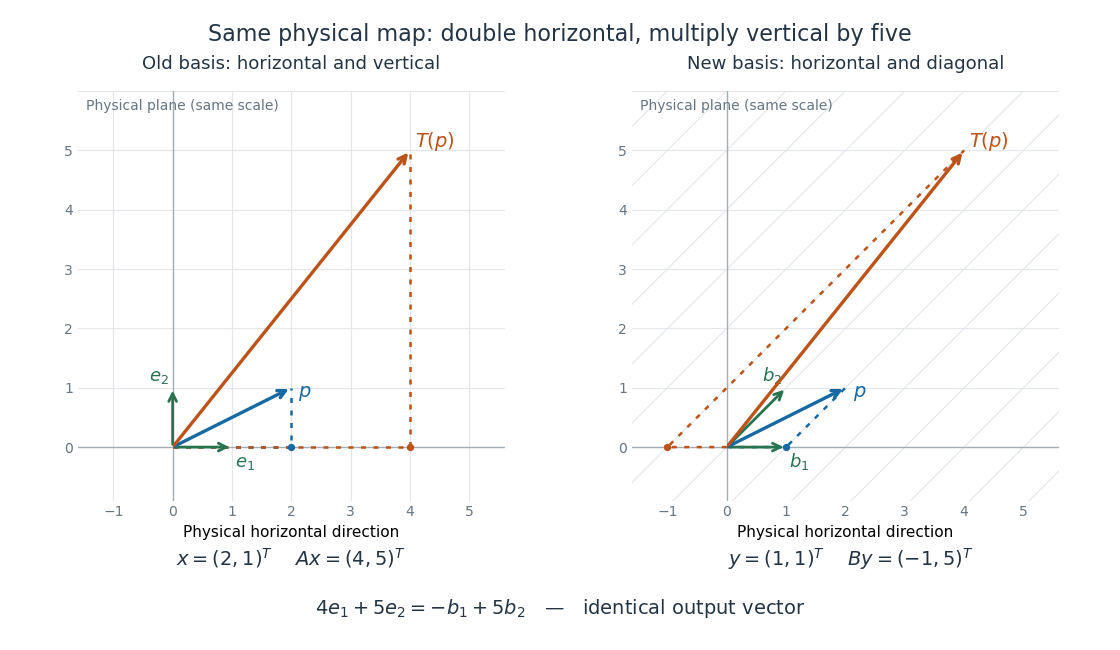
One linear operator and the same two physical vectors described in a standard basis and an oblique basis
. Both panels use the same physical plane and scale. The blue arrow is , and the orange arrow is . Dotted paths reconstruct them from their respective basis vectors; the right grid follows , . Details.This is why matrix similarity is useful: a convenient basis can simplify calculations without changing the linear operator. A diagonalizable matrix can be replaced by a diagonal matrix, making repeated application a calculation with powers of its eigenvalues. In the example, makes the two independent stretch factors visible, while expresses the same action in directions chosen for another purpose. Matrix similarity invariants separate properties of the linear operator from features of its address system.

Matrix similarity is an important concept in linear algebra that describes a relationship between two square matrices. Two matrices \( A \) and \( B \) are said to be similar if there exists an invertible matrix \( P \) such that: \[ B = P^{-1} A P \] In this expression: - \( A \) is the original matrix. - \( B \) is the matrix that is similar to \( A \).


New to topics? Read the docs here!