An -by- square matrix over a field is invertible when it has a two-sided matrix inverse. Equivalently, its linear map is a bijection: every output comes from exactly one input. For a square matrix, the following conditions are equivalent:Here matrix rank means both full column rank and full row rank. The square hypothesis matters: a rectangular matrix can have full column rank without reaching every output, or full row rank without determining every input.[ref]
https://ocw.mit.edu/courses/18-06-linear-algebra-spring-2010/resources/lecture-3-multiplication-and-inverse-matrices/. Strang, MIT 18.06 Lecture 3: multiplication and inverse matrices
The equivalences explain why invertibility is a question about retaining information. A trivial kernel makes the linear map injective; the rank-nullity theorem then gives matrix rank , so its columns form a basis and the linear map is also surjective. Assigning to each output its unique input gives a linear map: the preimage of is . The determinant is nonzero precisely when the columns are linearly independent. Thus algebraic solvability and independent directions describe the same phenomenon; over the real numbers, nonzero oriented volume supplies its geometric interpretation.
Let be finite square matrices over a field and write with . If , then . Taking determinants proves is an invertible matrix, and rearrangement gives . Thus commutes with . If , then and , proving an explicit eigenvalue transfer. The argument avoids assuming commutation before proving it; it depends on square finite-dimensional matrices, where a right inverse is two-sided.
Let be a real square matrix and suppose for every real vector , with . The Cauchy-Schwarz inequality gives , hence for all . In particular the kernel is zero, so is an invertible matrix. Applying the bound to gives the operator norm estimate in the Euclidean norm.
Symmetry of is unnecessary: for its symmetric part of a matrix . Thus the hypothesis is exactly a positive lower bound on that symmetric matrix, even when the antisymmetric part is nonzero.
An square matrix over a field, with , is singular when it has no matrix inverse. Geometrically, its linear map loses at least one input direction: some nonzero vector satisfies , so . Over the real numbers, the following family makes that loss visible:
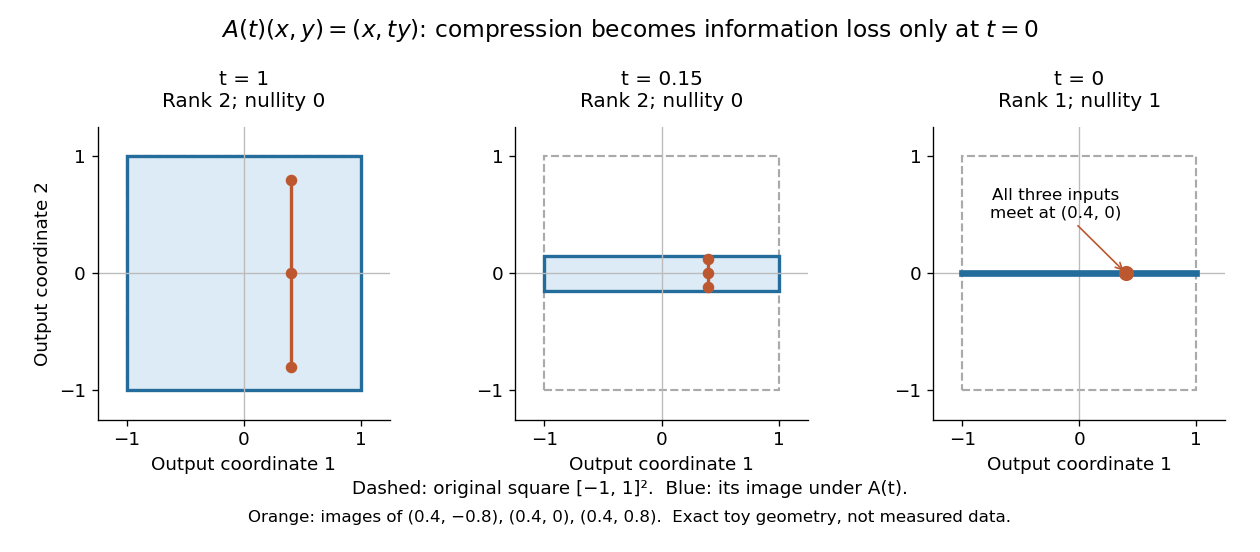
Compression by becomes collapse only at
. The square retains two-dimensional extent for and , but maps to a segment at . The orange points come from three inputs with the same first coordinate and different second coordinates. They coincide only at . This is exact illustrative geometry, not measured data. Details.For this diagonal matrix, . Whenever , the input can be recovered as and the kernel is . At , the kernel becomes : the entire second coordinate is forgotten. Consequently has no solution if , and has the solution straight line , , if . A singular matrix therefore need not make a particular linear system inconsistent; it prevents unique recovery when that linear system is consistent.
For an square matrix, all these tests describe the same failure:Here is the field of scalars. Equivalently, the columns are linearly dependent, the linear map is neither injective nor surjective, and some outputs cannot be reached. See the invertible matrix equivalences and Strang's MIT 18.06SC lecture summary, Multiplication and inverse matrices, p. 2. Over an infinite field, every consistent linear system for a singular matrix has infinitely many solutions; over a finite field with elements and nullity , it has exactly solutions. This follows by adding each kernel vector to one solution.
The square hypothesis is essential. For an matrix, injectivity means matrix rank (full column rank), whereas surjectivity means matrix rank (full row rank). A rectangular matrix can satisfy one condition without the other; its kernel and image of a linear map give the useful tests without calling it a singular matrix.
Exact singularity also differs from sensitivity. For , is an invertible matrix, but its smallest singular value is and its condition number in Euclidean norm is . A change changes the recovered input by : with and , an output change of causes an input change of . These are exact toy values, not measurements. The condition number quantifies this sensitivity before a direction is lost; see Steve Marschner, Condition numbers, §2. A small determinant alone is not a reliable sensitivity test: has determinant yet condition number one for every nonzero real , since both singular values shrink equally.
Let be an invertible matrix and a real square matrix of the same odd order. If the displayed identity holds, multiply it on the left by to obtain . Taking determinants givesThus . Since is real, the first factor is positive, forcing to be a singular matrix. Both odd dimension and reality matter: an invertible real antisymmetric matrix exists in even dimension, while over the complex numbers a squared determinant can equal .
Articles by others on the same topic

An **invertible matrix** (also known as a non-singular matrix or non-degenerate matrix) is a square matrix \( A \) that has an inverse. This means there exists another matrix \( B \) such that: \[ AB = BA = I \] where \( I \) is the identity matrix of the same dimension as \( A \). A matrix is invertible if and only if its determinant is non-zero (i.e.


The set of all invertible matrices forms a group: the general linear group with matrix multiplication. Non-invertible matrices don't form a group due to the lack of inverse.