
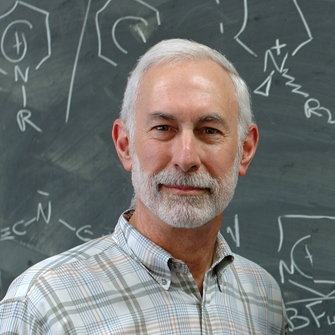
Michael D. Fayer is a physical chemist studying molecular dynamics with ultrafast optical methods. His Stanford-hosted curriculum vitae explicitly gives this name; the D. is retained without further expansion. His research description connects two-dimensional infrared spectroscopy with molecular interactions in liquids, confined water and other structured materials.[ref]
Michael D. Fayer profile and curriculum vitae at Stanford. CV, heading and Principal Research Interests; profile, Bio
With Kyungwon Kwak, Sungnam Park and Ilya J. Finkelstein, Michael D. Fayer coauthored the 2007 center-line method for extracting dynamical information from two-dimensional infrared spectroscopy. This is a shared paper contribution, not evidence for separate individual experimental roles.[ref]
The scientific question can be illustrated by an original frequency-fluctuation model. Let be the deviation of a molecular vibrational frequency from its mean, and suppose its vibrational frequency-frequency correlation function isThe normalized memory is . With stipulated , it falls to about 0.368 after 3 ps and 0.0498 after 9 ps. An ordinary mean frequency would not reveal that memory time. These are model calculations, not measurements of confined water.
In the vibrational photon echo approach, controlled optical pulse delays connect an initial frequency label with a later response. The 2D IR center-line slope helps summarize changing spectral geometry. Interpreting that observable as molecular memory requires the response assumptions and axis convention; a slope fitted to arbitrary data is not automatically .
That distinction connects apparatus with theory. Pulse timing, the infrared spectroscopy response and a model of environmental fluctuations all enter the inverse problem. Measurements can constrain how a molecular environment changes while leaving multiple microscopic explanations possible. Michael D. Fayer's Stanford research description explicitly places theoretical analysis alongside the experiments.[ref]
Michael D. Fayer profile and curriculum vitae at Stanford. profile, Bio; CV, Principal Research Interests
New to topics? Read the docs here!