
For coprime integers with , the multiplicative order is the least positive integer such thatIt counts the distinct powers in the cyclic subgroup generated by the congruence class of . Thus it is an order of a group element in the unit group .[ref]
A Computational Introduction to Number Theory and Algebra by Victor Shoup. pp. 153 and 156–157, Theorem 6.29
For example, the modular exponentiation , starting at , produces . The first return to one takes three steps, so . Starting at the congruence class three and repeatedly multiplying by two instead gives : these are the other three units modulo seven, outside the cyclic subgroup generated by two.
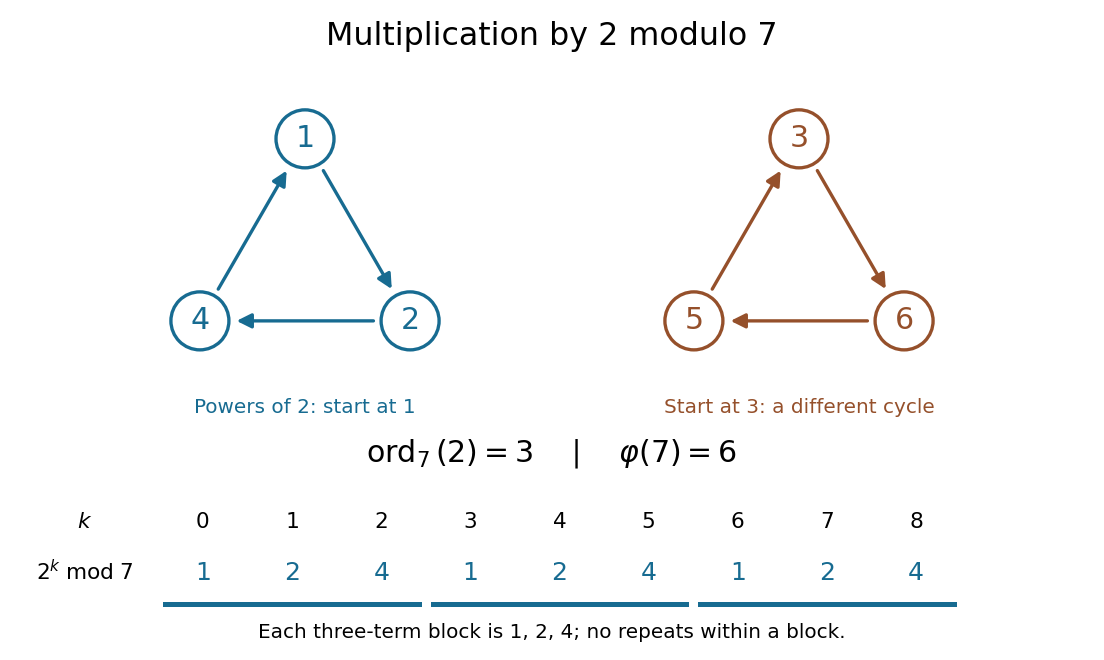
Euler's theorem guarantees a return to one at exponent , where is Euler's totient function. Thus the multiplicative order exists for every unit.[ref]
Euler’s Theorem by Keith Conrad. p. 1, Theorem 1.2; pp. 2–3, permutation of the units and cancellation
In fact,By Lagrange's theorem, the size of the cyclic subgroup divides the size of the unit group, which is Euler's totient function. For two modulo seven, this is ; the multiplicative order need not equal Euler's totient function. If , its multiplicative order is one.The coprime integers hypothesis is necessary: if , any common divisor of and divides one. For instance, powers of two modulo eight give , with no positive-exponent return to one. This sequence eventually settles, but two has no multiplicative order modulo eight.


The multiplicative order of an integer \( a \) modulo \( n \) is defined as the smallest positive integer \( k \) such that \[ a^k \equiv 1 \mod n. \] In simpler terms, it is the smallest exponent \( k \) for which raising \( a \) to the power of \( k \) results in a value that, when divided by \( n \), leaves a remainder of 1.
New to topics? Read the docs here!