Nested interval theorem
ID: nested-interval-theorem

If are nonempty closed intervals with finite endpoints, then at least one real number belongs to every member. If their lengths tend to zero, exactly one real number belongs to every member. The result turns an unlimited sequence of consistent enclosures into an existence guarantee.
Write . Nesting makes the left endpoints nondecreasing and the right endpoints nonincreasing. Their bounds give finite supremum and infimum, withIndeed, every is an upper bound for all the , so the least-upper-bound property gives for every . This proves the displayed interval is nonempty. If , its two endpoints must coincide. This is the connection to the completeness of the real numbers discussed in Günther Hörmann and David Langer, Einführung in die Analysis, §§3.15–3.16: nested intervals and order completeness.
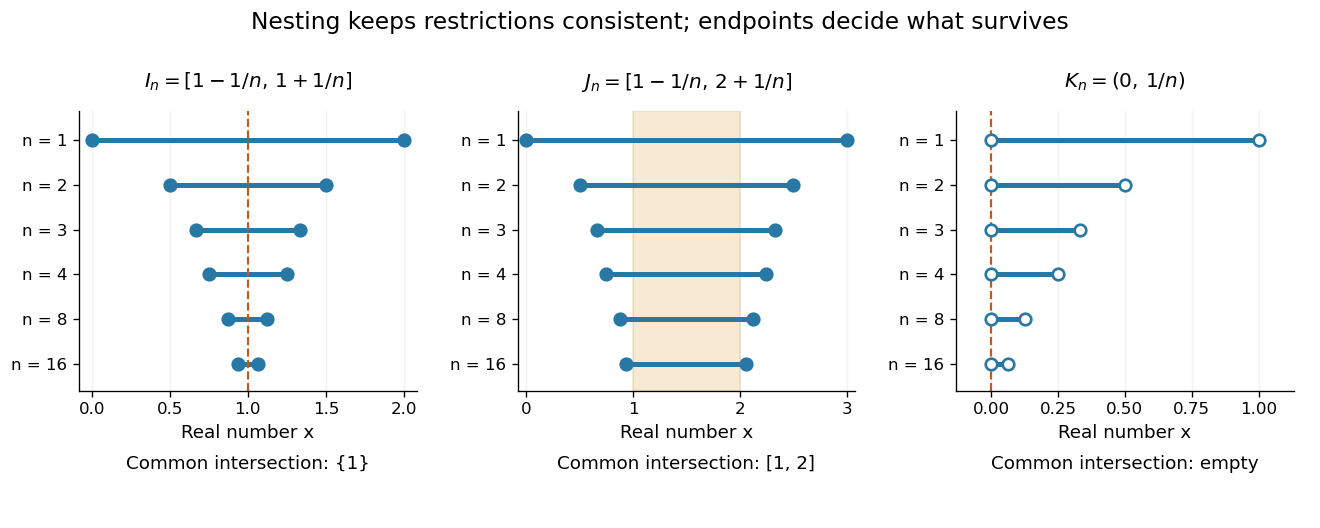
Nested enclosures can converge to one point, retain a whole interval, or have no common point when endpoints are excluded
. Details. 
The distinction between existence and uniqueness is useful in computation. If an unknown point lies in every , the midpoint satisfiesThus the enclosure itself certifies an absolute error without knowing the answer. The bisection error bound is the special case where each update halves the width.
Closedness and a finite initial enclosure matter. The open intervals have no common point, while the closed but unbounded intervals also have empty intersection. A picture of a few intervals cannot certify the intersection of an infinite family; the hypotheses of the nested interval theorem do that work.
New to topics? Read the docs here!