For a nonempty set , a real number is its supremum precisely when it is an upper bound and no smaller real number is an upper bound. It is unique: two least upper bounds must each be no greater than the other.
For , every number at least one is an upper bound, and none smaller than one bounds the whole set. Thus , although . For , that same supremum is also the maximum. The approximation property of a supremum supplies witnesses arbitrarily close to an unattained upper edge.
Let be nonempty sets of real numbers bounded above. Their Minkowski sum is , allowing every pair from the Cartesian product . ThenThe sum of the two suprema is an upper bound for every permitted sum. For the reverse bound, use the approximation property of a supremum to choose and . Their sum is within of the claimed value. This reasoning does not require either supremum to be a maximum.
Separate choices matter. On , choose the functions and . Each has supremum one, but their sum at a shared input is always one:The maximum of occurs at , while that of occurs at . A common input cannot realize both choices. With separate inputs, choosing and gives . The allowed pairs of output values are the entire unit square for separate inputs, but only the line segment for the shared input.
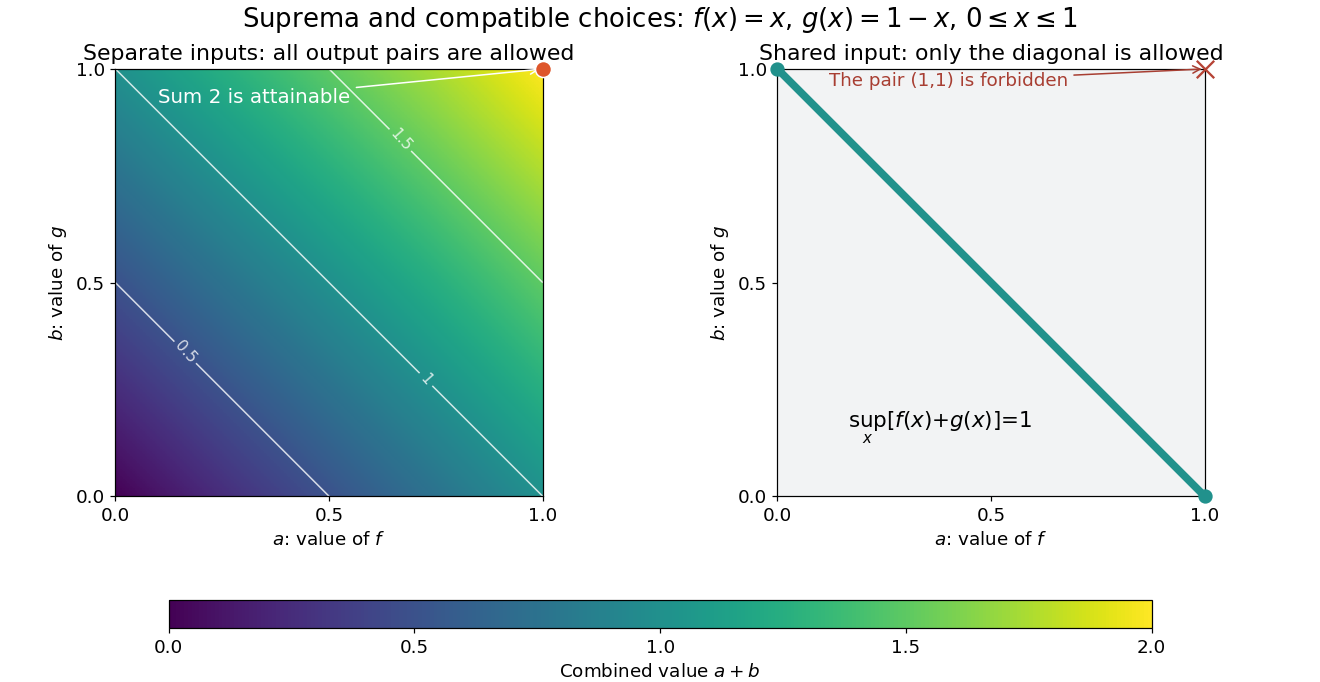

For any two bounded functions on the same nonempty domain of a function, the useful general estimate isThe inequality can be strict, as the example shows. Equality does not require attained maxima, but it does require that the two large values can be approached at compatible inputs. For example, on gives equality with value two, although neither function reaches its supremum. This distinction is useful when an objective function combines terms sharing a decision variable: adding the best possible termwise scores gives an upper bound, not necessarily a feasible combined score.
Suppose are bounded functions on the same nonempty set, and the supremum norm of their difference is at most . Then their optimal values differ by at most the same amount:Indeed, for every , so ; exchange and for the other direction. Adding a constant shifts a supremum by that constant, a basic compatibility between upper bounds and addition.[ref]
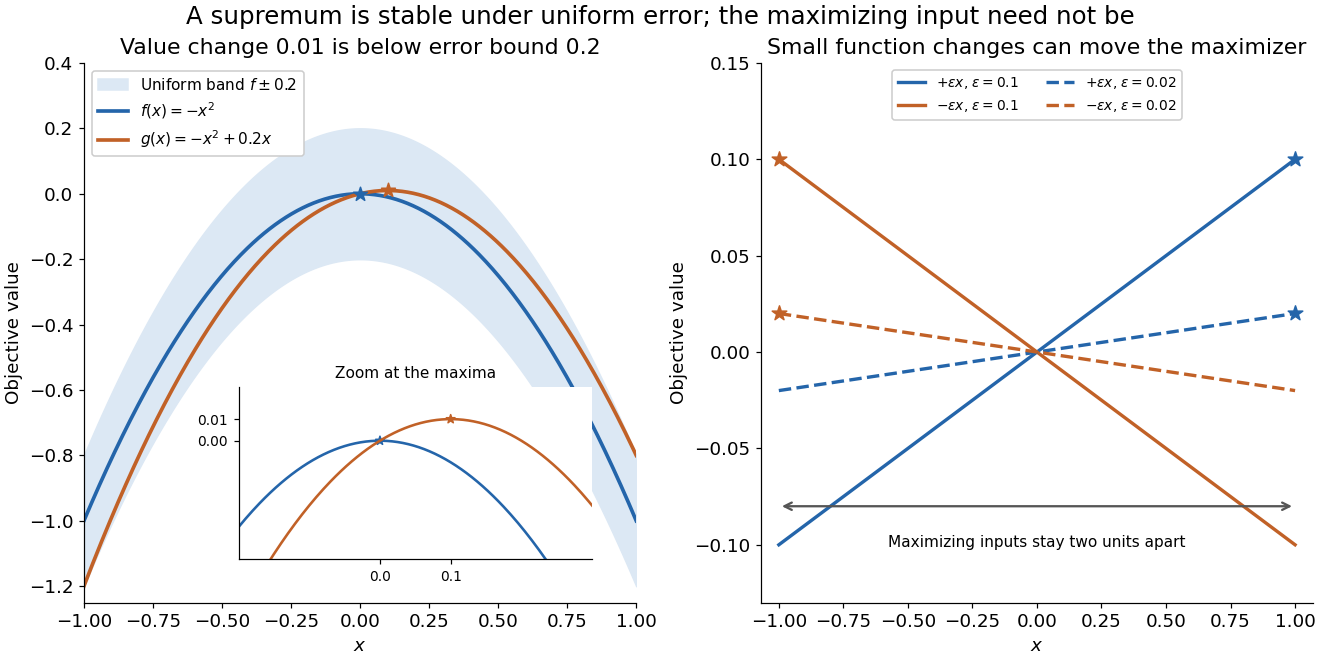
For a chosen example on , take and . Their supremum error is , since . Completing the square givesThus has maximum zero at , while has maximum at . The change in optimal value, , is smaller than the certified bound . For the vertical translation , the bound is exact: its supremum error and optimal-value change are both .
Uniform error controls the optimal value; maximizing inputs require additional control
. Original polynomial examples on . Left: and lie within a vertical error band of , while their maxima differ by . Right: the small tilts and have maximizing inputs and for every ; solid lines use and dashed lines use . These chosen examples are not measured errors or claims about an arbitrary optimizer. Details.
A stable optimal value does not guarantee a stable maximizing input. On , the two linear functions and satisfyFor every positive , their unique maximizing inputs remain two units apart, at and . Both functions approach the flat zero function, which has many maximizing inputs. Consequently an accurate objective function value is not by itself a certificate that the optimizing decision is accurate.
The estimate also gives a convenient consequence of uniform convergence. If converges uniformly to a bounded function on a nonempty , then for the bounded tail of the sequence. Uniform control handles the changing input that defines the best value. Pointwise convergence alone supplies no such control; the existing examples under uniform convergence illustrate that distinction.
Let be nonempty and bounded above. An upper bound equals exactly when, for every , some satisfies . If no such member existed, would be a smaller upper bound. Conversely, the condition defeats every proposed upper bound by taking . [ref]
1.2 The set of real numbers. Basic Analysis: Introduction to Real Analysis, Volume I by Jiří Lebl; Lebl, Basic Analysis I, §1.2: approximation of a supremum
.For and , is one witness: . Choosing with produces a sequence converging to by the squeeze theorem. The choices need not form a monotone sequence.
If a nonempty real set has finite supremum and , then every interval contains infinitely many elements of . Otherwise its finitely many elements have a largest value ; all remaining elements are at most , making an upper bound. The interval cannot be empty either, by the defining approximation property of a supremum. Thus failure to attain a finite supremum forces accumulation from below.
Articles by others on the same topic
There are currently no matching articles.