In exact arithmetic, after completed halvings the retained root bracket has width and midpoint , whereThe absolute value bound holds for every zero of a function in the current root bracket, including the one approached by continued bisection method updates. A zero of a function discarded with an earlier half need not satisfy later bounds. Before update , the evaluated candidate is , whose corresponding guarantee is . After update , the new midpoint has the smaller guarantee , even without evaluating .
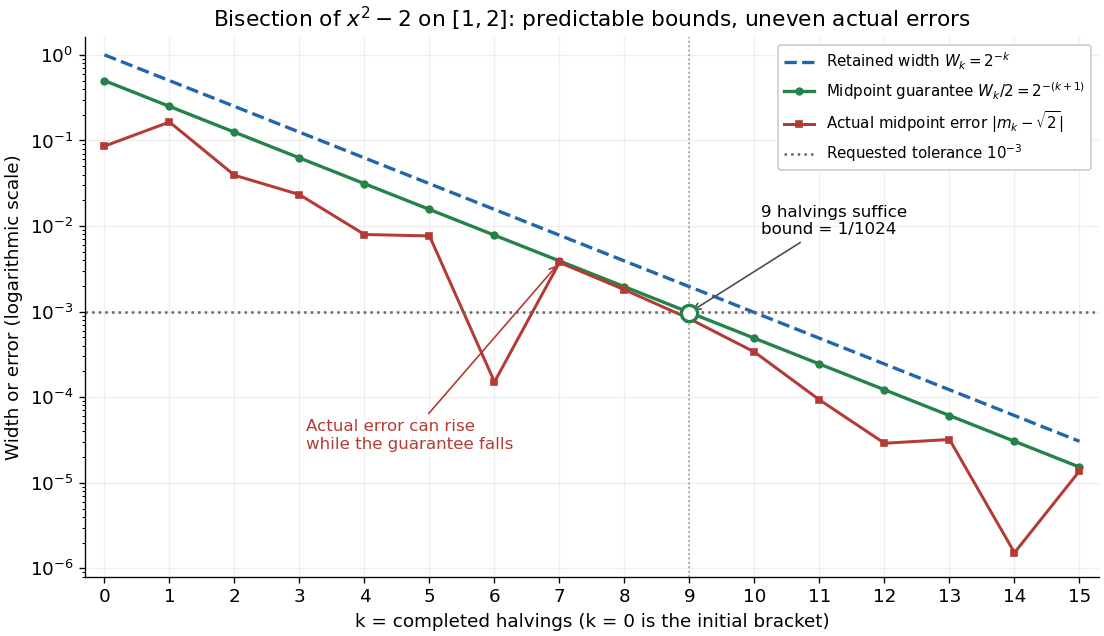
Bisection widths, midpoint error bounds, and actual square-root errors after zero to fifteen halvings
. Details. 
The guaranteed error halves at every step; the actual absolute value error need not decrease at every step or have successive ratio . In the square root example it increases from to , while both errors remain below their guarantees. An exact midpoint zero of a function instead gives zero error and immediate termination. For this example is an irrational number, so no finite exact halving can produce it as a midpoint.
For a brief proof outline, each retained half has half the previous width and contains a zero of a function by the intermediate value theorem. Every point in the retained root bracket is at most half its width from its midpoint. If the process does not stop at a zero of a function, the nested interval theorem gives one common point as the widths tend to zero; continuity and the opposite endpoint signs force its function value to be zero. Uniqueness in the initial root bracket is unnecessary.
Articles by others on the same topic
There are currently no matching articles.