
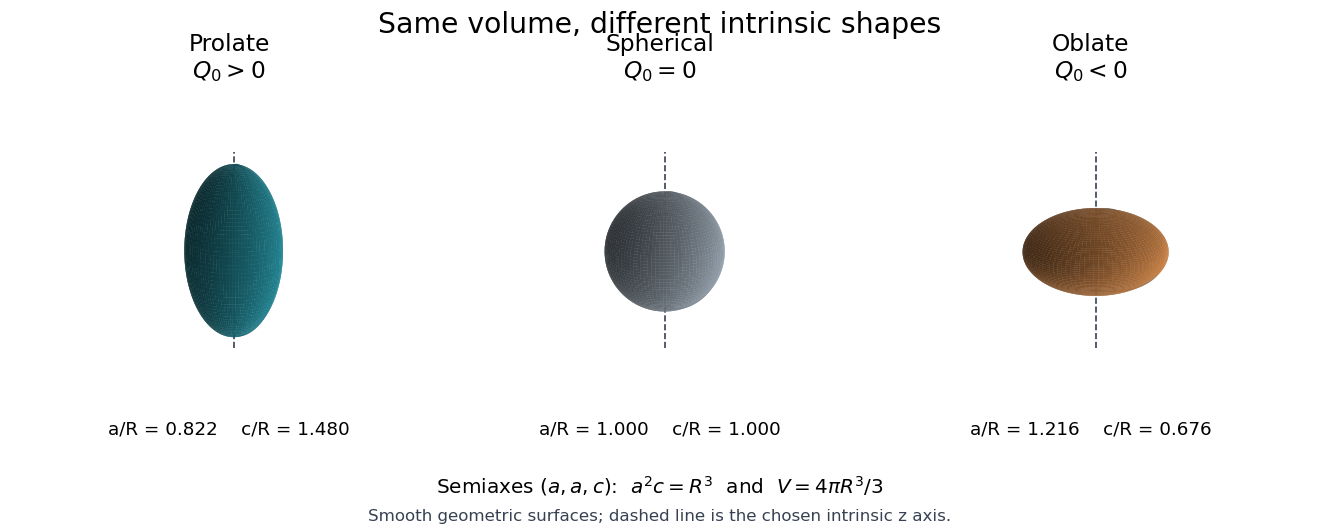
Departure of an intrinsic nuclear shape from spherical symmetry. Here intrinsic means referred to axes attached to a model nuclear charge distribution. A nuclear quantum state with definite spin need not have the same laboratory charge density as that intrinsic distribution. In particular, the ground state of a deformed even-even nucleus can have , a spherical laboratory expectation value, and a nonzero intrinsic nuclear quadrupole moment.
For an illustrative uniform charge density inside a spheroid, let the semiaxes be and keep its volume equal to that of a sphere of radius :Thus gives a prolate spheroid, a sphere, and an oblate spheroid. These are three-dimensional equal-volume shapes: equal areas of their drawn cross-sections would be a different constraint. Real nuclear charge distributions have diffuse surfaces and need not be uniform, axially symmetric or confined to one shape.

New to topics? Read the docs here!