Departure of an intrinsic nuclear shape from spherical symmetry. Here intrinsic means referred to axes attached to a model nuclear charge distribution. A nuclear quantum state with definite spin need not have the same laboratory charge density as that intrinsic distribution. In particular, the ground state of a deformed even-even nucleus can have , a spherical laboratory expectation value, and a nonzero intrinsic nuclear quadrupole moment.
For an illustrative uniform charge density inside a spheroid, let the semiaxes be and keep its volume equal to that of a sphere of radius :Thus gives a prolate spheroid, a sphere, and an oblate spheroid. These are three-dimensional equal-volume shapes: equal areas of their drawn cross-sections would be a different constraint. Real nuclear charge distributions have diffuse surfaces and need not be uniform, axially symmetric or confined to one shape.
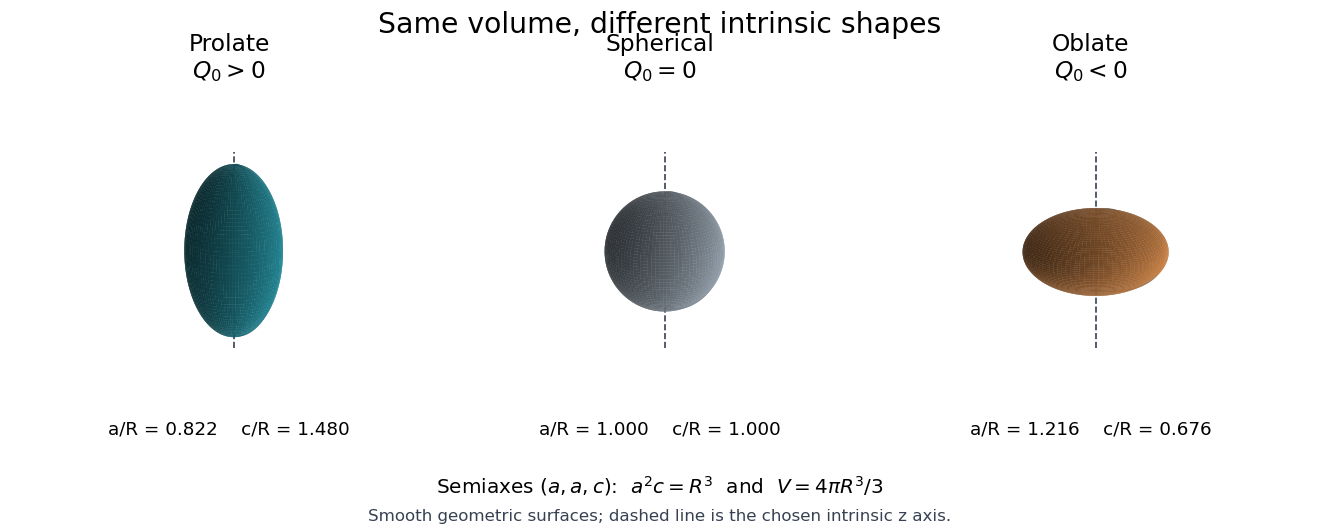

The axial electric quadrupole moment of an intrinsic nuclear charge distribution, with the origin at its center and the axis along its symmetry axis:This convention includes electric charge in ; a tabulated moment divided by the elementary charge instead has units of area. For the uniform spheroid, mapping a uniform unit ball to gives and , soThe formula explains the signs in the figure. It measures an anisotropy of the nuclear charge distribution, rather than counting individual nucleons on a surface. An illustrative choice gives , and , while preserving exactly.
James Rainwater's lecture contrasts measured laboratory electric quadrupole moments with intrinsic moments inferred through Coulomb excitation, including even-even nuclei. Extracting intrinsic shape therefore uses a nuclear model, rather than equating every measured moment to .[ref]
Background for the Spheroidal Nuclear Model Proposal by James Rainwater. p. 266, Fig. 4 and preceding Coulomb-excitation discussion
The laboratory expectation value of the axial electric quadrupole moment in the stretched nuclear quantum state ; is the laboratory component of total angular momentum. It differs from the intrinsic nuclear quadrupole moment . In an axial nuclear rotational band with , projection onto definite angular momentum givesHere denotes the component of total angular momentum along the intrinsic symmetry axis. Consequently a positive for a prolate spheroid corresponds to a negative in this model. The sign of the laboratory moment alone must be interpreted together with the band assignment.
The result has a short symmetry explanation. A spin-zero state has no preferred spatial direction. Its second charge moments satisfy , so . Equivalently, averaging an intrinsic axis uniformly over directions gives , where is a Legendre polynomial. This is a statement about a quantum expectation value, not a classical picture of a spinning object sweeping through orientations.
For an independent check of the sign, the , rotor orientation probability is proportional to , using a spherical harmonic. With ,A zero static laboratory moment does not make every quadrupole observable zero. With electric multipole operator , define the reduced transition strength using a reduced matrix element:In the axial rotor, angular projection gives and . The factor of five is the ratio of the numbers of magnetic substates. Thus an electric quadrupole transition can reveal collective deformation even when . These strengths determine within the model; their squares alone cannot distinguish its sign.
Articles by others on the same topic
There are currently no matching articles.