A spatial charge density describing the electric charge inside an atomic nucleus. In a static description centered on the nucleus, normalize it bywhere is the atomic number and the elementary charge. A nuclear charge distribution is an average over a nuclear quantum state, rather than a photograph of immobile protons. Even when the average has spherical symmetry, individual nucleons need not sit on spherical shells. The proton charge radius and the internal charge density of the neutron also contribute: a distribution of pointlike proton centers is an approximation to a nuclear charge distribution, not its definition.
The experimental attraction is that an Electron probes electric charge through the electromagnetic interaction, without itself feeling the nuclear force. Varying its momentum transfer changes the spatial scale tested. Long wavelengths mainly constrain a nuclear charge radius; shorter wavelengths can distinguish a diffuse edge from a sharper one through diffraction. Recovering the entire nuclear charge distribution from a finite range of noisy scattering data remains an inverse problem.
A common spherical model of a heavy nuclear charge distribution uses a half-density radius and surface diffuseness . The normalization is fixed by . The 90%-to-10% surface thickness is : solve and and subtract the two radii. Typical fits have an approximately constant surface thickness and a radius scaling roughly as the cube root of mass number. This is a spatial density model, not an assertion of a thermal Fermi-Dirac distribution for nuclear positions.
Robert Hofstadter's Stanford installation selected Electrons up to . Magnetic spectrometer scans counted shielded Lucite Cherenkov radiation pulses per monitor charge. Carbon-12 at and resolved elastic scattering and inelastic scattering ( excitation). Calibration used forward-beam energy, hydrogen nuclear recoil and carbon-12 energy levels. Closed entrance slits checked background.[ref]
Electron Scattering and Nuclear Structure by Robert Hofstadter. §III(b)(1), pp. 222–223, Fig. 11; §IV(a), pp. 227–231, Figs. 14–17
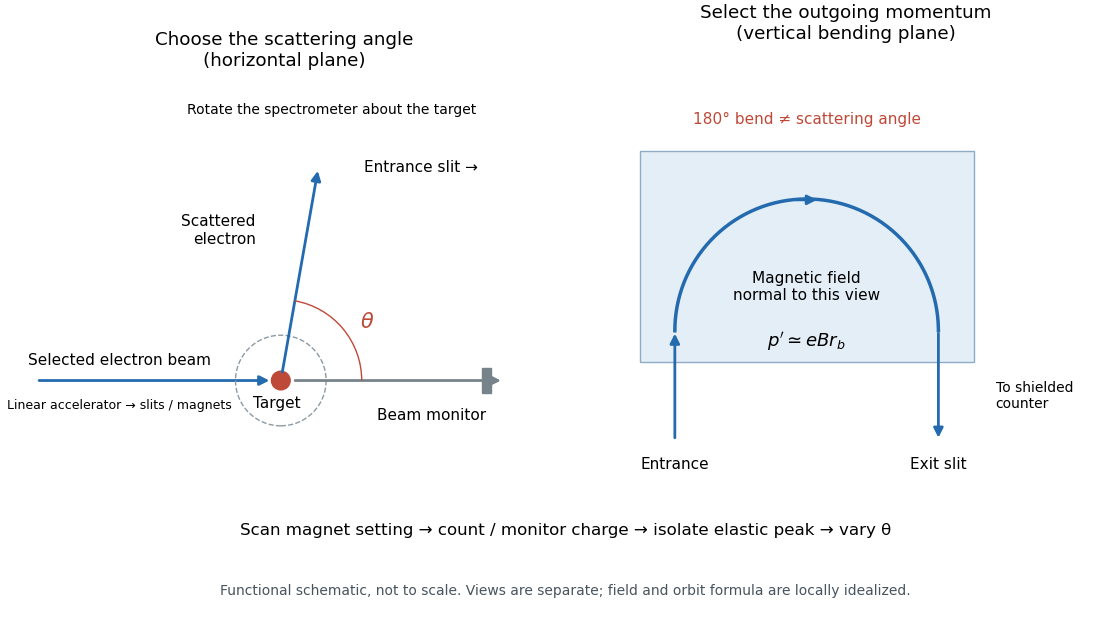

The key distinction is between an Electron counter and an energy measurement. Here the counter registers particles admitted by the magnetic spectrometer; changing its magnetic field selects another outgoing momentum. A peak is therefore reconstructed from a scan, rather than read as one pulse whose height equals the scattered Electron energy. Dividing counts by monitored incident electric charge compensates for changes in beam intensity. A peak's height alone is insufficient: its area and the instrument's accepted momentum interval determine the selected yield.
An inelastic scattering peak corresponds to a different final nuclear quantum state, so including it in the elastic scattering yield would answer a different structural question. Conversely, finite energy resolution can hide sufficiently nearby excitations beneath an apparent elastic scattering peak. Background subtraction, target-loss corrections, angular acceptance and counter efficiency all enter before counts become a differential scattering cross-section. A dip in uncorrected counts is therefore not automatically a zero of a nuclear charge form factor.
The root mean square radius of a nuclear charge distribution, referred to its center. Define its charge-weighted second moment byFor a spherical charge density with finite fourth moment, insert the Taylor series into the nuclear charge form factor:Thus a radius is a low-momentum transfer slope, not necessarily the position of a sharp edge. In this real static model,The factor of two between the slopes of and matters when interpreting a differential scattering cross-section. A proton charge radius is the corresponding size concept for the proton; the spatial arrangement of many nucleons introduces an additional scale in a heavier atomic nucleus.
In the static charge density model, define the normalized Fourier transformHere is the spatial momentum transfer divided by the reduced Planck constant: has units of inverse length. Physical momentum transfer is . We keep and the speed of light explicit; compute , expressing the numerator in and in , to obtain in inverse femtometres. The spatial is distinct from the invariant four-momentum transfer used in relativistic scattering cross-sections.
For spherical symmetry, take the polar axis along and use spherical coordinates. With the cosine of the polar angle,Every radial shell contributes an amplitude. At all shells add with the same sign; at larger their contributions can cancel. This cancellation is the origin of a diffraction minimum in the nuclear charge form factor, rather than an absence of electric charge in the nucleus.
The static Fourier transform interpretation is appropriate for the nuclear model and kinematic regime specified here. A fully relativistic composite system requires frame and current conventions; its electric form factor is not universally the transform of a frame-independent three-dimensional charge density.
Consider an ideal nuclear charge distribution that is constant inside a ball of radius and zero outside:This is a deliberately sharp-edged model. Substitution into the spherical nuclear charge form factor gives, for ,At take the continuous limit . Direct radial integration gives , and the Taylor series provides an independent check:The first positive zero solves , equivalently , with . Consequently the first diffraction minimum moves toward smaller momentum transfer as increases.
For comparison, a smooth Gaussian function charge density with the same nuclear charge radius isThe Fourier transform of a Gaussian stays positive and has no zero. Both models have the same leading low- curvature, but they disagree at higher momentum transfer: at , the sphere gives and the Gaussian function gives . Measuring only a nuclear charge radius cannot distinguish these two nuclear charge distributions.
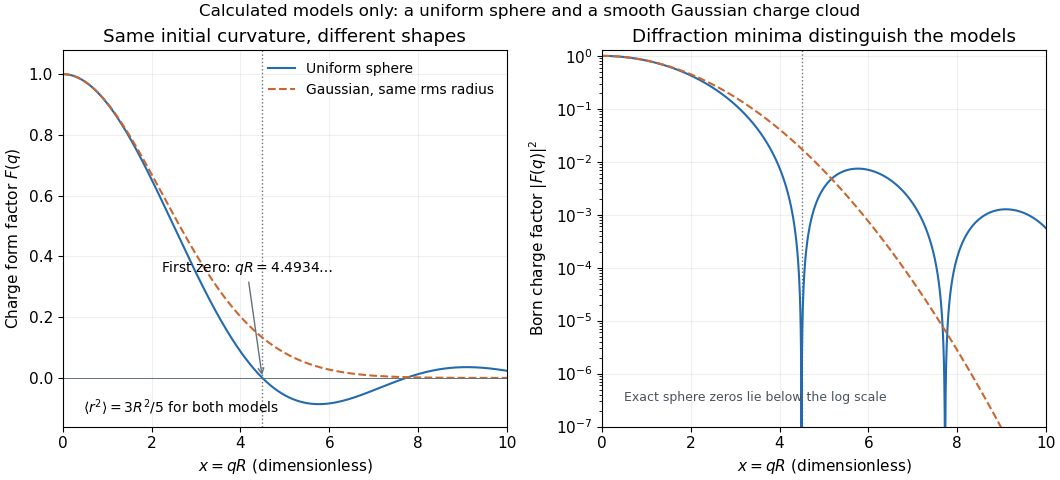

As a chosen scale illustration, take . The predicted first zero is , or using . With a ultrarelativistic Electron beam and negligible nuclear recoil, it occurs at . These are consequences of chosen model parameters, not measured properties of carbon or a claim that all atomic nuclei are uniform balls.
For an ultrarelativistic Electron scattered elastically by a static, spherical, spin-zero atomic nucleus, a plane-wave Born approximation retains a single electromagnetic interaction. The Fourier transform of its Coulomb potential is proportional to . Relative to the same point charge, the scattering amplitude is therefore multiplied by and the differential scattering cross-section by :Here is the incident total Electron energy, the scattering angle, a solid angle element, and the fine-structure constant. The cosine factor already accounts for the projectile's spin; a spinless projectile would give a different point-charge factor. The formula neglects nuclear recoil, electron rest-mass corrections, radiative corrections and Coulomb distortion in electron scattering. The latter can be substantial at large : electron waves then require treatment in the target's Coulomb potential, rather than undistorted plane waves.
Nonzero target spin can introduce magnetic and additional electric contributions, so division by this point-charge expression does not generally isolate one charge form factor for a proton or deuteron. Even for spin zero, finite energy resolution, recoil and Coulomb distortion in electron scattering can change a measured minimum. A zero of the uniform-sphere model is a clear illustration of amplitude cancellation, not a universal prediction of a zero experimental counting rate.
Articles by others on the same topic
There are currently no matching articles.