On-off X-ray photon counting
ID: on-off-x-ray-photon-counting

Background subtraction must account for uncertainty in the background measurement itself. In an original idealized experiment, an on-source exposure contains source and background, while an independent off-source exposure contains background alone. Assume stationary rates and identical background acceptance per unit live time. With , let independent counts obey Poisson distributions:Then linearity of expectation and addition of variances for independent random variables giveThe result concerns accepted source counts , after all efficiencies. For large counts the normal approximation gives the descriptive signal-to-noise ratio in photon countingThis plug-in ratio is not an exact null-hypothesis significance. Small counts require the discrete Poisson model; searching many sky directions also changes a detection claim's p-value.
Choose and , with observed counts and . Thus , , and the estimated standard deviation is counts. The inferred uses the preceding and includes counting uncertainty only. The descriptive ratio is . Treating the scaled off-source background as exact would omit 200 counts squared from the estimated variance.
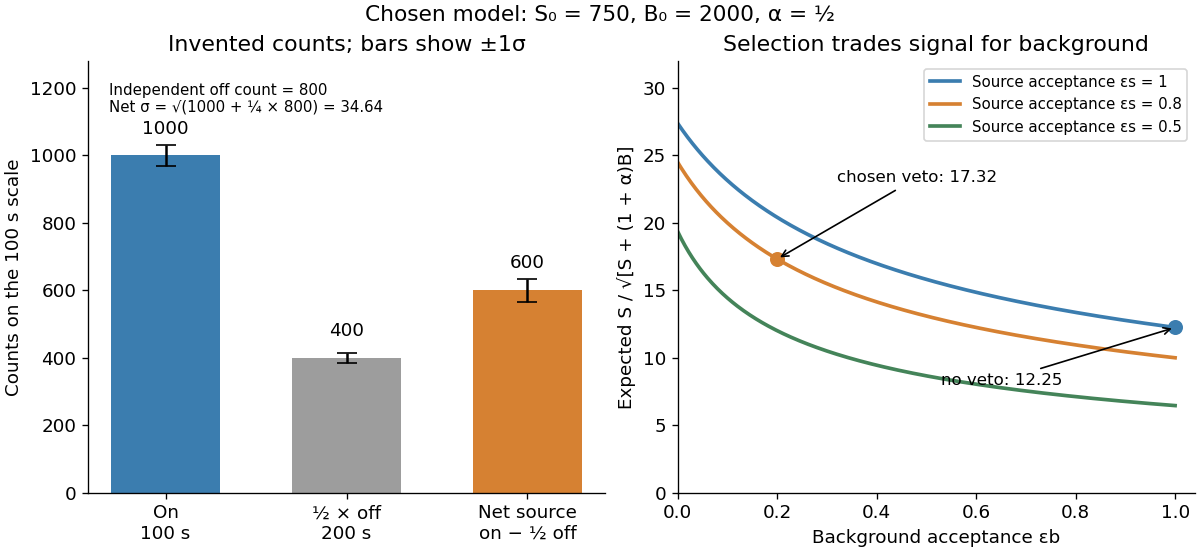
Invented on-off counts and the effect of background rejection
. All numbers are chosen teaching values, not historical measurements. Independent off-source counts contribute uncertainty. The rejection curves hold the source acceptance fixed within each labelled case. Details.
For a selection-design comparison, suppose before a veto the expected source contribution is , the on-source background is , and . Let source acceptance be and background acceptance be . Then , , and , whereas omitting the veto gives . Rejection helps because the background is reduced enough to compensate for lost source events. A different veto can make matters worse; source efficiency and background rejection are separate probabilities. This comparison is an independent teaching example, not the efficiency calibration used above.
New to topics? Read the docs here!