
The optimizer state is information retained by an optimization algorithm beyond the current parameter values. It can include a momentum buffer and algorithm-specific counters or running estimates. Consequently, two runs with identical parameters and current gradients can produce different next optimizer updates if their stored states differ.
For an original scalar example, minimize with the recurrenceThis is the momentum form with dampening, decay and the
nesterov flag disabled in the PyTorch stochastic gradient descent implementation.[ref]SGD in the PyTorch documentation. PyTorch2.15, algorithm pseudocode; momentum and dampening description
At , and , a stored gives and . A stored instead gives and . The current parameter and gradient were identical; the difference came from history.An optimization checkpoint that saves only the parameters cannot reproduce that next step. In PyTorch,
Optimizer.state_dict() stores per-parameter state and parameter-group settings such as learning rate, but not the parameter values themselves. Its parameter identifiers associate state with ordered parameter groups and are not a check of semantic parameter identity during loading.[ref]torch.optim in the PyTorch documentation. PyTorch2.15, Optimizer.state_dict API, state/param_groups entries and loading note
Save and restore the corresponding parameters separately and keep the state-to-parameter association consistent. Reproducing an entire training run may additionally require the data order and other changing state.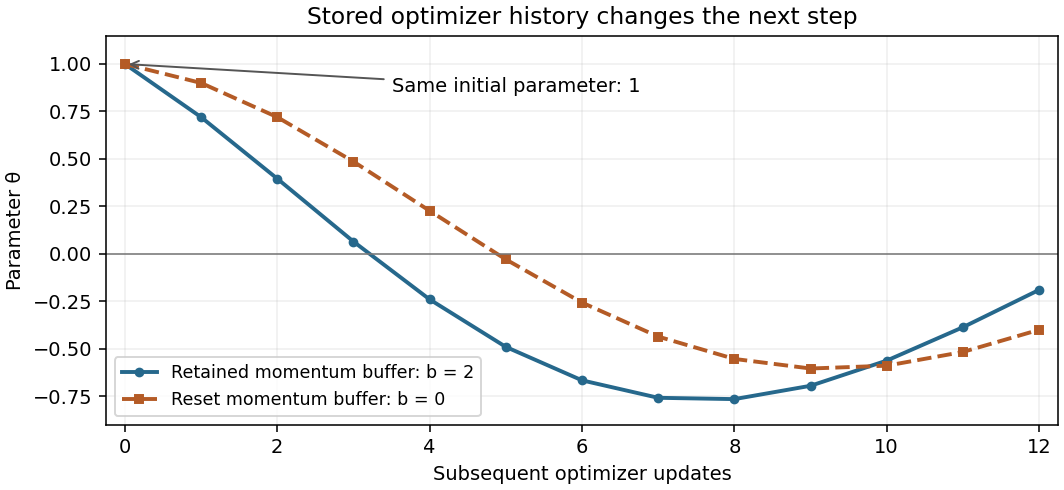

New to topics? Read the docs here!