
In a power-form rate law , the partial orders of reaction are and , and the overall order of reaction is . For example, doubling at fixed multiplies by : factors of one, two, and four correspond to partial orders of reaction zero, one, and two. These exponents can also be fractional or negative. A single constant order of reaction need not describe a rate law that is not a power form. See IUPAC Gold Book: order of reaction.
For a simple irreversible conversion with rate equation , initial concentration , and fixed , compare zero-order reactions, first-order reactions, and second-order reactions using the dimensionless quantitiesTheir integrated curves, starting at , areFor the zero-order reaction, the plotted extension stops conversion at depletion. It does not continue to obey once . A negative concentration would be unphysical. The first-order reaction and second-order reaction approach zero without reaching it at finite time in these models.
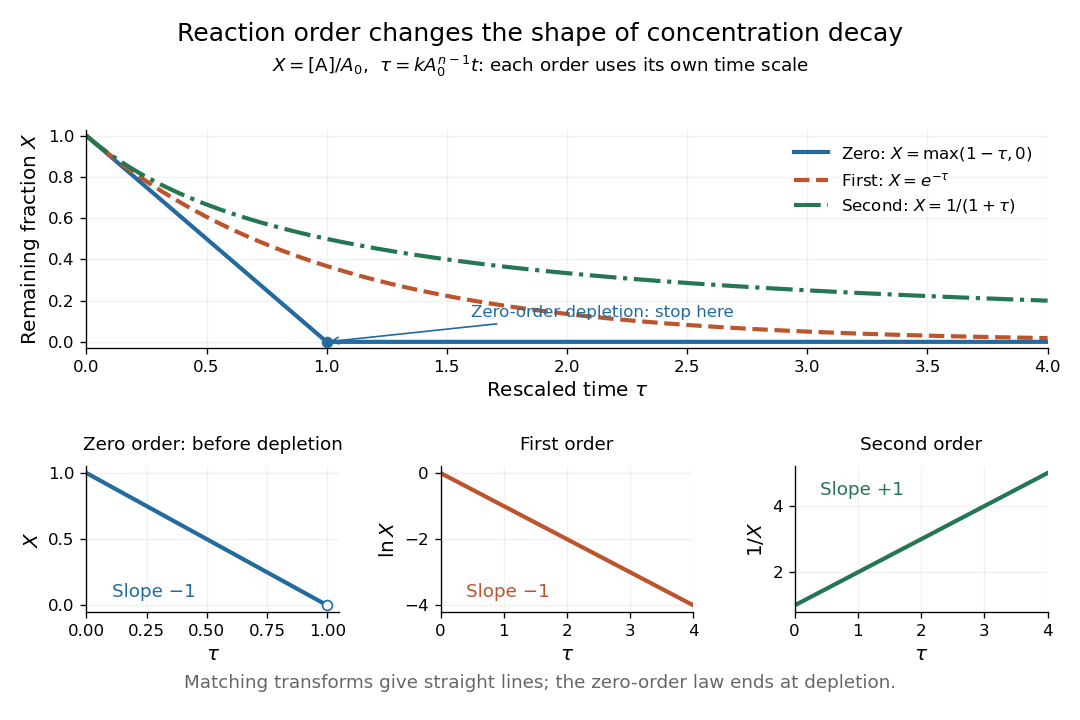
Dimensionless concentration decays for three orders of reaction, with zero-order reaction depletion and the corresponding linearizing plots
. Details. 
The common axis compares curve shapes after each model's own time rescaling, rather than equal laboratory times for an identical numerical . In the lower panels, , , and respectively give straight lines with slopes , , and for the matching order of reaction. The natural logarithm uses a dimensionless quantity. These transformed plots help test a proposed rate law; the zero-order reaction line applies only before depletion. See Flowers et al., Chemistry 2e, §12.4: integrated rate laws.
New to topics? Read the docs here!