A first-order reaction has a reaction rate proportional to one reactant concentration in the simple single-species case. For an irreversible in a closed system at fixed volume, take , , and constant rate constant . Its rate equation and solution areA short check is enough: differentiating gives , and the two concentrations sum to , as required by the one-to-one stoichiometry. Thus the same exponential decay describes both remaining reactant and decreasing reaction rate. Fixed means a fixed fractional loss per unit time, not a fixed absolute consumption rate.
Choose illustrative values and , with measured in seconds. Then , , and . The half-life isAt each successive half-life, half the remaining reactant is consumed; is independent of for this first-order reaction. At , the calculated values are , , and . These are model predictions for chosen parameters, rather than experimental measurements.
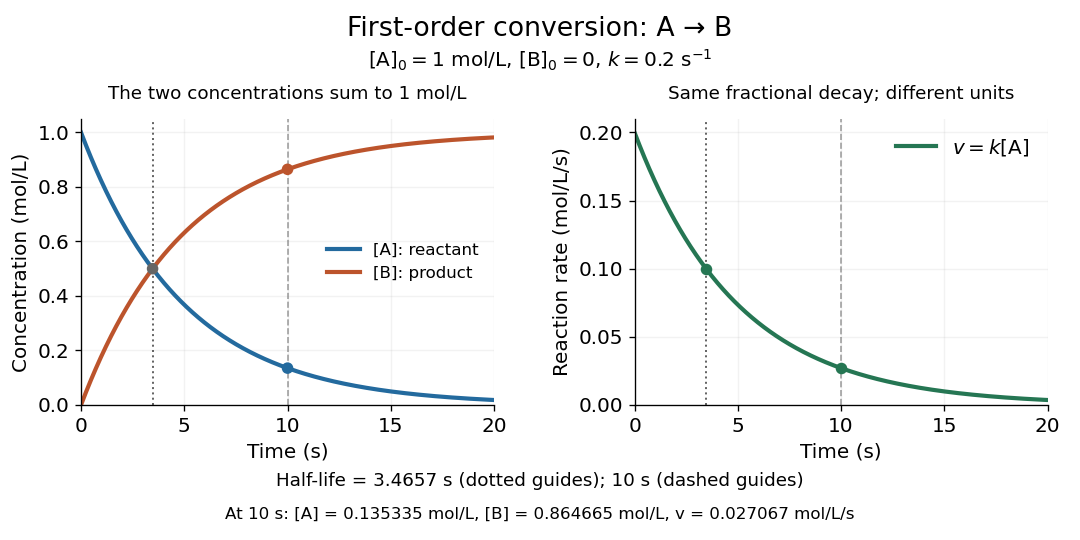
Illustrative first-order reaction: reactant loss, reaction product formation, and declining reaction rate for
. Details. 
The left panel tracks the two concentrations; the right tracks their instantaneous conversion reaction rate. Their different vertical units matter: , so the numerical curves need not have the same height. This gives a practical way to translate a measured concentration into a forecast of both conversion and waiting time.
The coefficient of a first-order concentration term in a rate law. Its units are inverse time; two reversible first-order directions contribute additively to the relaxation rate.
Articles by others on the same topic
There are currently no matching articles.