
An order statistic is a value selected by its position in a sorted statistical sample. For real observations , writeThe th order statistic is the th smallest value, counting repeated values separately. The parentheses distinguish sorted position from the original observation label: and need not be equal. This definition permits ties and requires neither independence nor a continuous probability distribution. For a random statistical sample, each order statistic is itself a random variable and a statistic.
For example, the five fixed observationssort toTheir original indices in sorted order are , so . Their ranks of observations, listed in original observation order, are . Here is the minimum, is the sample maximum, and is the sample median. These are deliberately chosen observations, rather than simulated draws.
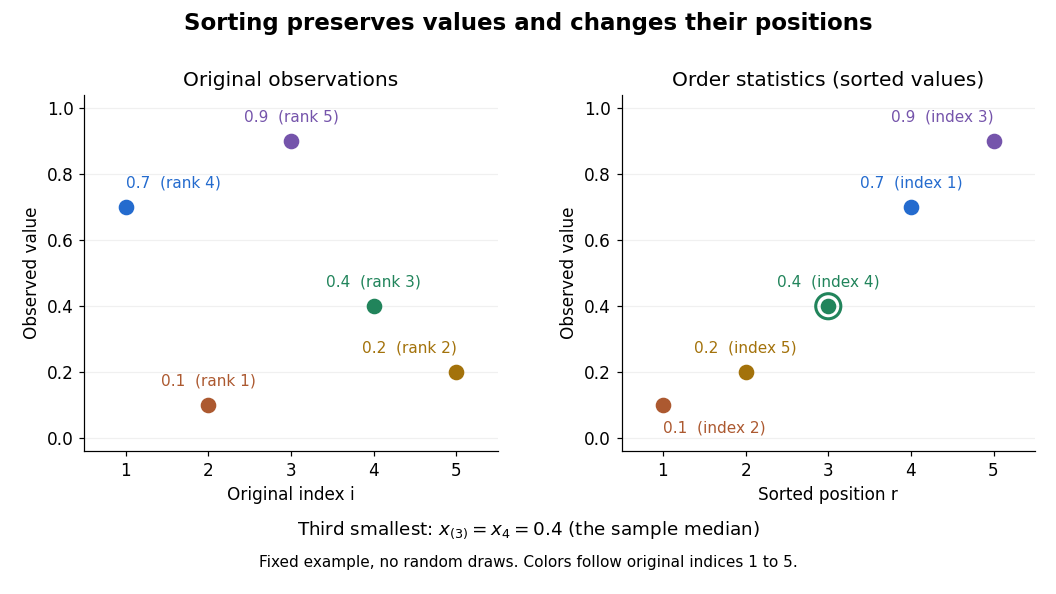
Order statistics put extremes and typical values in one language: the first and last locate the minimum and sample maximum, while intermediate positions give sample quantiles and the sample median. Under the existing generalized-inverse convention, the sample quantile at level is . For the five observations, the sample quantiles at are . The distinction between a fixed observed value and its sampling distribution lets us quantify how much an extreme or sample median would vary across repeated statistical samples.
The useful counting identity isFor independent and identically distributed random variables with a continuous cumulative distribution function , the count on the right has binomial distribution with parameters , givingThis cumulative distribution function is a binomial distribution tail: a question about sorting becomes a question about counting successes in Bernoulli trials. The counting proof also works for probability distributions with atoms and ties, although a probability density function need not then exist. For a uniform order statistic, on , which makes the formula particularly explicit.


An order statistic is a statistic that provides information about the ranks of elements in a sample from a population.
New to topics? Read the docs here!