Orientation selectivity
ID: orientation-selectivity

Orientation selectivity is a systematic dependence of a visual neuron's response on the axis of a bar, edge or stripe pattern presented in its receptive field, under specified stimulus conditions. Here the angle measures the stripe axis from horizontal: is horizontal and vertical. An axis has no arrow, so and describe the same orientation. A preference for one direction of movement across that axis is an additional property; the 1962 recordings included both equal and unequal responses to opposite movements. [ref]
https://www.gatsby.ucl.ac.uk/teaching/courses/tn1-2020/additional/systems/JPhysiol-1962-Hubel-106-54.pdf. Hubel and Wiesel (1962), p. 112: orientation versus opposite movements
A particularly clear experiment using extracellular single-unit recording appears in the 1959 paper, Figures 2–3. A bright slit was centered on the same receptive field and rotated through successive angles; each presentation lasted one second. The vertical slit strongly increased the extracellularly recorded spike train, whereas the horizontal slit was ineffective. Small-spot tests had identified ON and OFF receptive-field subregions, with a central ON region and opposing flanks: rotation illuminated less of the center and more of the flanks. Geometry and location therefore mattered together. These dimensions belong to that recorded unit, not to every neuron. [ref]
https://xbio-live.s3.amazonaws.com/narratives/57358/Hubel%20and%20Wiesel%201959_Guided%20paper.pdf. Hubel and Wiesel, Receptive fields of single neurones in the cat's striate cortex (1959), pp. 578–579, Figures 2–3: primary recordings
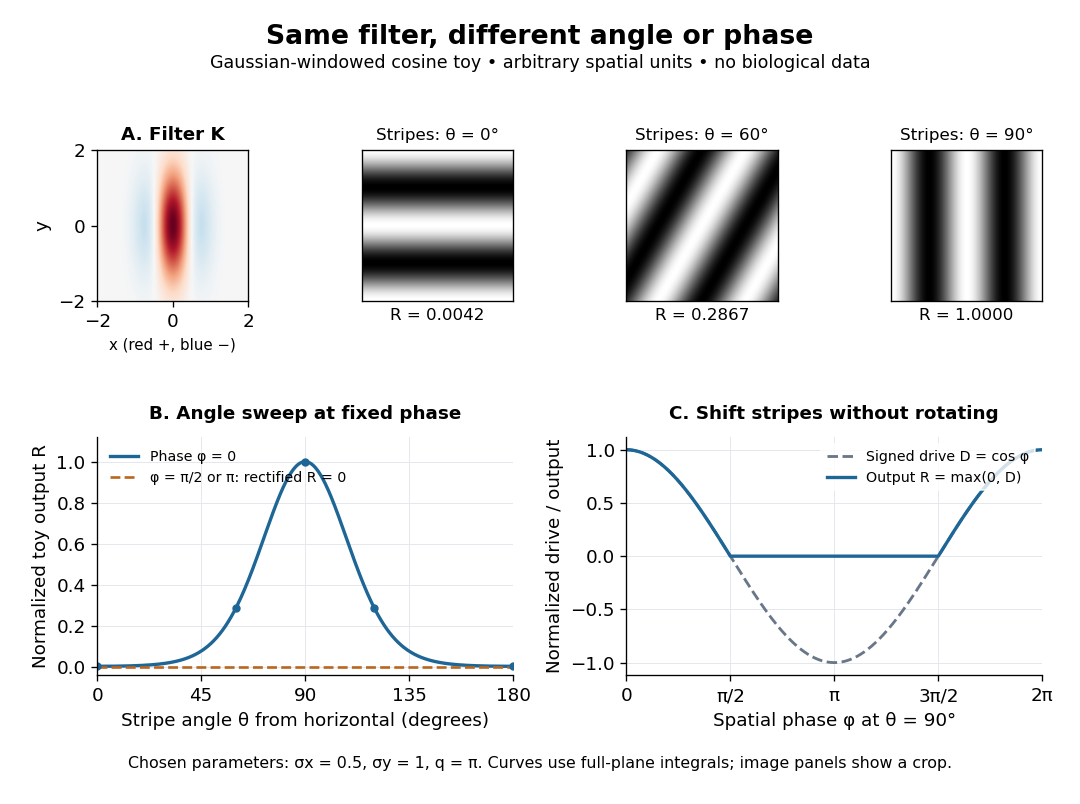
An orientation tuning curve summarizes a controlled angle sweep. Keep location, size and visual contrast fixed; for a stripe pattern also specify spatial frequency and phase. The same signed spatial filter model of a simple cell can produce strong orientation selectivity and strong dependence on phase, as the following original toy illustrates. Its smooth curves are calculated predictions, not digitized or invented biological measurements.

New to topics? Read the docs here!