Parallel axis theorem
ID: parallel-axis-theorem

The parallel axis theorem transfers a moment of inertia from an axis through the centre of mass to a parallel axis through :Here is the total mass and is the shortest perpendicular distance between the two axes. Both moments of inertia concern the same mass distribution and the same axis direction. The axis for must pass through the centre of mass; may refer to an axis outside the body. No uniform-density or planar-shape assumption is needed. Within any family of parallel axes, the centre of mass axis minimizes the moment of inertia.[ref]
A short proof isolates why the centre of mass matters. Choose parallel axes perpendicular to an plane, put at the origin, and place at . Thenbecause in centre of mass coordinates. Individual mass elements can move closer to the new axis, but their weighted cross terms cancel. For arbitrary parallel axes and , use , where each distance is measured from the parallel centre of mass axis; adding times the squared separation of and is generally incorrect. A displacement along the axis has . Changing the axis direction instead requires the inertia tensor or, in its applicable planar setting, the perpendicular axis theorem.
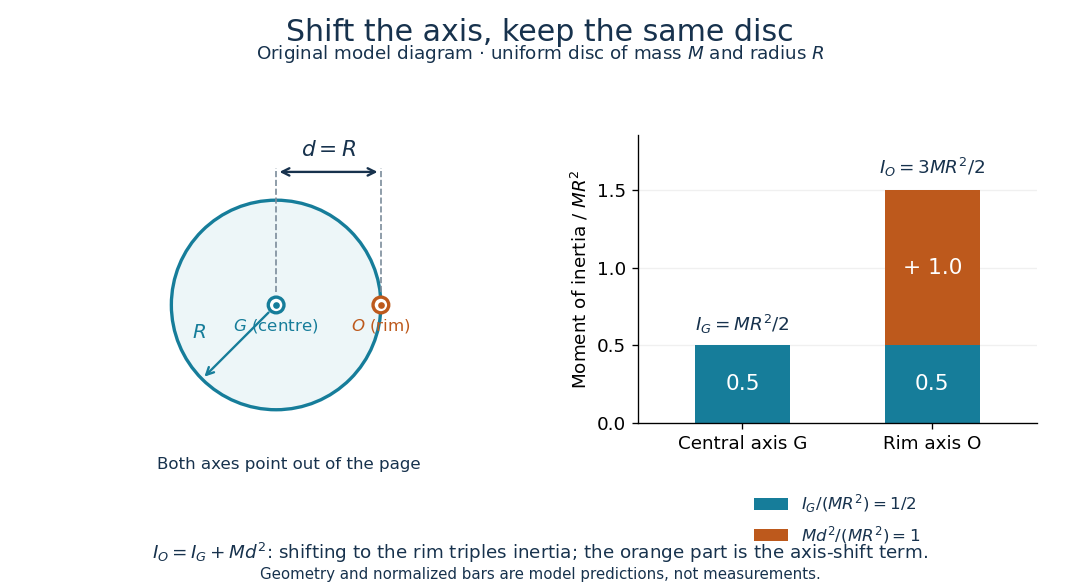
For a uniform disc, mass and radius , the central perpendicular moment of inertia is . Shifting that axis to the rim gives and , three times . In the computed , example, , and . At angular speed the rim-pivoted disc has rotational kinetic energy . Its centre of mass now moves, so already includes that translation; adding a separate centre of mass translation term to it would count that contribution twice.
The physical pendulum measurement described under moment of inertia provides a practical check: infer at several pivot positions, then subtract to obtain . Keep all pivot axes parallel and measure to the centre of mass of the entire moving assembly. The same assembly should yield the same within measurement precision. If a smartphone is attached, its mass and its own moment of inertia belong in both the geometric prediction and the centre of mass calculation. The published bar-and-phone study explicitly adds both contributions using the parallel axis theorem.[ref]
For a careful replication, release small swings without a push, repeat timings at several small amplitudes, and check that the extrapolated oscillation period is stable as amplitude decreases. Time many complete oscillations and repeat the run; two crossings of a photogate per cycle must not be mistaken for two cycles. Inspect decay of amplitude and compare early and late timings to detect significant pivot friction or air drag. Mark the bar and phone mount to detect relative slip, tighten the attachment, and check that the pivot support does not rock or migrate between holes. Repeat with an independent photogate or video readout to check the phone's timing. These are proposed controls for the replication, not additional results reported by the authors. The ideal model excludes appreciable damping, large swings and flexing; subtraction of also magnifies relative errors when is much smaller than .
The oscillation period need not increase monotonically with pivot distance: the shift raises the moment of inertia but also increases the gravitational restoring torque. For a computed slender uniform bar model of length , andThis expression has its minimum at . With , and stipulated , the prediction is ; it is not a recorded timing or a prediction for the bar with a phone attached. The competing terms explain why a timing experiment can reveal a mass distribution rather than merely its weight.


The Parallel Axis Theorem is a concept in physics and engineering, particularly in the area of mechanics, that relates the moment of inertia of a rigid body about an axis to the moment of inertia about a parallel axis that passes through the center of mass of the body.
New to topics? Read the docs here!