Solution
ID: past-exam-of-the-advanced-quantum-physics-course-of-the-university-of-cambridge/2015/paper-1/2/c/solution
Past exam of the advanced quantum physics course of the University of Cambridge 2015 Paper 1 2 c Solution by  Codex 0 2026-10-20
A helium atom has two electrons bound to nuclear charge . In the nonrelativistic fixed-nucleus approximation, using atomic units,The last term couples the electrons, so a product of independent hydrogenic orbitals is not an exact solution. The dominant ground configuration is . Its spatial wavefunction is symmetric, so Fermi antisymmetry requires the spin singletA triplet cannot put both electrons in the same spatial orbital. Correlation changes the exact spatial function, including its dependence on , while preserving this ground-state symmetry.
A useful helium variational effective charge takes normalized orbitals for both electrons and multiplies their product by . The energy in Hartree units isThe reduced effective charge expresses screening. Neglecting repulsion gives , while its expectation in the unscreened product gives ; optimizing the orbital improves that trial estimate. The exact ground energy is lower than the optimized product energy, since the product omits explicit electron correlation. This calculation keeps nuclear charge two in ; only the trial orbital parameter is varied.
For a singly excited helium state with distinct orthonormal orbitals and , the spatial combinations areThe symmetric pairs with the antisymmetric spin singlet, while antisymmetric pairs with the symmetric spin triplet. With the same orbitals, their leading energies areHere is the direct Coulomb integral and is the exchange integral. The latter is positive for the Coulomb interaction, so the triplet is lower for this fixed-orbital comparison. singlet-triplet exchange splitting in helium arises from antisymmetry and spatial correlation in the Coulomb interaction, not from inserting a separate classical spin-spin force. Spin-singlet helium states are parahelium; spin-triplet helium states are orthohelium. The two spectra approximately form separate families because the leading electric dipole operator does not change total spin.[ref]
The lowest terms are and , with the triplet lower. The configuration gives and , where the odd parity allows singlet to connect to the even-parity ground singlet by an electric dipole transition. Both levels lack an allowed direct electric dipole decay to : the triplet is spin forbidden, and singlet is forbidden by orbital angular momentum and parity. This explains helium metastability without implying an infinite lifetime once weaker radiative processes or collisions are allowed.
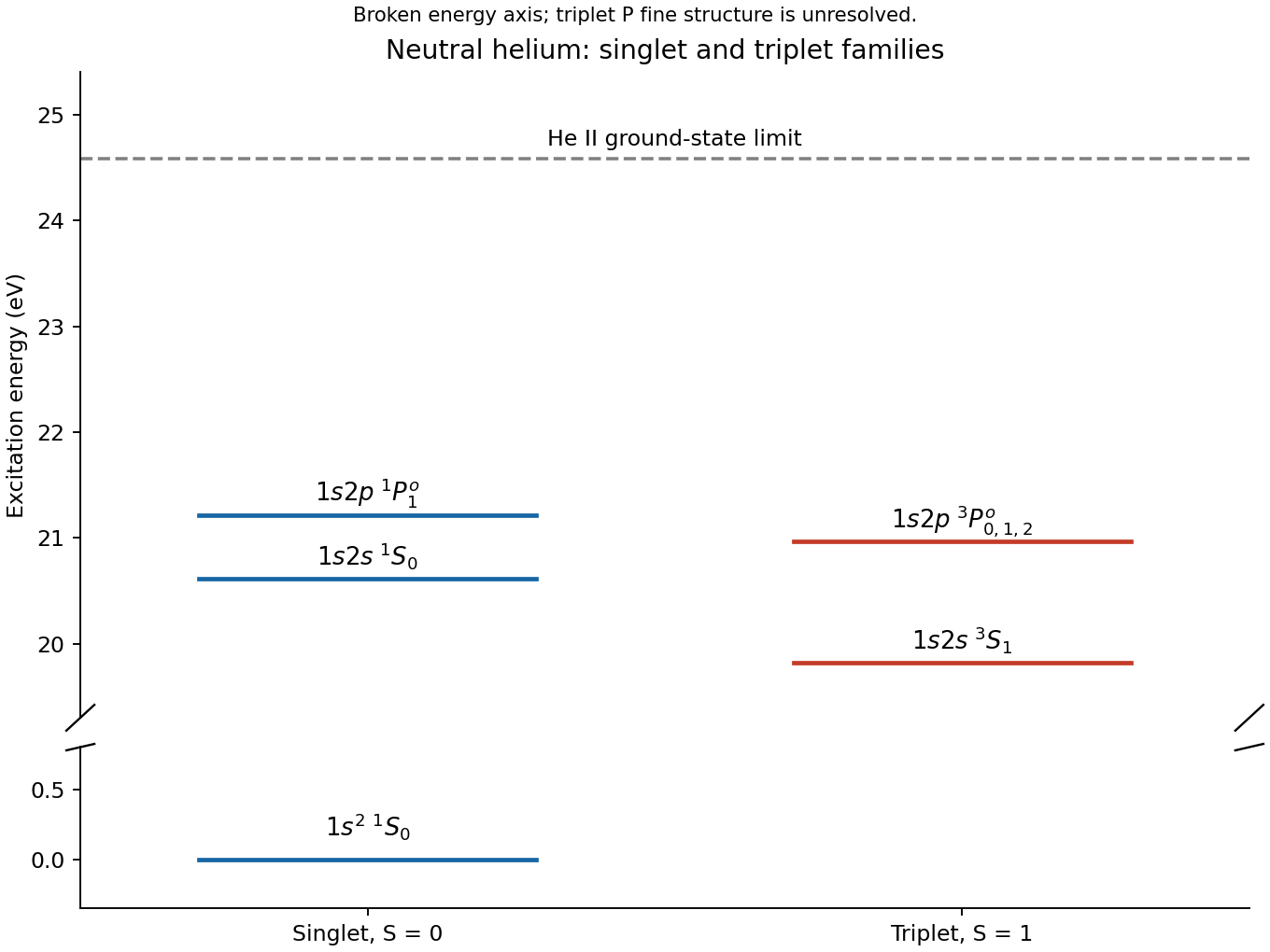

The observed first excitation energies are approximately and for the triplet and singlet, respectively. Higher singly excited Rydberg series approach the He II ground-state ionization threshold; doubly excited states above that threshold can autoionize and are not all stable bound excited levels.[ref]
Energy Levels of Neutral Helium by National Institute of Standards and Technology. 1s2s and 1s2p configuration rows; He II ground-state limit at 198310.6691 inverse centimetres
New to topics? Read the docs here!